

relative to Int17 (Fig. 4). The onium ylide intermediate Int17 can also undergo an
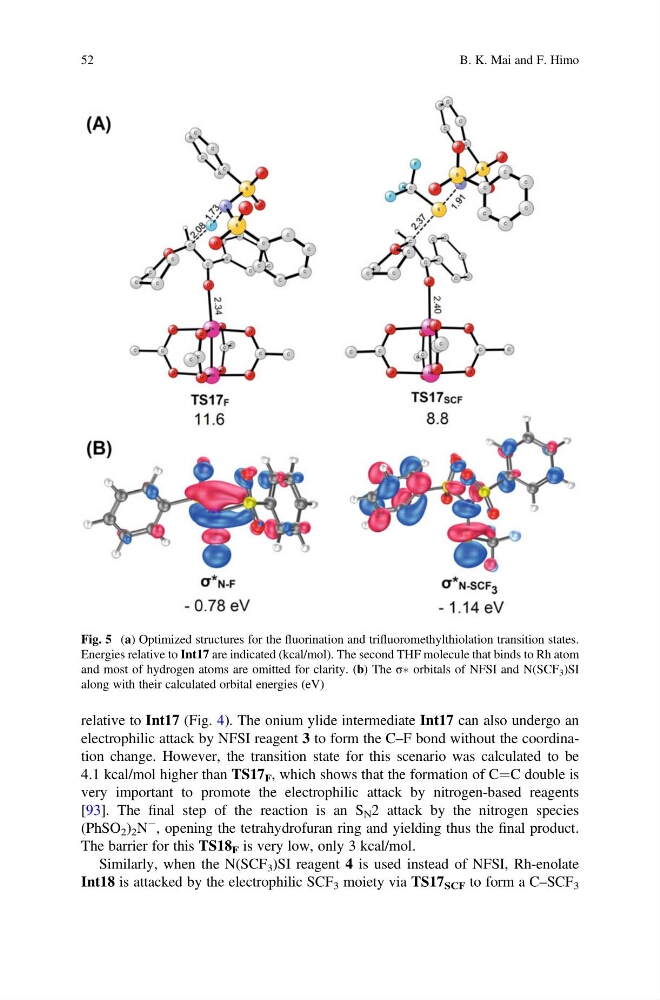
electrophilic attack by NFSI reagent 3 to form the C–F bond without the coordination change. However, the transition state for this scenario was calculated to be
4.1 kcal/mol higher than TS17 F , which shows that the formation of C¼C double is
very important to promote the electrophilic attack by nitrogen-based reagents
[93]. The final step of the reaction is an S N 2 attack by the nitrogen species
(PhSO 2 ) 2 N
À , opening the tetrahydrofuran ring and yielding thus the final product.
The barrier for this TS18 F is very low, only 3 kcal/mol.
Similarly, when the N(SCF 3 )SI reagent 4 is used instead of NFSI, Rh-enolate
Int18 is attacked by the electrophilic SCF 3 moiety via TS17 SCF to form a C–SCF 3
Fig. 5 (a) Optimized structures for the fluorination and trifluoromethylthiolation transition states.
Energies relative to Int17 are indicated (kcal/mol). The second THF molecule that binds to Rh atom
and most of hydrogen atoms are omitted for clarity. (b) The σà orbitals of NFSI and N(SCF 3 )SI
along with their calculated orbital energies (eV)
52
B. K. Mai and F. Himo
electrophilic attack by NFSI reagent 3 to form the C–F bond without the coordination change. However, the transition state for this scenario was calculated to be
4.1 kcal/mol higher than TS17 F , which shows that the formation of C¼C double is
very important to promote the electrophilic attack by nitrogen-based reagents
[93]. The final step of the reaction is an S N 2 attack by the nitrogen species
(PhSO 2 ) 2 N
À , opening the tetrahydrofuran ring and yielding thus the final product.
The barrier for this TS18 F is very low, only 3 kcal/mol.
Similarly, when the N(SCF 3 )SI reagent 4 is used instead of NFSI, Rh-enolate
Int18 is attacked by the electrophilic SCF 3 moiety via TS17 SCF to form a C–SCF 3
Fig. 5 (a) Optimized structures for the fluorination and trifluoromethylthiolation transition states.
Energies relative to Int17 are indicated (kcal/mol). The second THF molecule that binds to Rh atom
and most of hydrogen atoms are omitted for clarity. (b) The σà orbitals of NFSI and N(SCF 3 )SI
along with their calculated orbital energies (eV)
52
B. K. Mai and F. Himo