

Keywords Density functional theory (DFT) · Fluorination · Hypervalent iodine ·
Metal catalyst · Reaction mechanism
1 Introduction
Introduction of fluorine substituents can dramatically change the physical and
chemical properties of organic compounds, such as their metabolic stability,
lipophilicity, and membrane permeability [1, 2]. Accordingly, organofluorine compounds have found numerous applications in, e.g., the pharmaceutical and agrochemical industries [3–7]. In addition,
18 F-labelled organic compounds are
increasingly applied in medical diagnostics as radiotracers in positron-emission
tomography, due to the special radionuclear properties of this isotope [8–10].
The increasing demand for synthetic fluorine-containing organic compounds has
led to the emergence of new strategies to introduce fluorine to diverse substrates [11–
17]. Depending on the form of fluorine atom transferred, the introduction of fluorine
substituents to organic compounds can be classified as being either nucleophilic,
electrophilic, or radical [17–19]. While all three strategies have some advantages and
disadvantages in terms of reactivity and selectivity, the use of electrophilic fluorination reagents in combination with metal catalysts constitutes an important trend in
fluorination chemistry in recent years and has led to significant breakthroughs
[15, 17–27].
A number of stable, safe, and easy-to-handle electrophilic reagents have been
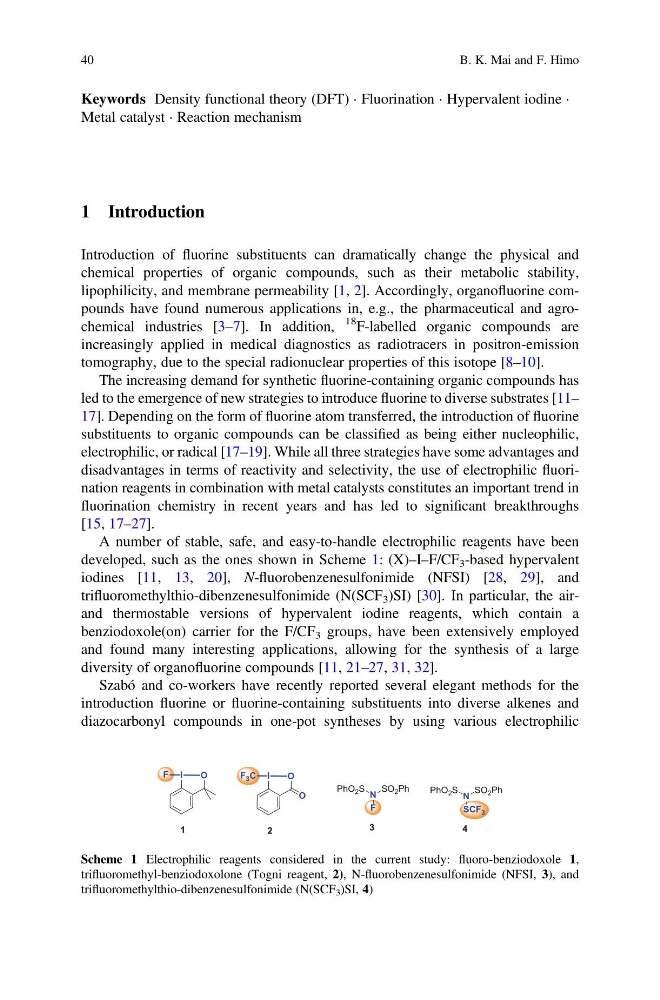
developed, such as the ones shown in Scheme 1: (X)–I–F/CF 3 -based hypervalent
iodines [11, 13, 20], N-fluorobenzenesulfonimide (NFSI) [28, 29], and
trifluoromethylthio-dibenzenesulfonimide (N(SCF 3 )SI) [30]. In particular, the airand thermostable versions of hypervalent iodine reagents, which contain a
benziodoxole(on) carrier for the F/CF 3 groups, have been extensively employed
and found many interesting applications, allowing for the synthesis of a large
diversity of organofluorine compounds [11, 21–27, 31, 32].
Szabó and co-workers have recently reported several elegant methods for the
introduction fluorine or fluorine-containing substituents into diverse alkenes and
diazocarbonyl compounds in one-pot syntheses by using various electrophilic
O
I
F
1
O
O
I
F 3 C
2
SO 2 Ph
PhO 2 S
F
N
3
SO 2 Ph
PhO 2 S
SCF 3
N
4
Scheme 1 Electrophilic reagents considered in the current study: fluoro-benziodoxole 1,
trifluoromethyl-benziodoxolone (Togni reagent, 2), N-fluorobenzenesulfonimide (NFSI, 3), and
trifluoromethylthio-dibenzenesulfonimide (N(SCF 3 )SI, 4)
40
B. K. Mai and F. Himo
Metal catalyst · Reaction mechanism
1 Introduction
Introduction of fluorine substituents can dramatically change the physical and
chemical properties of organic compounds, such as their metabolic stability,
lipophilicity, and membrane permeability [1, 2]. Accordingly, organofluorine compounds have found numerous applications in, e.g., the pharmaceutical and agrochemical industries [3–7]. In addition,
18 F-labelled organic compounds are
increasingly applied in medical diagnostics as radiotracers in positron-emission
tomography, due to the special radionuclear properties of this isotope [8–10].
The increasing demand for synthetic fluorine-containing organic compounds has
led to the emergence of new strategies to introduce fluorine to diverse substrates [11–
17]. Depending on the form of fluorine atom transferred, the introduction of fluorine
substituents to organic compounds can be classified as being either nucleophilic,
electrophilic, or radical [17–19]. While all three strategies have some advantages and
disadvantages in terms of reactivity and selectivity, the use of electrophilic fluorination reagents in combination with metal catalysts constitutes an important trend in
fluorination chemistry in recent years and has led to significant breakthroughs
[15, 17–27].
A number of stable, safe, and easy-to-handle electrophilic reagents have been
developed, such as the ones shown in Scheme 1: (X)–I–F/CF 3 -based hypervalent
iodines [11, 13, 20], N-fluorobenzenesulfonimide (NFSI) [28, 29], and
trifluoromethylthio-dibenzenesulfonimide (N(SCF 3 )SI) [30]. In particular, the airand thermostable versions of hypervalent iodine reagents, which contain a
benziodoxole(on) carrier for the F/CF 3 groups, have been extensively employed
and found many interesting applications, allowing for the synthesis of a large
diversity of organofluorine compounds [11, 21–27, 31, 32].
Szabó and co-workers have recently reported several elegant methods for the
introduction fluorine or fluorine-containing substituents into diverse alkenes and
diazocarbonyl compounds in one-pot syntheses by using various electrophilic
O
I
F
1
O
O
I
F 3 C
2
SO 2 Ph
PhO 2 S
F
N
3
SO 2 Ph
PhO 2 S
SCF 3
N
4
Scheme 1 Electrophilic reagents considered in the current study: fluoro-benziodoxole 1,
trifluoromethyl-benziodoxolone (Togni reagent, 2), N-fluorobenzenesulfonimide (NFSI, 3), and
trifluoromethylthio-dibenzenesulfonimide (N(SCF 3 )SI, 4)
40
B. K. Mai and F. Himo