

Born–Oppenheimer potential energy surface (PES) in the direction of the internal
coordinate q n . For an increasing bond length described by q n , this coordinate
becomes the coordinate of bond dissociation. Zou and Cremer [229] demonstrated
that by approximating the PES in this direction by a Morse potential and freezing the
electron density during the dissociation process, the local stretching force constant is
directly related to the intrinsic strength of a bond, which qualifies the local stretching
force as unique quantitative bond strength measure.
Before proceeding with the derivation of the local vibrational modes, it is useful
to point out that the term local mode has been used by different authors in different
ways:
1. The Konkoli–Cremer local vibrational modes are the unique and only equivalents
of the normal modes, which are obtained by utilizing the Wilson equation of
vibrational spectroscopy [86]. The Konkoli–Cremer local modes are related to the
isolated modes of McKean obtained by isotope substitution [230], which represent a good approximation for the Konkoli–Cremer local vibrational modes.
2. Henry and co-workers [231–235] use the term local modes in connection with
local mode (an)harmonic oscillator models to describe the overtones of XH
stretching modes. Therefore, microwave spectroscopists and other experimentalists refer to local modes often in connection with overtone spectroscopy.
3. Reiher and co-workers [236–238] calculate unitarily transformed normal modes
of a polymer being associated with a given band in the vibrational spectrum,
where the criteria for the transformation are inspired by those applied for the
localization of molecular orbitals. The authors speak in this case of local vibrational modes, because the modes are localized in just a few units of a polymer.
However, these so-called localized modes are still delocalized within the polymer
units.
4. In solid-state physics, the vibrational mode(s) of an impurity in a solid material is
(are) called local modes [239, 240].
3.1 Theory of Local Vibrational Modes
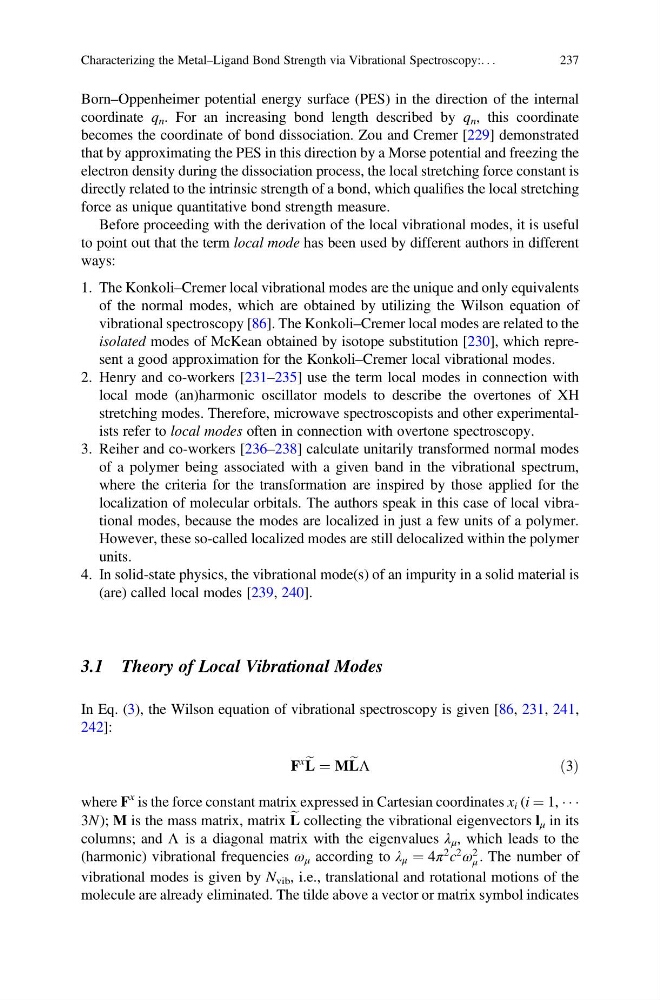
In Eq. (3), the Wilson equation of vibrational spectroscopy is given [86, 231, 241,
242]:
F
x e
L ¼ M e
LΛ
ð3Þ
where F
x is the force constant matrix expressed in Cartesian coordinates x i (i ¼ 1, Á Á Á
3N ); M is the mass matrix, matrix e
L collecting the vibrational eigenvectors l μ in its
columns; and Λ is a diagonal matrix with the eigenvalues λ μ , which leads to the
(harmonic) vibrational frequencies ω μ according to λ μ ¼ 4π
2 c
2
ω
2
μ . The number of
vibrational modes is given by N vib , i.e., translational and rotational motions of the
molecule are already eliminated. The tilde above a vector or matrix symbol indicates
Characterizing the Metal–Ligand Bond Strength via Vibrational Spectroscopy:. . .
237
coordinate q n . For an increasing bond length described by q n , this coordinate
becomes the coordinate of bond dissociation. Zou and Cremer [229] demonstrated
that by approximating the PES in this direction by a Morse potential and freezing the
electron density during the dissociation process, the local stretching force constant is
directly related to the intrinsic strength of a bond, which qualifies the local stretching
force as unique quantitative bond strength measure.
Before proceeding with the derivation of the local vibrational modes, it is useful
to point out that the term local mode has been used by different authors in different
ways:
1. The Konkoli–Cremer local vibrational modes are the unique and only equivalents
of the normal modes, which are obtained by utilizing the Wilson equation of
vibrational spectroscopy [86]. The Konkoli–Cremer local modes are related to the
isolated modes of McKean obtained by isotope substitution [230], which represent a good approximation for the Konkoli–Cremer local vibrational modes.
2. Henry and co-workers [231–235] use the term local modes in connection with
local mode (an)harmonic oscillator models to describe the overtones of XH
stretching modes. Therefore, microwave spectroscopists and other experimentalists refer to local modes often in connection with overtone spectroscopy.
3. Reiher and co-workers [236–238] calculate unitarily transformed normal modes
of a polymer being associated with a given band in the vibrational spectrum,
where the criteria for the transformation are inspired by those applied for the
localization of molecular orbitals. The authors speak in this case of local vibrational modes, because the modes are localized in just a few units of a polymer.
However, these so-called localized modes are still delocalized within the polymer
units.
4. In solid-state physics, the vibrational mode(s) of an impurity in a solid material is
(are) called local modes [239, 240].
3.1 Theory of Local Vibrational Modes
In Eq. (3), the Wilson equation of vibrational spectroscopy is given [86, 231, 241,
242]:
F
x e
L ¼ M e
LΛ
ð3Þ
where F
x is the force constant matrix expressed in Cartesian coordinates x i (i ¼ 1, Á Á Á
3N ); M is the mass matrix, matrix e
L collecting the vibrational eigenvectors l μ in its
columns; and Λ is a diagonal matrix with the eigenvalues λ μ , which leads to the
(harmonic) vibrational frequencies ω μ according to λ μ ¼ 4π
2 c
2
ω
2
μ . The number of
vibrational modes is given by N vib , i.e., translational and rotational motions of the
molecule are already eliminated. The tilde above a vector or matrix symbol indicates
Characterizing the Metal–Ligand Bond Strength via Vibrational Spectroscopy:. . .
237