

5.3 Catalase
Protecting our body from harmful substances like superoxide (O 2
• – ) or hydrogen
peroxide (H 2 O 2 ) is achieved by a variety of enzymes: superoxide dismutases to
transform superoxide into hydrogen peroxide, which is coupled to a catalase enzyme
that transforms the peroxide into water oxygen. A number of biomimetic complexes
have been reported for the latter process [204], most of which are based on
manganese. Despite their obvious societal interest, these complexes have not gained
much attention, which is why we focused on their activity in two families of Mn
complexes [50, 205]. The first family (Mn
III ) was inspired by Doctrow and
co-workers [206, 207], while the latter (Mn
II ) resulted from a recent study by
Britovsek and co-workers [208]. The oxidation state of Mn (II vs. III) showed to
be vital in understanding some differences in the mechanism, although both
followed the proposed ping-pong mechanism [209] where the transformation of
peroxide into water/dioxygen takes place in two phases. In the first phase, O–O bond
breaking leads to a Mn(O) species and water; the Mn-oxo then performs HAT on an
additional peroxide molecule in the second phase, twice, to build the second water
molecule and leaves the deprotonated peroxide behind as (triplet) dioxygen. Nevertheless, with the Mn
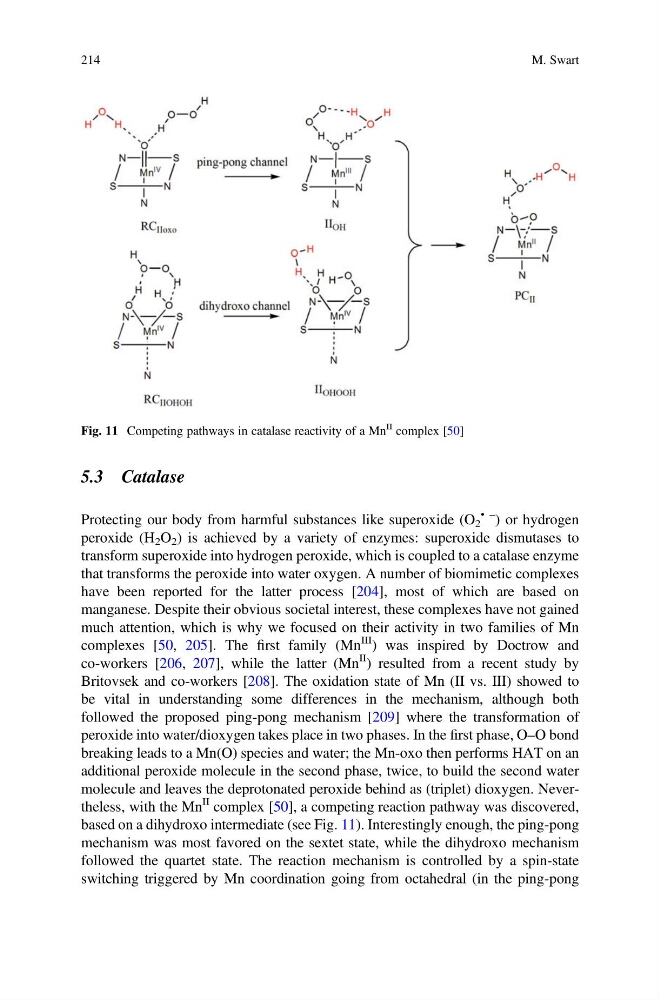
II complex [50], a competing reaction pathway was discovered,
based on a dihydroxo intermediate (see Fig. 11). Interestingly enough, the ping-pong
mechanism was most favored on the sextet state, while the dihydroxo mechanism
followed the quartet state. The reaction mechanism is controlled by a spin-state
switching triggered by Mn coordination going from octahedral (in the ping-pong
Fig. 11 Competing pathways in catalase reactivity of a Mn
II complex [50]
214
M. Swart
Protecting our body from harmful substances like superoxide (O 2
• – ) or hydrogen
peroxide (H 2 O 2 ) is achieved by a variety of enzymes: superoxide dismutases to
transform superoxide into hydrogen peroxide, which is coupled to a catalase enzyme
that transforms the peroxide into water oxygen. A number of biomimetic complexes
have been reported for the latter process [204], most of which are based on
manganese. Despite their obvious societal interest, these complexes have not gained
much attention, which is why we focused on their activity in two families of Mn
complexes [50, 205]. The first family (Mn
III ) was inspired by Doctrow and
co-workers [206, 207], while the latter (Mn
II ) resulted from a recent study by
Britovsek and co-workers [208]. The oxidation state of Mn (II vs. III) showed to
be vital in understanding some differences in the mechanism, although both
followed the proposed ping-pong mechanism [209] where the transformation of
peroxide into water/dioxygen takes place in two phases. In the first phase, O–O bond
breaking leads to a Mn(O) species and water; the Mn-oxo then performs HAT on an
additional peroxide molecule in the second phase, twice, to build the second water
molecule and leaves the deprotonated peroxide behind as (triplet) dioxygen. Nevertheless, with the Mn
II complex [50], a competing reaction pathway was discovered,
based on a dihydroxo intermediate (see Fig. 11). Interestingly enough, the ping-pong
mechanism was most favored on the sextet state, while the dihydroxo mechanism
followed the quartet state. The reaction mechanism is controlled by a spin-state
switching triggered by Mn coordination going from octahedral (in the ping-pong
Fig. 11 Competing pathways in catalase reactivity of a Mn
II complex [50]
214
M. Swart