

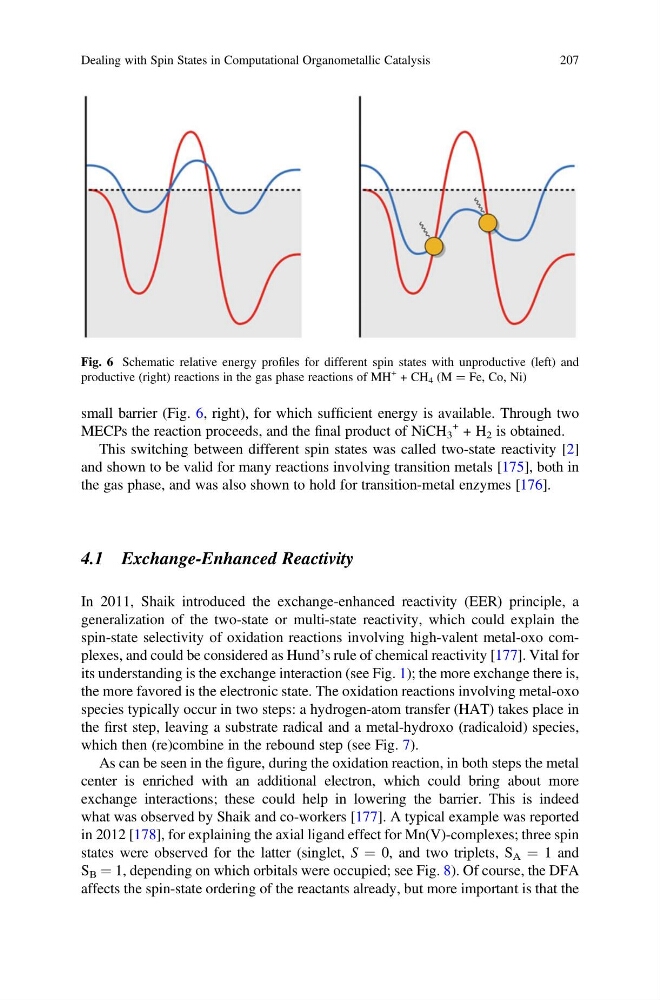
small barrier (Fig. 6, right), for which sufficient energy is available. Through two
MECPs the reaction proceeds, and the final product of NiCH 3
+ + H 2 is obtained.
This switching between different spin states was called two-state reactivity [2]
and shown to be valid for many reactions involving transition metals [175], both in
the gas phase, and was also shown to hold for transition-metal enzymes [176].
4.1 Exchange-Enhanced Reactivity
In 2011, Shaik introduced the exchange-enhanced reactivity (EER) principle, a
generalization of the two-state or multi-state reactivity, which could explain the
spin-state selectivity of oxidation reactions involving high-valent metal-oxo complexes, and could be considered as Hund’s rule of chemical reactivity [177]. Vital for
its understanding is the exchange interaction (see Fig. 1); the more exchange there is,
the more favored is the electronic state. The oxidation reactions involving metal-oxo
species typically occur in two steps: a hydrogen-atom transfer (HAT) takes place in
the first step, leaving a substrate radical and a metal-hydroxo (radicaloid) species,
which then (re)combine in the rebound step (see Fig. 7).
As can be seen in the figure, during the oxidation reaction, in both steps the metal
center is enriched with an additional electron, which could bring about more
exchange interactions; these could help in lowering the barrier. This is indeed
what was observed by Shaik and co-workers [177]. A typical example was reported
in 2012 [178], for explaining the axial ligand effect for Mn(V)-complexes; three spin
states were observed for the latter (singlet, S ¼ 0, and two triplets, S A ¼ 1 and
S B ¼ 1, depending on which orbitals were occupied; see Fig. 8). Of course, the DFA
affects the spin-state ordering of the reactants already, but more important is that the
Fig. 6 Schematic relative energy profiles for different spin states with unproductive (left) and
productive (right) reactions in the gas phase reactions of MH
+ + CH 4 (M ¼ Fe, Co, Ni)
Dealing with Spin States in Computational Organometallic Catalysis
207
MECPs the reaction proceeds, and the final product of NiCH 3
+ + H 2 is obtained.
This switching between different spin states was called two-state reactivity [2]
and shown to be valid for many reactions involving transition metals [175], both in
the gas phase, and was also shown to hold for transition-metal enzymes [176].
4.1 Exchange-Enhanced Reactivity
In 2011, Shaik introduced the exchange-enhanced reactivity (EER) principle, a
generalization of the two-state or multi-state reactivity, which could explain the
spin-state selectivity of oxidation reactions involving high-valent metal-oxo complexes, and could be considered as Hund’s rule of chemical reactivity [177]. Vital for
its understanding is the exchange interaction (see Fig. 1); the more exchange there is,
the more favored is the electronic state. The oxidation reactions involving metal-oxo
species typically occur in two steps: a hydrogen-atom transfer (HAT) takes place in
the first step, leaving a substrate radical and a metal-hydroxo (radicaloid) species,
which then (re)combine in the rebound step (see Fig. 7).
As can be seen in the figure, during the oxidation reaction, in both steps the metal
center is enriched with an additional electron, which could bring about more
exchange interactions; these could help in lowering the barrier. This is indeed
what was observed by Shaik and co-workers [177]. A typical example was reported
in 2012 [178], for explaining the axial ligand effect for Mn(V)-complexes; three spin
states were observed for the latter (singlet, S ¼ 0, and two triplets, S A ¼ 1 and
S B ¼ 1, depending on which orbitals were occupied; see Fig. 8). Of course, the DFA
affects the spin-state ordering of the reactants already, but more important is that the
Fig. 6 Schematic relative energy profiles for different spin states with unproductive (left) and
productive (right) reactions in the gas phase reactions of MH
+ + CH 4 (M ¼ Fe, Co, Ni)
Dealing with Spin States in Computational Organometallic Catalysis
207