

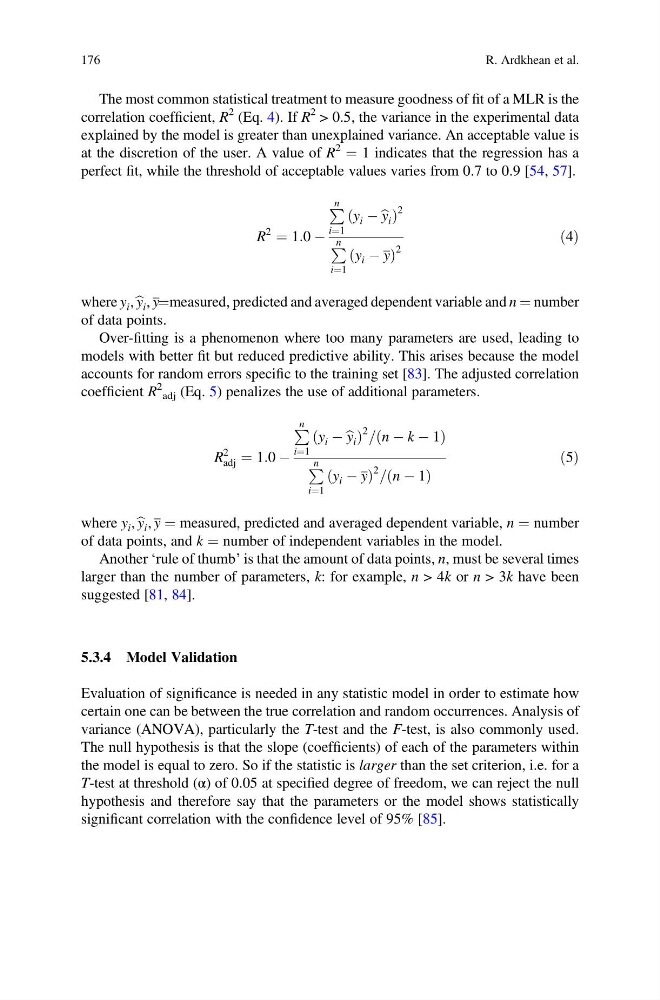
The most common statistical treatment to measure goodness of fit of a MLR is the
correlation coefficient, R
2 (Eq. 4). If R
2 > 0.5, the variance in the experimental data
explained by the model is greater than unexplained variance. An acceptable value is
at the discretion of the user. A value of R
2
¼ 1 indicates that the regression has a
perfect fit, while the threshold of acceptable values varies from 0.7 to 0.9 [54, 57].
R
2
¼ 1:0 À
P n
i¼1
y i À b y i
ð
Þ
2
P n
i¼1
y i À y
ð
Þ
2
ð4Þ
where y i , b y i , y¼measured, predicted and averaged dependent variable and n ¼ number
of data points.
Over-fitting is a phenomenon where too many parameters are used, leading to
models with better fit but reduced predictive ability. This arises because the model
accounts for random errors specific to the training set [83]. The adjusted correlation
coefficient R
2
adj (Eq. 5) penalizes the use of additional parameters.
R
2
adj ¼ 1:0 À
P n
i¼1
y i À b y i
ð
Þ
2 = n À k À 1
ð
Þ
P n
i¼1
y i À y
ð
Þ
2 = n À 1
ð
Þ
ð5Þ
where y i , b y i , y ¼ measured, predicted and averaged dependent variable, n ¼ number
of data points, and k ¼ number of independent variables in the model.
Another ‘rule of thumb’ is that the amount of data points, n, must be several times
larger than the number of parameters, k: for example, n > 4k or n > 3k have been
suggested [81, 84].
5.3.4 Model Validation
Evaluation of significance is needed in any statistic model in order to estimate how
certain one can be between the true correlation and random occurrences. Analysis of
variance (ANOVA), particularly the T-test and the F-test, is also commonly used.
The null hypothesis is that the slope (coefficients) of each of the parameters within
the model is equal to zero. So if the statistic is larger than the set criterion, i.e. for a
T-test at threshold (α) of 0.05 at specified degree of freedom, we can reject the null
hypothesis and therefore say that the parameters or the model shows statistically
significant correlation with the confidence level of 95% [85].
176
R. Ardkhean et al.
correlation coefficient, R
2 (Eq. 4). If R
2 > 0.5, the variance in the experimental data
explained by the model is greater than unexplained variance. An acceptable value is
at the discretion of the user. A value of R
2
¼ 1 indicates that the regression has a
perfect fit, while the threshold of acceptable values varies from 0.7 to 0.9 [54, 57].
R
2
¼ 1:0 À
P n
i¼1
y i À b y i
ð
Þ
2
P n
i¼1
y i À y
ð
Þ
2
ð4Þ
where y i , b y i , y¼measured, predicted and averaged dependent variable and n ¼ number
of data points.
Over-fitting is a phenomenon where too many parameters are used, leading to
models with better fit but reduced predictive ability. This arises because the model
accounts for random errors specific to the training set [83]. The adjusted correlation
coefficient R
2
adj (Eq. 5) penalizes the use of additional parameters.
R
2
adj ¼ 1:0 À
P n
i¼1
y i À b y i
ð
Þ
2 = n À k À 1
ð
Þ
P n
i¼1
y i À y
ð
Þ
2 = n À 1
ð
Þ
ð5Þ
where y i , b y i , y ¼ measured, predicted and averaged dependent variable, n ¼ number
of data points, and k ¼ number of independent variables in the model.
Another ‘rule of thumb’ is that the amount of data points, n, must be several times
larger than the number of parameters, k: for example, n > 4k or n > 3k have been
suggested [81, 84].
5.3.4 Model Validation
Evaluation of significance is needed in any statistic model in order to estimate how
certain one can be between the true correlation and random occurrences. Analysis of
variance (ANOVA), particularly the T-test and the F-test, is also commonly used.
The null hypothesis is that the slope (coefficients) of each of the parameters within
the model is equal to zero. So if the statistic is larger than the set criterion, i.e. for a
T-test at threshold (α) of 0.05 at specified degree of freedom, we can reject the null
hypothesis and therefore say that the parameters or the model shows statistically
significant correlation with the confidence level of 95% [85].
176
R. Ardkhean et al.