

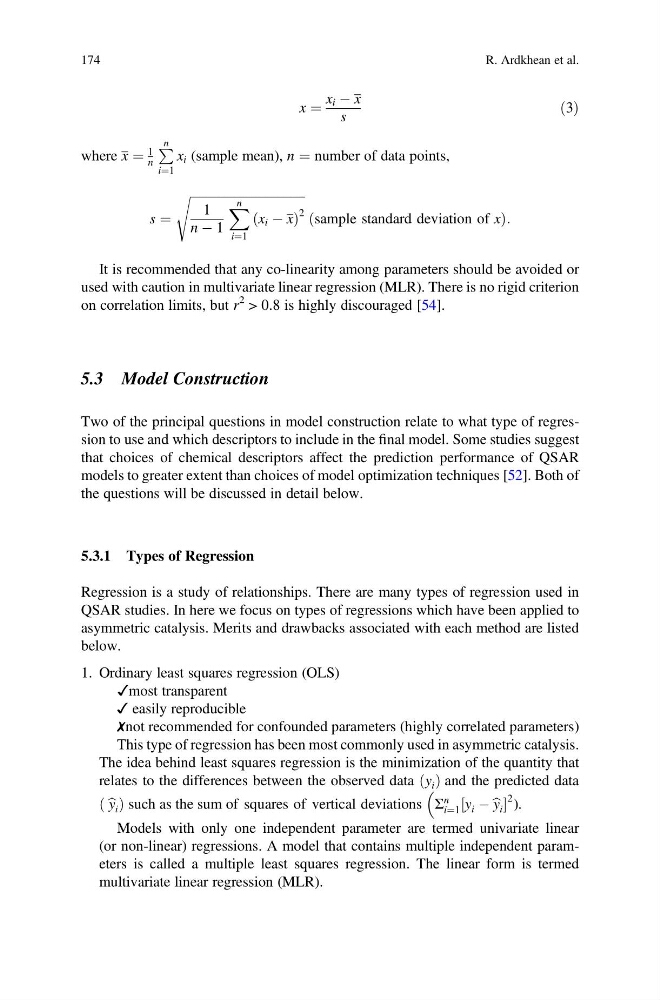
x ¼
x i À x
s
ð3Þ
where x ¼
1
n
P n
i¼1
x i (sample mean), n ¼ number of data points,
s ¼
ffiffiffiffiffiffiffiffiffiffiffiffiffiffiffiffiffiffiffiffiffiffiffiffiffiffiffiffiffiffiffiffiffiffiffiffiffi
1
n À 1
X n
i¼1
x i À x
ð
Þ
2
s
sample standard deviation of x
ð
Þ :
It is recommended that any co-linearity among parameters should be avoided or
used with caution in multivariate linear regression (MLR). There is no rigid criterion
on correlation limits, but r
2 > 0.8 is highly discouraged [54].
5.3 Model Construction
Two of the principal questions in model construction relate to what type of regression to use and which descriptors to include in the final model. Some studies suggest
that choices of chemical descriptors affect the prediction performance of QSAR
models to greater extent than choices of model optimization techniques [52]. Both of
the questions will be discussed in detail below.
5.3.1 Types of Regression
Regression is a study of relationships. There are many types of regression used in
QSAR studies. In here we focus on types of regressions which have been applied to
asymmetric catalysis. Merits and drawbacks associated with each method are listed
below.
1. Ordinary least squares regression (OLS)
✓most transparent
✓ easily reproducible
✗not recommended for confounded parameters (highly correlated parameters)
This type of regression has been most commonly used in asymmetric catalysis.
The idea behind least squares regression is the minimization of the quantity that
relates to the differences between the observed data y i
ð Þ and the predicted data
b y i
ð Þ such as the sum of squares of vertical deviations Σ
n
i¼1 y i À b y i
½
2
).
Models with only one independent parameter are termed univariate linear
(or non-linear) regressions. A model that contains multiple independent parameters is called a multiple least squares regression. The linear form is termed
multivariate linear regression (MLR).
174
R. Ardkhean et al.
x i À x
s
ð3Þ
where x ¼
1
n
P n
i¼1
x i (sample mean), n ¼ number of data points,
s ¼
ffiffiffiffiffiffiffiffiffiffiffiffiffiffiffiffiffiffiffiffiffiffiffiffiffiffiffiffiffiffiffiffiffiffiffiffiffi
1
n À 1
X n
i¼1
x i À x
ð
Þ
2
s
sample standard deviation of x
ð
Þ :
It is recommended that any co-linearity among parameters should be avoided or
used with caution in multivariate linear regression (MLR). There is no rigid criterion
on correlation limits, but r
2 > 0.8 is highly discouraged [54].
5.3 Model Construction
Two of the principal questions in model construction relate to what type of regression to use and which descriptors to include in the final model. Some studies suggest
that choices of chemical descriptors affect the prediction performance of QSAR
models to greater extent than choices of model optimization techniques [52]. Both of
the questions will be discussed in detail below.
5.3.1 Types of Regression
Regression is a study of relationships. There are many types of regression used in
QSAR studies. In here we focus on types of regressions which have been applied to
asymmetric catalysis. Merits and drawbacks associated with each method are listed
below.
1. Ordinary least squares regression (OLS)
✓most transparent
✓ easily reproducible
✗not recommended for confounded parameters (highly correlated parameters)
This type of regression has been most commonly used in asymmetric catalysis.
The idea behind least squares regression is the minimization of the quantity that
relates to the differences between the observed data y i
ð Þ and the predicted data
b y i
ð Þ such as the sum of squares of vertical deviations Σ
n
i¼1 y i À b y i
½
2
).
Models with only one independent parameter are termed univariate linear
(or non-linear) regressions. A model that contains multiple independent parameters is called a multiple least squares regression. The linear form is termed
multivariate linear regression (MLR).
174
R. Ardkhean et al.