

The phosphorescent state resulting from excitation will be in the triplet state, so
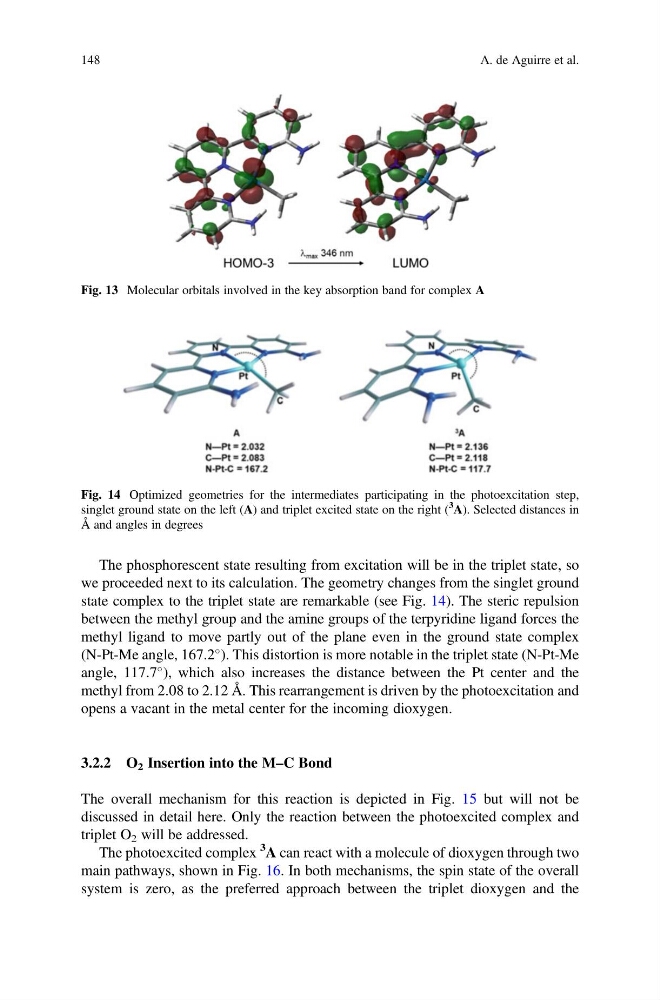
we proceeded next to its calculation. The geometry changes from the singlet ground
state complex to the triplet state are remarkable (see Fig. 14). The steric repulsion
between the methyl group and the amine groups of the terpyridine ligand forces the
methyl ligand to move partly out of the plane even in the ground state complex
(N-Pt-Me angle, 167.2
). This distortion is more notable in the triplet state (N-Pt-Me
angle, 117.7
), which also increases the distance between the Pt center and the
methyl from 2.08 to 2.12 Å. This rearrangement is driven by the photoexcitation and
opens a vacant in the metal center for the incoming dioxygen.
3.2.2 O 2 Insertion into the M–C Bond
The overall mechanism for this reaction is depicted in Fig. 15 but will not be
discussed in detail here. Only the reaction between the photoexcited complex and
triplet O 2 will be addressed.
The photoexcited complex
3 A can react with a molecule of dioxygen through two
main pathways, shown in Fig. 16. In both mechanisms, the spin state of the overall
system is zero, as the preferred approach between the triplet dioxygen and the
Fig. 13 Molecular orbitals involved in the key absorption band for complex A
Fig. 14 Optimized geometries for the intermediates participating in the photoexcitation step,
singlet ground state on the left (A) and triplet excited state on the right (
3
A). Selected distances in
Å and angles in degrees
148
A. de Aguirre et al.
we proceeded next to its calculation. The geometry changes from the singlet ground
state complex to the triplet state are remarkable (see Fig. 14). The steric repulsion
between the methyl group and the amine groups of the terpyridine ligand forces the
methyl ligand to move partly out of the plane even in the ground state complex
(N-Pt-Me angle, 167.2
). This distortion is more notable in the triplet state (N-Pt-Me
angle, 117.7
), which also increases the distance between the Pt center and the
methyl from 2.08 to 2.12 Å. This rearrangement is driven by the photoexcitation and
opens a vacant in the metal center for the incoming dioxygen.
3.2.2 O 2 Insertion into the M–C Bond
The overall mechanism for this reaction is depicted in Fig. 15 but will not be
discussed in detail here. Only the reaction between the photoexcited complex and
triplet O 2 will be addressed.
The photoexcited complex
3 A can react with a molecule of dioxygen through two
main pathways, shown in Fig. 16. In both mechanisms, the spin state of the overall
system is zero, as the preferred approach between the triplet dioxygen and the
Fig. 13 Molecular orbitals involved in the key absorption band for complex A
Fig. 14 Optimized geometries for the intermediates participating in the photoexcitation step,
singlet ground state on the left (A) and triplet excited state on the right (
3
A). Selected distances in
Å and angles in degrees
148
A. de Aguirre et al.