

10.5 Time-Independent Solutions Defining Physical Sectors
61
ii) (10.21), with boundary condition (10.22), does not have solutions unless ϕ ∞ is
a stationary point of the potential
U
(ϕ ∞ ) = 0,
(10.23)
iii) if ϕ ∞ is an absolute minimum of U , then ϕ is the unique solution of (10.21)
with ϕ ∞ as boundary value at infinity and ϕ = ϕ ∞ .
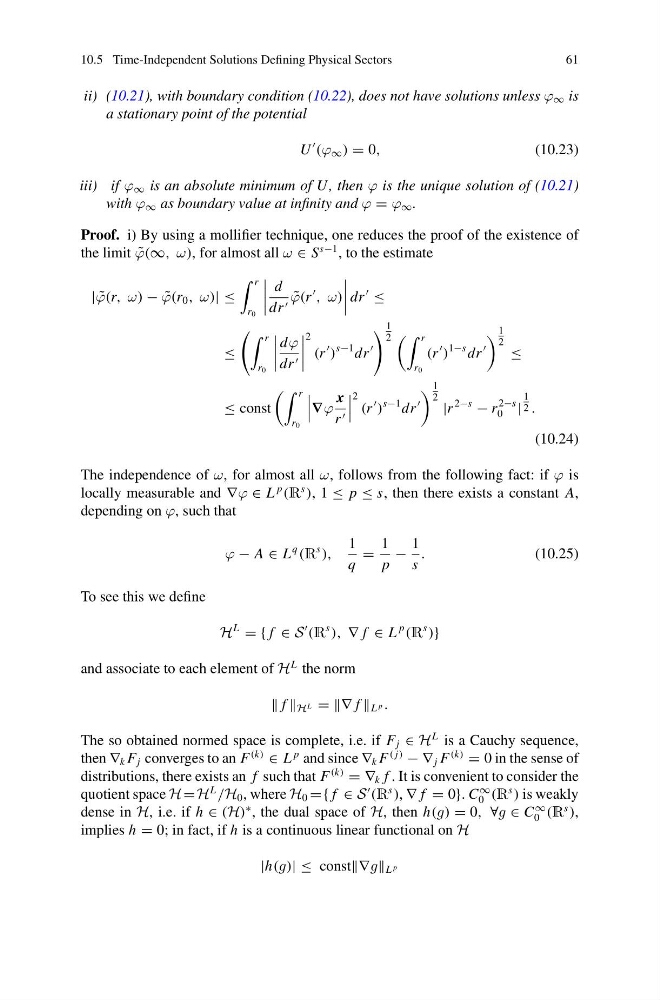
Proof. i) By using a mollifier technique, one reduces the proof of the existence of
the limit ˜
ϕ(∞, ω), for almost all ω ∈ S
s−1 , to the estimate
| ˜
ϕ(r, ω) − ˜
ϕ(r 0 , ω)| ≤
r
r 0
d
dr ˜
ϕ(r
, ω)
dr
≤
≤
r
r 0
dϕ
dr
2
(r
)
s−1 dr
1
2 r
r 0
(r
)
1−s dr
1
2 ≤
≤ const
r
r 0
∇ϕ
x
r
2 (r
)
s−1 dr
1
2 |r
2−s
− r
2−s
0 |
1
2 .
(10.24)
The independence of ω, for almost all ω, follows from the following fact: if ϕ is
locally measurable and ∇ϕ ∈ L
p
(R
s
), 1 ≤ p ≤ s, then there exists a constant A,
depending on ϕ, such that
ϕ − A ∈ L
q
(R
s
),
1
q
=
1
p
−
1
s
.
(10.25)
To see this we define
H
L
= { f ∈ S
(R
s
), ∇ f ∈ L
p
(R
s
)}
and associate to each element of H
L the norm
f H L = =∇ f L p .
The so obtained normed space is complete, i.e. if F j ∈ H
L is a Cauchy sequence,
then ∇ k F j converges to an F
(k)
∈ L
p and since ∇ k F
( j)
− ∇ j F
(k)
= 0 in the sense of
distributions, there exists an f such that F
(k)
= ∇ k f . It is convenient to consider the
quotient space H = H
L
/H 0 , where H 0 ={ f ∈ S
(R
s
), ∇ f = 0}. C
∞
0 (R
s
) is weakly
dense in H, i.e. if h ∈ (H)
∗ , the dual space of H, then h(g) = 0, ∀g ∈ C
∞
0 (R
s
),
implies h = 0; in fact, if h is a continuous linear functional on H
|h(g)| ≤ const∇g L p
61
ii) (10.21), with boundary condition (10.22), does not have solutions unless ϕ ∞ is
a stationary point of the potential
U
(ϕ ∞ ) = 0,
(10.23)
iii) if ϕ ∞ is an absolute minimum of U , then ϕ is the unique solution of (10.21)
with ϕ ∞ as boundary value at infinity and ϕ = ϕ ∞ .
Proof. i) By using a mollifier technique, one reduces the proof of the existence of
the limit ˜
ϕ(∞, ω), for almost all ω ∈ S
s−1 , to the estimate
| ˜
ϕ(r, ω) − ˜
ϕ(r 0 , ω)| ≤
r
r 0
d
dr ˜
ϕ(r
, ω)
dr
≤
≤
r
r 0
dϕ
dr
2
(r
)
s−1 dr
1
2 r
r 0
(r
)
1−s dr
1
2 ≤
≤ const
r
r 0
∇ϕ
x
r
2 (r
)
s−1 dr
1
2 |r
2−s
− r
2−s
0 |
1
2 .
(10.24)
The independence of ω, for almost all ω, follows from the following fact: if ϕ is
locally measurable and ∇ϕ ∈ L
p
(R
s
), 1 ≤ p ≤ s, then there exists a constant A,
depending on ϕ, such that
ϕ − A ∈ L
q
(R
s
),
1
q
=
1
p
−
1
s
.
(10.25)
To see this we define
H
L
= { f ∈ S
(R
s
), ∇ f ∈ L
p
(R
s
)}
and associate to each element of H
L the norm
f H L = =∇ f L p .
The so obtained normed space is complete, i.e. if F j ∈ H
L is a Cauchy sequence,
then ∇ k F j converges to an F
(k)
∈ L
p and since ∇ k F
( j)
− ∇ j F
(k)
= 0 in the sense of
distributions, there exists an f such that F
(k)
= ∇ k f . It is convenient to consider the
quotient space H = H
L
/H 0 , where H 0 ={ f ∈ S
(R
s
), ∇ f = 0}. C
∞
0 (R
s
) is weakly
dense in H, i.e. if h ∈ (H)
∗ , the dual space of H, then h(g) = 0, ∀g ∈ C
∞
0 (R
s
),
implies h = 0; in fact, if h is a continuous linear functional on H
|h(g)| ≤ const∇g L p