

56
10 Appendix
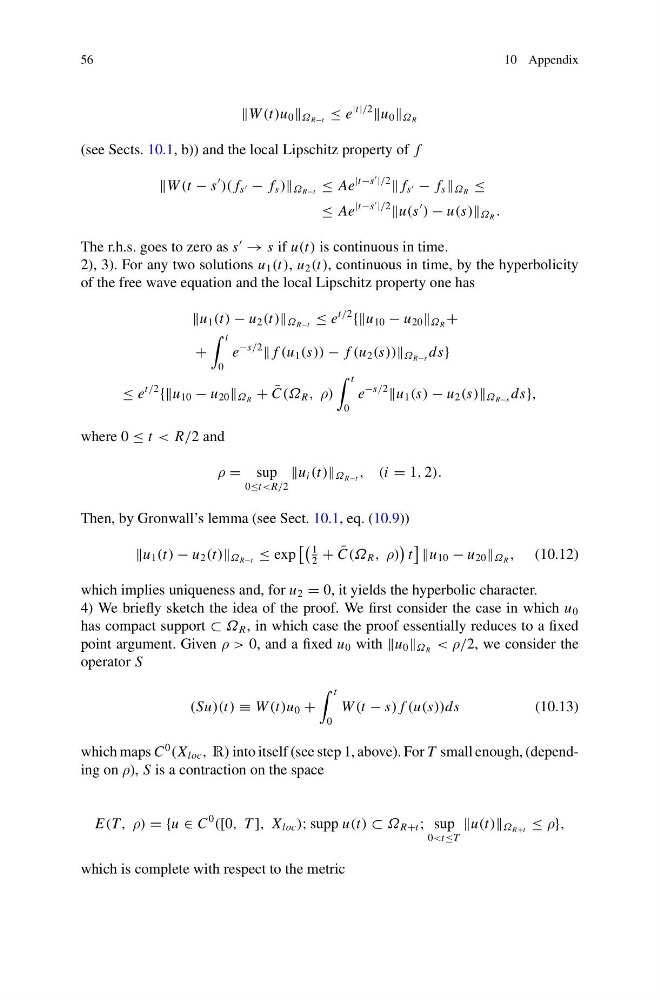
W (t)u 0 Ω R−t ≤ e
|t|/2
u 0 Ω R
(see Sects. 10.1, b)) and the local Lipschitz property of f
W (t − s
)( f s − f s ) Ω R−t ≤ Ae
|t−s
|/2
f s − f s Ω R ≤
≤ Ae
|t−s
|/2
u(s
) − u(s) Ω R .
The r.h.s. goes to zero as s
→ s if u(t) is continuous in time.
2), 3). For any two solutions u 1 (t), u 2 (t), continuous in time, by the hyperbolicity
of the free wave equation and the local Lipschitz property one has
u 1 (t) − u 2 (t) Ω R−t ≤ e
t/2
{{u 10 − u 20 Ω R +
+
t
0
e
−s/2
f (u 1 (s)) − f (u 2 (s)) Ω R−s ds}
≤ e
t/2
{{u 10 − u 20 Ω R + ¯
C(Ω R , ρ)
t
0
e
−s/2
u 1 (s) − u 2 (s) Ω R−s ds},
where 0 ≤ t < R/2 and
ρ = sup
0≤t
Then, by Gronwall’s lemma (see Sect. 10.1, eq. (10.9))
u 1 (t) − u 2 (t) Ω R−t ≤ exp
1
2
+ ¯
C(Ω R , ρ)
t
u 10 − u 20 Ω R , (10.12)
which implies uniqueness and, for u 2 = 0, it yields the hyperbolic character.
4) We briefly sketch the idea of the proof. We first consider the case in which u 0
has compact support ⊂ Ω R , in which case the proof essentially reduces to a fixed
point argument. Given ρ > 0, and a fixed u 0 with u 0 Ω R < ρ/2, we consider the
operator S
(Su)(t) ≡ W (t)u 0 +
t
0
W (t − s) f (u(s))ds
(10.13)
which maps C
0
(X loc , R) into itself (see step 1, above). For T small enough, (depending on ρ), S is a contraction on the space
E(T, ρ) = {u ∈ C
0
([0, T ], X loc ); supp u(t) ⊂ Ω R+t ; sup
0
which is complete with respect to the metric
10 Appendix
W (t)u 0 Ω R−t ≤ e
|t|/2
u 0 Ω R
(see Sects. 10.1, b)) and the local Lipschitz property of f
W (t − s
)( f s − f s ) Ω R−t ≤ Ae
|t−s
|/2
f s − f s Ω R ≤
≤ Ae
|t−s
|/2
u(s
) − u(s) Ω R .
The r.h.s. goes to zero as s
→ s if u(t) is continuous in time.
2), 3). For any two solutions u 1 (t), u 2 (t), continuous in time, by the hyperbolicity
of the free wave equation and the local Lipschitz property one has
u 1 (t) − u 2 (t) Ω R−t ≤ e
t/2
{{u 10 − u 20 Ω R +
+
t
0
e
−s/2
f (u 1 (s)) − f (u 2 (s)) Ω R−s ds}
≤ e
t/2
{{u 10 − u 20 Ω R + ¯
C(Ω R , ρ)
t
0
e
−s/2
u 1 (s) − u 2 (s) Ω R−s ds},
where 0 ≤ t < R/2 and
ρ = sup
0≤t
Then, by Gronwall’s lemma (see Sect. 10.1, eq. (10.9))
u 1 (t) − u 2 (t) Ω R−t ≤ exp
1
2
+ ¯
C(Ω R , ρ)
t
u 10 − u 20 Ω R , (10.12)
which implies uniqueness and, for u 2 = 0, it yields the hyperbolic character.
4) We briefly sketch the idea of the proof. We first consider the case in which u 0
has compact support ⊂ Ω R , in which case the proof essentially reduces to a fixed
point argument. Given ρ > 0, and a fixed u 0 with u 0 Ω R < ρ/2, we consider the
operator S
(Su)(t) ≡ W (t)u 0 +
t
0
W (t − s) f (u(s))ds
(10.13)
which maps C
0
(X loc , R) into itself (see step 1, above). For T small enough, (depending on ρ), S is a contraction on the space
E(T, ρ) = {u ∈ C
0
([0, T ], X loc ); supp u(t) ⊂ Ω R+t ; sup
0
which is complete with respect to the metric