

54
10 Appendix
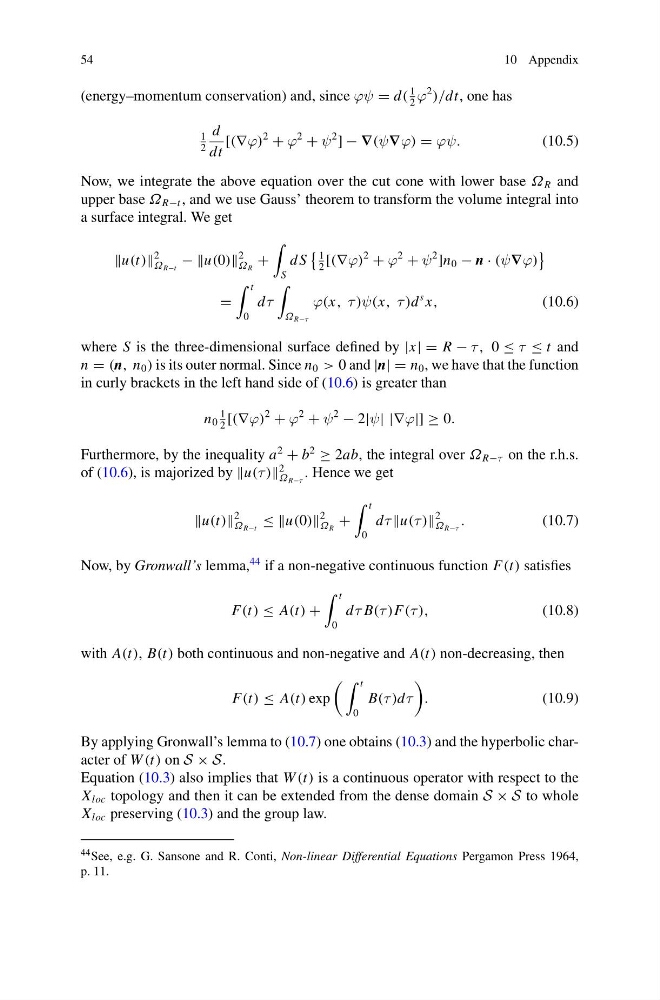
(energy–momentum conservation) and, since ϕψ = d(
1
2
ϕ
2
)/dt, one has
1
2
d
dt
[(∇ϕ)
2
+ ϕ
2
+ ψ
2
] − ∇(ψ∇ϕ) = ϕψ.
(10.5)
Now, we integrate the above equation over the cut cone with lower base Ω R and
upper base Ω R−t , and we use Gauss’ theorem to transform the volume integral into
a surface integral. We get
u(t)
2
Ω R−t
− −u(0)
2
Ω R
+
S
d S
1
2
[(∇ϕ)
2
+ ϕ
2
+ ψ
2
]n 0 − n · (ψ∇ϕ)
=
t
0
dτ
Ω R−τ
ϕ(x, τ )ψ(x, τ )d
s x,
(10.6)
where S is the three-dimensional surface defined by |x| = R − τ , 0 ≤ τ ≤ t and
n = (n, n 0 ) is its outer normal. Since n 0 > 0 and |n| = n 0 , we have that the function
in curly brackets in the left hand side of (10.6) is greater than
n 0
1
2
[(∇ϕ)
2
+ ϕ
2
+ ψ
2
− 2|ψ| |∇ϕ|] ≥ 0.
Furthermore, by the inequality a
2
+ b
2
≥ 2ab, the integral over Ω R−τ on the r.h.s.
of (10.6), is majorized by u(τ )
2
Ω R−τ
. Hence we get
u(t)
2
Ω R−t
≤ ≤u(0)
2
Ω R
+
t
0
dτ u(τ )
2
Ω R−τ
.
(10.7)
Now, by Gronwall’s lemma,
44 if a non-negative continuous function F(t) satisfies
F(t) ≤ A(t) +
t
0
dτ B(τ )F(τ ),
(10.8)
with A(t), B(t) both continuous and non-negative and A(t) non-decreasing, then
F(t) ≤ A(t) exp
t
0
B(τ )dτ
.
(10.9)
By applying Gronwall’s lemma to (10.7) one obtains (10.3) and the hyperbolic character of W (t) on S × S.
Equation (10.3) also implies that W (t) is a continuous operator with respect to the
X loc topology and then it can be extended from the dense domain S × S to whole
X loc preserving (10.3) and the group law.
44 See, e.g. G. Sansone and R. Conti, Non-linear Differential Equations Pergamon Press 1964,
p. 11.
10 Appendix
(energy–momentum conservation) and, since ϕψ = d(
1
2
ϕ
2
)/dt, one has
1
2
d
dt
[(∇ϕ)
2
+ ϕ
2
+ ψ
2
] − ∇(ψ∇ϕ) = ϕψ.
(10.5)
Now, we integrate the above equation over the cut cone with lower base Ω R and
upper base Ω R−t , and we use Gauss’ theorem to transform the volume integral into
a surface integral. We get
u(t)
2
Ω R−t
− −u(0)
2
Ω R
+
S
d S
1
2
[(∇ϕ)
2
+ ϕ
2
+ ψ
2
]n 0 − n · (ψ∇ϕ)
=
t
0
dτ
Ω R−τ
ϕ(x, τ )ψ(x, τ )d
s x,
(10.6)
where S is the three-dimensional surface defined by |x| = R − τ , 0 ≤ τ ≤ t and
n = (n, n 0 ) is its outer normal. Since n 0 > 0 and |n| = n 0 , we have that the function
in curly brackets in the left hand side of (10.6) is greater than
n 0
1
2
[(∇ϕ)
2
+ ϕ
2
+ ψ
2
− 2|ψ| |∇ϕ|] ≥ 0.
Furthermore, by the inequality a
2
+ b
2
≥ 2ab, the integral over Ω R−τ on the r.h.s.
of (10.6), is majorized by u(τ )
2
Ω R−τ
. Hence we get
u(t)
2
Ω R−t
≤ ≤u(0)
2
Ω R
+
t
0
dτ u(τ )
2
Ω R−τ
.
(10.7)
Now, by Gronwall’s lemma,
44 if a non-negative continuous function F(t) satisfies
F(t) ≤ A(t) +
t
0
dτ B(τ )F(τ ),
(10.8)
with A(t), B(t) both continuous and non-negative and A(t) non-decreasing, then
F(t) ≤ A(t) exp
t
0
B(τ )dτ
.
(10.9)
By applying Gronwall’s lemma to (10.7) one obtains (10.3) and the hyperbolic character of W (t) on S × S.
Equation (10.3) also implies that W (t) is a continuous operator with respect to the
X loc topology and then it can be extended from the dense domain S × S to whole
X loc preserving (10.3) and the group law.
44 See, e.g. G. Sansone and R. Conti, Non-linear Differential Equations Pergamon Press 1964,
p. 11.