

8 Examples
45
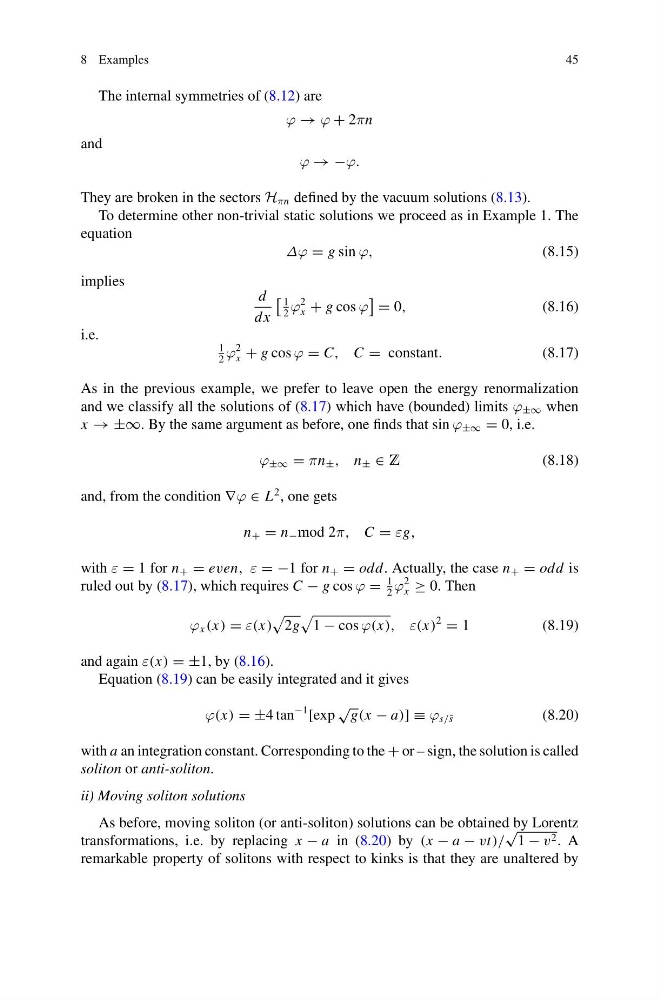
The internal symmetries of (8.12) are
ϕ → ϕ + 2πn
and
ϕ → −ϕ.
They are broken in the sectors H πn defined by the vacuum solutions (8.13).
To determine other non-trivial static solutions we proceed as in Example 1. The
equation
Δϕ = g sin ϕ,
(8.15)
implies
d
dx
1
2
ϕ
2
x + g cos ϕ
= 0,
(8.16)
i.e.
1
2
ϕ
2
x + g cos ϕ = C, C = constant.
(8.17)
As in the previous example, we prefer to leave open the energy renormalization
and we classify all the solutions of (8.17) which have (bounded) limits ϕ ±∞ when
x → ±∞. By the same argument as before, one finds that sin ϕ ±∞ = 0, i.e.
ϕ ±∞ = πn ± , n ± ∈ Z
(8.18)
and, from the condition ∇ϕ ∈ L
2 , one gets
n + = n − mod 2π, C = εg,
with ε = 1 for n + = even, ε = −1 for n + = odd. Actually, the case n + = odd is
ruled out by (8.17), which requires C − g cos ϕ =
1
2
ϕ
2
x ≥ 0. Then
ϕ x (x) = ε(x)
2g
1 − cos ϕ(x), ε(x)
2
= 1
(8.19)
and again ε(x) = ±1, by (8.16).
Equation (8.19) can be easily integrated and it gives
ϕ(x) = ±4 tan
−1
[exp
√ g(x − a)] ≡ ϕ s/¯ s
(8.20)
with a an integration constant. Corresponding to the + or – sign, the solution is called
soliton or anti-soliton.
ii) Moving soliton solutions
As before, moving soliton (or anti-soliton) solutions can be obtained by Lorentz
transformations, i.e. by replacing x − a in (8.20) by (x − a − vt)/
√
1 − v 2 . A
remarkable property of solitons with respect to kinks is that they are unaltered by
45
The internal symmetries of (8.12) are
ϕ → ϕ + 2πn
and
ϕ → −ϕ.
They are broken in the sectors H πn defined by the vacuum solutions (8.13).
To determine other non-trivial static solutions we proceed as in Example 1. The
equation
Δϕ = g sin ϕ,
(8.15)
implies
d
dx
1
2
ϕ
2
x + g cos ϕ
= 0,
(8.16)
i.e.
1
2
ϕ
2
x + g cos ϕ = C, C = constant.
(8.17)
As in the previous example, we prefer to leave open the energy renormalization
and we classify all the solutions of (8.17) which have (bounded) limits ϕ ±∞ when
x → ±∞. By the same argument as before, one finds that sin ϕ ±∞ = 0, i.e.
ϕ ±∞ = πn ± , n ± ∈ Z
(8.18)
and, from the condition ∇ϕ ∈ L
2 , one gets
n + = n − mod 2π, C = εg,
with ε = 1 for n + = even, ε = −1 for n + = odd. Actually, the case n + = odd is
ruled out by (8.17), which requires C − g cos ϕ =
1
2
ϕ
2
x ≥ 0. Then
ϕ x (x) = ε(x)
2g
1 − cos ϕ(x), ε(x)
2
= 1
(8.19)
and again ε(x) = ±1, by (8.16).
Equation (8.19) can be easily integrated and it gives
ϕ(x) = ±4 tan
−1
[exp
√ g(x − a)] ≡ ϕ s/¯ s
(8.20)
with a an integration constant. Corresponding to the + or – sign, the solution is called
soliton or anti-soliton.
ii) Moving soliton solutions
As before, moving soliton (or anti-soliton) solutions can be obtained by Lorentz
transformations, i.e. by replacing x − a in (8.20) by (x − a − vt)/
√
1 − v 2 . A
remarkable property of solitons with respect to kinks is that they are unaltered by