

20
4 General Properties of Solutions of Classical Field Equations
The proof that the above classes of potentials satisfy the local Lipschitz condition
is similar to that for global Lipschitz continuity (see Lemma 5.3 in Chap. 5), except
that local Sobolev inequalities are used instead of global ones (for details see Ref. I,
quoted in Chap. 3, footnote 4).
Since, for the present purposes, we are not interested in optimal conditions, (for
a more general discussion see Ref. I), in the following discussion, for simplicity, we
will consider potentials belonging to the above classes, for s = 1, 2, 3.
The above Local Lipschitz condition guarantees that
1) Equation (4.6) is well defined for u ∈ C
0
(X loc , R)
2) the solution of (4.6), if it exists, is unique
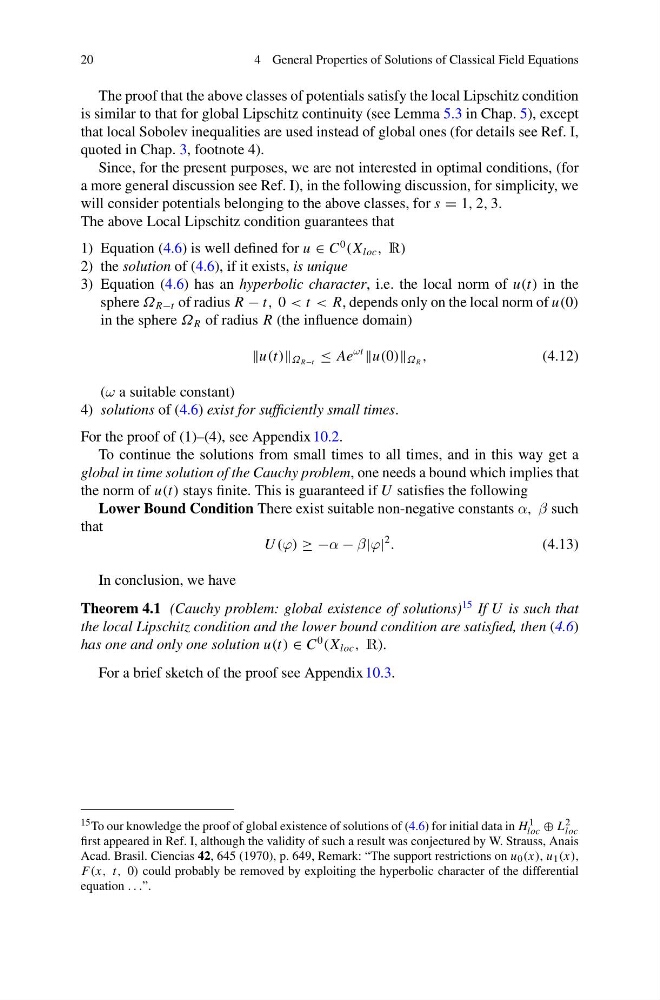
3) Equation (4.6) has an hyperbolic character, i.e. the local norm of u(t) in the
sphere Ω R−t of radius R − t, 0 < t < R, depends only on the local norm of u(0)
in the sphere Ω R of radius R (the influence domain)
u(t) Ω R−t ≤ Ae
ωt
u(0) Ω R ,
(4.12)
(ω a suitable constant)
4) solutions of (4.6) exist for sufficiently small times.
For the proof of (1)–(4), see Appendix 10.2.
To continue the solutions from small times to all times, and in this way get a
global in time solution of the Cauchy problem, one needs a bound which implies that
the norm of u(t) stays finite. This is guaranteed if U satisfies the following
Lower Bound Condition There exist suitable non-negative constants α, β such
that
U (ϕ) ≥ −α − β|ϕ|
2
.
(4.13)
In conclusion, we have
Theorem 4.1 (Cauchy problem: global existence of solutions)
15 If U is such that
the local Lipschitz condition and the lower bound condition are satisfied, then (4.6)
has one and only one solution u(t) ∈ C
0
(X loc , R).
For a brief sketch of the proof see Appendix 10.3.
15 To our knowledge the proof of global existence of solutions of (4.6) for initial data in H 1
loc ⊕ L 2
loc
first appeared in Ref. I, although the validity of such a result was conjectured by W. Strauss, Anais
Acad. Brasil. Ciencias 42, 645 (1970), p. 649, Remark: “The support restrictions on u 0 (x), u 1 (x),
F(x, t, 0) could probably be removed by exploiting the hyperbolic character of the differential
equation . . .”.
4 General Properties of Solutions of Classical Field Equations
The proof that the above classes of potentials satisfy the local Lipschitz condition
is similar to that for global Lipschitz continuity (see Lemma 5.3 in Chap. 5), except
that local Sobolev inequalities are used instead of global ones (for details see Ref. I,
quoted in Chap. 3, footnote 4).
Since, for the present purposes, we are not interested in optimal conditions, (for
a more general discussion see Ref. I), in the following discussion, for simplicity, we
will consider potentials belonging to the above classes, for s = 1, 2, 3.
The above Local Lipschitz condition guarantees that
1) Equation (4.6) is well defined for u ∈ C
0
(X loc , R)
2) the solution of (4.6), if it exists, is unique
3) Equation (4.6) has an hyperbolic character, i.e. the local norm of u(t) in the
sphere Ω R−t of radius R − t, 0 < t < R, depends only on the local norm of u(0)
in the sphere Ω R of radius R (the influence domain)
u(t) Ω R−t ≤ Ae
ωt
u(0) Ω R ,
(4.12)
(ω a suitable constant)
4) solutions of (4.6) exist for sufficiently small times.
For the proof of (1)–(4), see Appendix 10.2.
To continue the solutions from small times to all times, and in this way get a
global in time solution of the Cauchy problem, one needs a bound which implies that
the norm of u(t) stays finite. This is guaranteed if U satisfies the following
Lower Bound Condition There exist suitable non-negative constants α, β such
that
U (ϕ) ≥ −α − β|ϕ|
2
.
(4.13)
In conclusion, we have
Theorem 4.1 (Cauchy problem: global existence of solutions)
15 If U is such that
the local Lipschitz condition and the lower bound condition are satisfied, then (4.6)
has one and only one solution u(t) ∈ C
0
(X loc , R).
For a brief sketch of the proof see Appendix 10.3.
15 To our knowledge the proof of global existence of solutions of (4.6) for initial data in H 1
loc ⊕ L 2
loc
first appeared in Ref. I, although the validity of such a result was conjectured by W. Strauss, Anais
Acad. Brasil. Ciencias 42, 645 (1970), p. 649, Remark: “The support restrictions on u 0 (x), u 1 (x),
F(x, t, 0) could probably be removed by exploiting the hyperbolic character of the differential
equation . . .”.