

Appendix F: U(1) Problem Solved by Gauge Group Topology
271
In fact, since the group valued C
∞ gauge functions U(x) are of compact support
in space, they obviously extend to the one-point compactification of R
3 , ˙
R
3 , which
is isomorphic to the three sphere S
3 , and define continuous mappings of S
3 onto the
global gauge group G:
U(x) : ˙
R
3
∼ S
3
→ G.
Now, each simple Lie group, in particular SU (3), may be continuously deformed
into one of its SU (2) subgroups and SU (2) is isomorphic to S
3 . Then, U(x) defines
a mapping of S
3 onto S
3 .
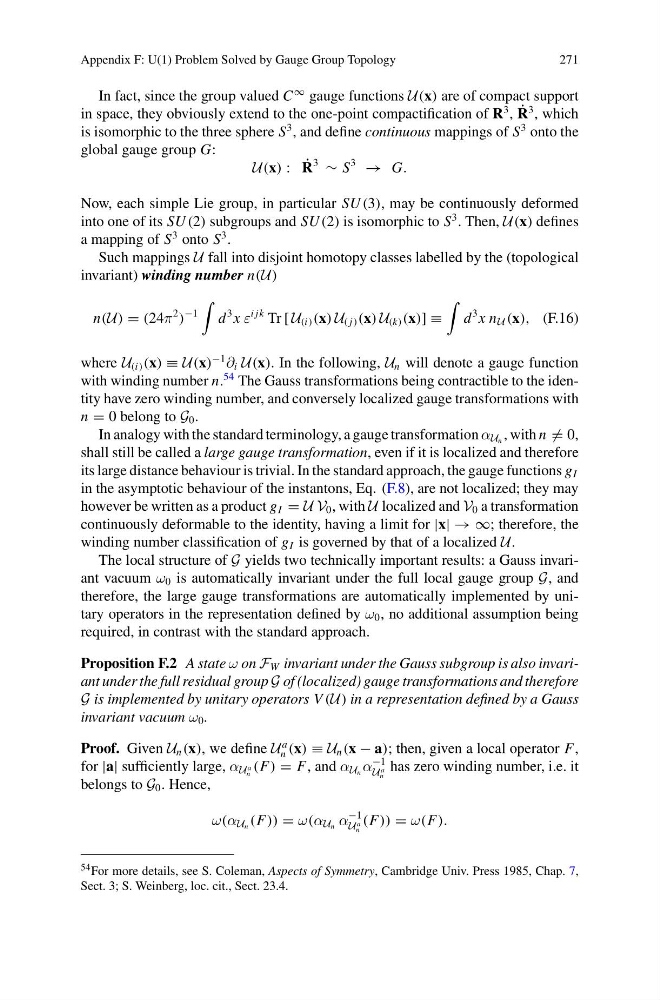
Such mappings U fall into disjoint homotopy classes labelled by the (topological
invariant) winding number n(U)
n(U) = (24π
2
)
−1
d
3 x ε
i jk Tr [ U (i) (x) U ( j) (x) U (k) (x)] ≡
d
3 x n U (x), (F.16)
where U (i) (x) ≡ U(x)
−1
∂ i U(x). In the following, U n will denote a gauge function
with winding number n.
54 The Gauss transformations being contractible to the identity have zero winding number, and conversely localized gauge transformations with
n = 0 belong to G 0 .
In analogy with the standard terminology, a gauge transformation α U n , with n = 0,
shall still be called a large gauge transformation, even if it is localized and therefore
its large distance behaviour is trivial. In the standard approach, the gauge functions g I
in the asymptotic behaviour of the instantons, Eq. (F.8), are not localized; they may
however be written as a product g I = U V 0 , with U localized and V 0 a transformation
continuously deformable to the identity, having a limit for |x| → ∞; therefore, the
winding number classification of g I is governed by that of a localized U.
The local structure of G yields two technically important results: a Gauss invariant vacuum ω 0 is automatically invariant under the full local gauge group G, and
therefore, the large gauge transformations are automatically implemented by unitary operators in the representation defined by ω 0 , no additional assumption being
required, in contrast with the standard approach.
Proposition F.2 A state ω on F W invariant under the Gauss subgroup is also invariant under the full residual group G of (localized) gauge transformations and therefore
G is implemented by unitary operators V (U) in a representation defined by a Gauss
invariant vacuum ω 0 .
Proof. Given U n (x), we define U
a
n (x) ≡ U n (x − a); then, given a local operator F,
for |a| sufficiently large, α U a
n
(F) = F, and α U n α
−1
U a
n
has zero winding number, i.e. it
belongs to G 0 . Hence,
ω(α U n (F)) = ω(α U n α
−1
U a
n
(F)) = ω(F).
54 For more details, see S. Coleman, Aspects of Symmetry, Cambridge Univ. Press 1985, Chap. 7,
Sect. 3; S. Weinberg, loc. cit., Sect. 23.4.
271
In fact, since the group valued C
∞ gauge functions U(x) are of compact support
in space, they obviously extend to the one-point compactification of R
3 , ˙
R
3 , which
is isomorphic to the three sphere S
3 , and define continuous mappings of S
3 onto the
global gauge group G:
U(x) : ˙
R
3
∼ S
3
→ G.
Now, each simple Lie group, in particular SU (3), may be continuously deformed
into one of its SU (2) subgroups and SU (2) is isomorphic to S
3 . Then, U(x) defines
a mapping of S
3 onto S
3 .
Such mappings U fall into disjoint homotopy classes labelled by the (topological
invariant) winding number n(U)
n(U) = (24π
2
)
−1
d
3 x ε
i jk Tr [ U (i) (x) U ( j) (x) U (k) (x)] ≡
d
3 x n U (x), (F.16)
where U (i) (x) ≡ U(x)
−1
∂ i U(x). In the following, U n will denote a gauge function
with winding number n.
54 The Gauss transformations being contractible to the identity have zero winding number, and conversely localized gauge transformations with
n = 0 belong to G 0 .
In analogy with the standard terminology, a gauge transformation α U n , with n = 0,
shall still be called a large gauge transformation, even if it is localized and therefore
its large distance behaviour is trivial. In the standard approach, the gauge functions g I
in the asymptotic behaviour of the instantons, Eq. (F.8), are not localized; they may
however be written as a product g I = U V 0 , with U localized and V 0 a transformation
continuously deformable to the identity, having a limit for |x| → ∞; therefore, the
winding number classification of g I is governed by that of a localized U.
The local structure of G yields two technically important results: a Gauss invariant vacuum ω 0 is automatically invariant under the full local gauge group G, and
therefore, the large gauge transformations are automatically implemented by unitary operators in the representation defined by ω 0 , no additional assumption being
required, in contrast with the standard approach.
Proposition F.2 A state ω on F W invariant under the Gauss subgroup is also invariant under the full residual group G of (localized) gauge transformations and therefore
G is implemented by unitary operators V (U) in a representation defined by a Gauss
invariant vacuum ω 0 .
Proof. Given U n (x), we define U
a
n (x) ≡ U n (x − a); then, given a local operator F,
for |a| sufficiently large, α U a
n
(F) = F, and α U n α
−1
U a
n
has zero winding number, i.e. it
belongs to G 0 . Hence,
ω(α U n (F)) = ω(α U n α
−1
U a
n
(F)) = ω(F).
54 For more details, see S. Coleman, Aspects of Symmetry, Cambridge Univ. Press 1985, Chap. 7,
Sect. 3; S. Weinberg, loc. cit., Sect. 23.4.