

Appendix F
U(1) Problem Solved by Gauge Group Topology
The main pattern and structure of the hadronic particles are expected to be described
by Quantum Chromodynamics (QCD), based on the colour gauge group G = SU (3).
Since quark masses are the (smaller) effect of the electroweak interaction (through
the expectations of the Higgs fields), one may put them equal to zero. Thus, the QCD
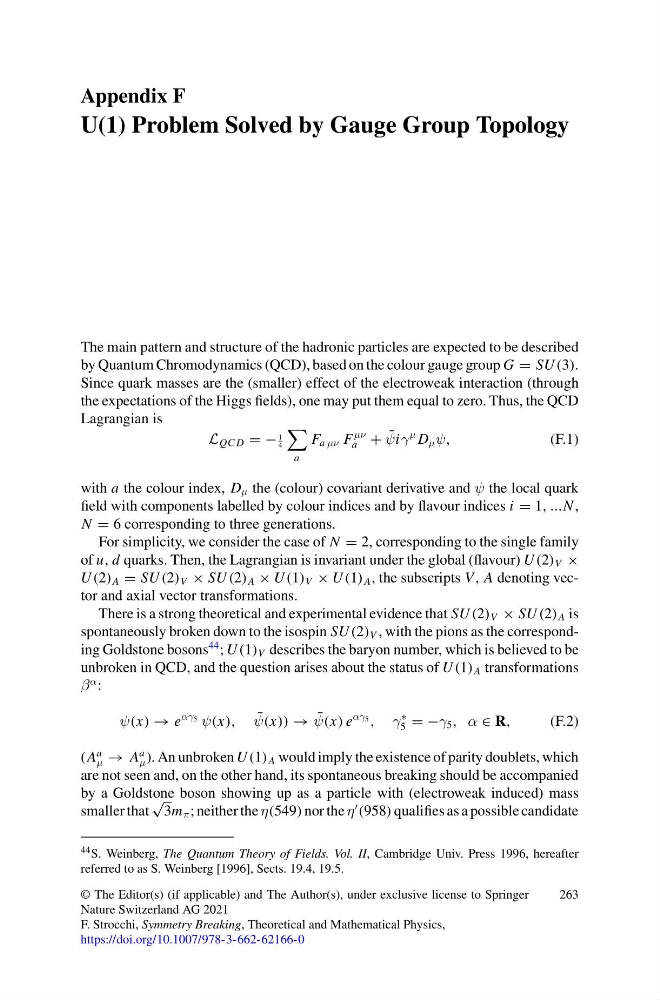
Lagrangian is
L QC D = −
1
4
a
F a μν F
μν
a + ¯
ψiγ
μ D μ ψ,
(F.1)
with a the colour index, D μ the (colour) covariant derivative and ψ the local quark
field with components labelled by colour indices and by flavour indices i = 1, ...N ,
N = 6 corresponding to three generations.
For simplicity, we consider the case of N = 2, corresponding to the single family
of u, d quarks. Then, the Lagrangian is invariant under the global (flavour) U (2) V ×
U (2) A = SU (2) V × SU (2) A × U (1) V × U (1) A , the subscripts V, A denoting vector and axial vector transformations.
There is a strong theoretical and experimental evidence that SU (2) V × SU (2) A is
spontaneously broken down to the isospin SU (2) V , with the pions as the corresponding Goldstone bosons
44 ; U (1) V describes the baryon number, which is believed to be
unbroken in QCD, and the question arises about the status of U (1) A transformations
β
α :
ψ(x) → e
αγ 5 ψ(x), ¯
ψ(x)) → ¯
ψ(x) e
αγ 5 , γ
∗
5 = −γ 5 , α ∈ R,
(F.2)
(A
a
μ → A
a
μ ). An unbroken U (1) A would imply the existence of parity doublets, which
are not seen and, on the other hand, its spontaneous breaking should be accompanied
by a Goldstone boson showing up as a particle with (electroweak induced) mass
smaller that
√
3m π ; neither the η(549) nor the η
(958) qualifies as a possible candidate
44 S. Weinberg, The Quantum Theory of Fields. Vol. II, Cambridge Univ. Press 1996, hereafter
referred to as S. Weinberg [1996], Sects. 19.4, 19.5.
© The Editor(s) (if applicable) and The Author(s), under exclusive license to Springer
Nature Switzerland AG 2021
F. Strocchi, Symmetry Breaking, Theoretical and Mathematical Physics,
https://doi.org/10.1007/978-3-662-62166-0
263
U(1) Problem Solved by Gauge Group Topology
The main pattern and structure of the hadronic particles are expected to be described
by Quantum Chromodynamics (QCD), based on the colour gauge group G = SU (3).
Since quark masses are the (smaller) effect of the electroweak interaction (through
the expectations of the Higgs fields), one may put them equal to zero. Thus, the QCD
Lagrangian is
L QC D = −
1
4
a
F a μν F
μν
a + ¯
ψiγ
μ D μ ψ,
(F.1)
with a the colour index, D μ the (colour) covariant derivative and ψ the local quark
field with components labelled by colour indices and by flavour indices i = 1, ...N ,
N = 6 corresponding to three generations.
For simplicity, we consider the case of N = 2, corresponding to the single family
of u, d quarks. Then, the Lagrangian is invariant under the global (flavour) U (2) V ×
U (2) A = SU (2) V × SU (2) A × U (1) V × U (1) A , the subscripts V, A denoting vector and axial vector transformations.
There is a strong theoretical and experimental evidence that SU (2) V × SU (2) A is
spontaneously broken down to the isospin SU (2) V , with the pions as the corresponding Goldstone bosons
44 ; U (1) V describes the baryon number, which is believed to be
unbroken in QCD, and the question arises about the status of U (1) A transformations
β
α :
ψ(x) → e
αγ 5 ψ(x), ¯
ψ(x)) → ¯
ψ(x) e
αγ 5 , γ
∗
5 = −γ 5 , α ∈ R,
(F.2)
(A
a
μ → A
a
μ ). An unbroken U (1) A would imply the existence of parity doublets, which
are not seen and, on the other hand, its spontaneous breaking should be accompanied
by a Goldstone boson showing up as a particle with (electroweak induced) mass
smaller that
√
3m π ; neither the η(549) nor the η
(958) qualifies as a possible candidate
44 S. Weinberg, The Quantum Theory of Fields. Vol. II, Cambridge Univ. Press 1996, hereafter
referred to as S. Weinberg [1996], Sects. 19.4, 19.5.
© The Editor(s) (if applicable) and The Author(s), under exclusive license to Springer
Nature Switzerland AG 2021
F. Strocchi, Symmetry Breaking, Theoretical and Mathematical Physics,
https://doi.org/10.1007/978-3-662-62166-0
263