

Appendix D: Global and Local Gauge Symmetries
253
In the Coulomb gauge, the free vector potential satisfies the above Eq. (D.1), but
the uniqueness of the solution is restored by the addition of the condition ∂ i A i = 0,
following from the Coulomb gauge fixing. In fact, as a consequence, the arbitrary
(local) C
∞ function χ(x, t) must now satisfy Δχ(x, t) = 0, which implies χ = 0.
Quite generally, independent of the chosen gauge fixing the local gauge transformations reduce to the identity on the physical states.
33
Thus, apart from possible topological invariants, a local gauge group is not seen
neither by the observables nor by the physical states and therefore, its empirical or
physical meaning is seriously in question. The contrast between the claimed fundamental role of the Gauge Principle and the disappearance of local gauge symmetries
from the physical scenario asks for an analysis which traces back the surviving
physical effects.
A hint comes from the second Noether theorem:
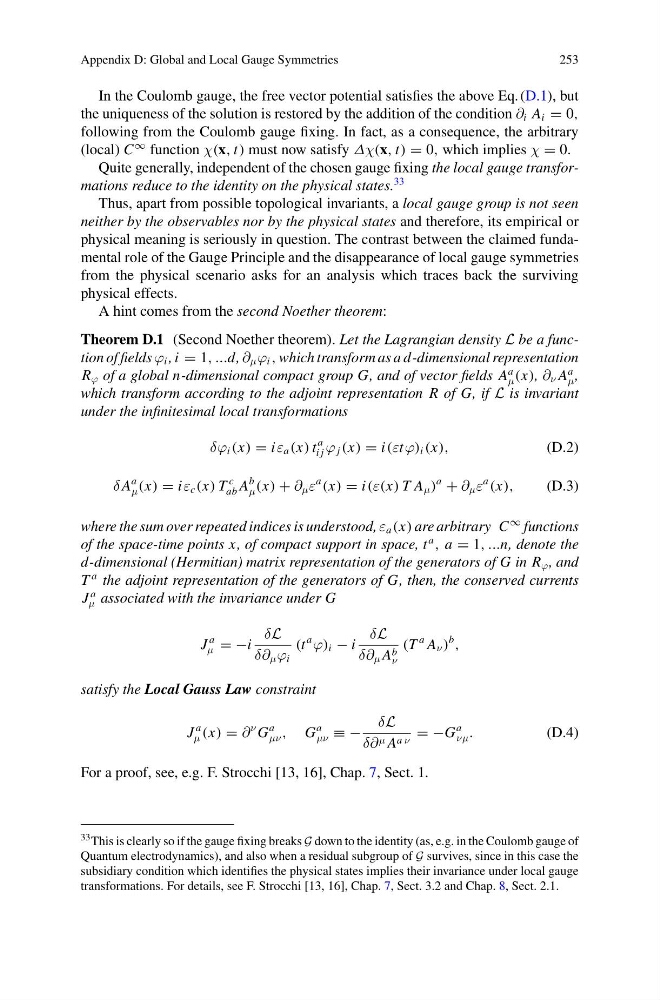
Theorem D.1 (Second Noether theorem). Let the Lagrangian density L be a function of fields ϕ i , i = 1, ...d, ∂ μ ϕ i , which transform as a d-dimensional representation
R ϕ of a global n-dimensional compact group G, and of vector fields A
a
μ (x), ∂ ν A
a
μ ,
which transform according to the adjoint representation R of G, if L is invariant
under the infinitesimal local transformations
δϕ i (x) = iε a (x) t
a
i j ϕ j (x) = i(εtϕ) i (x),
(D.2)
δ A
a
μ (x) = iε c (x) T
c
ab A
b
μ (x) + ∂ μ ε
a
(x) = i(ε(x) T A μ )
a
+ ∂ μ ε
a
(x),
(D.3)
where the sum over repeated indices is understood, ε a (x) are arbitrary C
∞ functions
of the space-time points x, of compact support in space, t
a
, a = 1, ...n, denote the
d-dimensional (Hermitian) matrix representation of the generators of G in R ϕ , and
T
a the adjoint representation of the generators of G, then, the conserved currents
J
a
μ associated with the invariance under G
J
a
μ = −i
δL
δ∂ μ ϕ i
(t
a
ϕ) i − i
δL
δ∂ μ A b
ν
(T
a A ν )
b
,
satisfy the Local Gauss Law constraint
J
a
μ (x) = ∂
ν G
a
μν , G
a
μν ≡ −
δL
δ∂ μ A a ν = −G
a
νμ .
(D.4)
For a proof, see, e.g. F. Strocchi [13, 16], Chap. 7, Sect. 1.
33 This is clearly so if the gauge fixing breaks G down to the identity (as, e.g. in the Coulomb gauge of
Quantum electrodynamics), and also when a residual subgroup of G survives, since in this case the
subsidiary condition which identifies the physical states implies their invariance under local gauge
transformations. For details, see F. Strocchi [13, 16], Chap. 7, Sect. 3.2 and Chap. 8, Sect. 2.1.
253
In the Coulomb gauge, the free vector potential satisfies the above Eq. (D.1), but
the uniqueness of the solution is restored by the addition of the condition ∂ i A i = 0,
following from the Coulomb gauge fixing. In fact, as a consequence, the arbitrary
(local) C
∞ function χ(x, t) must now satisfy Δχ(x, t) = 0, which implies χ = 0.
Quite generally, independent of the chosen gauge fixing the local gauge transformations reduce to the identity on the physical states.
33
Thus, apart from possible topological invariants, a local gauge group is not seen
neither by the observables nor by the physical states and therefore, its empirical or
physical meaning is seriously in question. The contrast between the claimed fundamental role of the Gauge Principle and the disappearance of local gauge symmetries
from the physical scenario asks for an analysis which traces back the surviving
physical effects.
A hint comes from the second Noether theorem:
Theorem D.1 (Second Noether theorem). Let the Lagrangian density L be a function of fields ϕ i , i = 1, ...d, ∂ μ ϕ i , which transform as a d-dimensional representation
R ϕ of a global n-dimensional compact group G, and of vector fields A
a
μ (x), ∂ ν A
a
μ ,
which transform according to the adjoint representation R of G, if L is invariant
under the infinitesimal local transformations
δϕ i (x) = iε a (x) t
a
i j ϕ j (x) = i(εtϕ) i (x),
(D.2)
δ A
a
μ (x) = iε c (x) T
c
ab A
b
μ (x) + ∂ μ ε
a
(x) = i(ε(x) T A μ )
a
+ ∂ μ ε
a
(x),
(D.3)
where the sum over repeated indices is understood, ε a (x) are arbitrary C
∞ functions
of the space-time points x, of compact support in space, t
a
, a = 1, ...n, denote the
d-dimensional (Hermitian) matrix representation of the generators of G in R ϕ , and
T
a the adjoint representation of the generators of G, then, the conserved currents
J
a
μ associated with the invariance under G
J
a
μ = −i
δL
δ∂ μ ϕ i
(t
a
ϕ) i − i
δL
δ∂ μ A b
ν
(T
a A ν )
b
,
satisfy the Local Gauss Law constraint
J
a
μ (x) = ∂
ν G
a
μν , G
a
μν ≡ −
δL
δ∂ μ A a ν = −G
a
νμ .
(D.4)
For a proof, see, e.g. F. Strocchi [13, 16], Chap. 7, Sect. 1.
33 This is clearly so if the gauge fixing breaks G down to the identity (as, e.g. in the Coulomb gauge of
Quantum electrodynamics), and also when a residual subgroup of G survives, since in this case the
subsidiary condition which identifies the physical states implies their invariance under local gauge
transformations. For details, see F. Strocchi [13, 16], Chap. 7, Sect. 3.2 and Chap. 8, Sect. 2.1.