

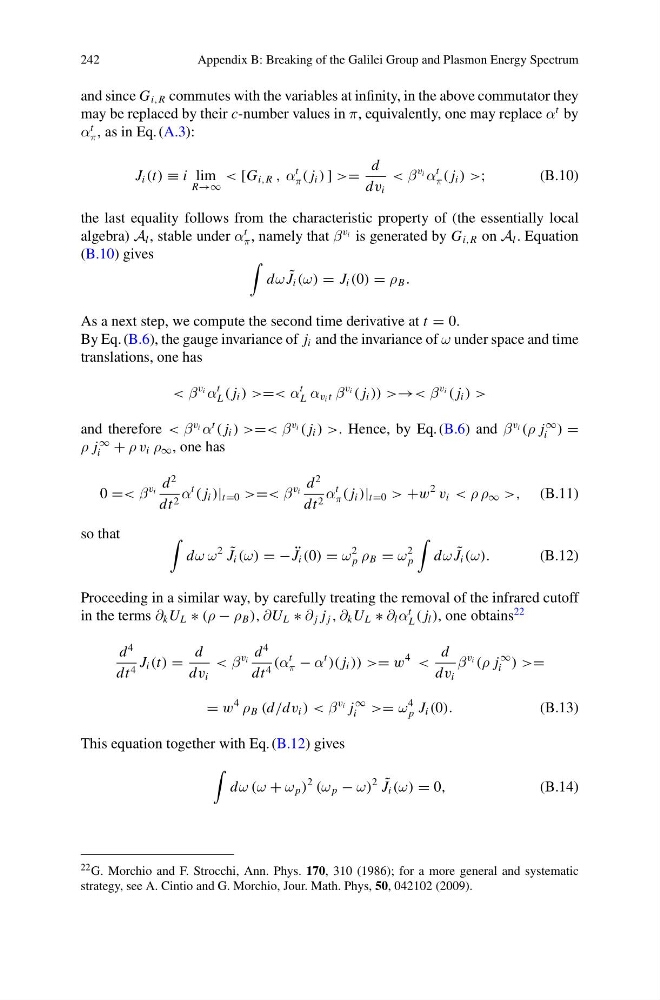
242
Appendix B: Breaking of the Galilei Group and Plasmon Energy Spectrum
and since G i,R commutes with the variables at infinity, in the above commutator they
may be replaced by their c-number values in π, equivalently, one may replace α
t by
α
t
π , as in Eq. (A.3):
J i (t) ≡ i lim
R→∞
< [G i,R , α
t
π ( j i ) ] >=
d
dv i
< β
v i α
t
π ( j i ) >;
(B.10)
the last equality follows from the characteristic property of (the essentially local
algebra) A l , stable under α
t
π , namely that β
v i is generated by G i,R on A l . Equation
(B.10) gives
dω ˜
J i (ω) = J i (0) = ρ B .
As a next step, we compute the second time derivative at t = 0.
By Eq. (B.6), the gauge invariance of j i and the invariance of ω under space and time
translations, one has
< β
v i α
t
L ( j i ) >=< α
t
L α v i t β
v i ( j i )) >→< β
v i ( j i ) >
and therefore < β
v i α
t
( j i ) >=< β
v i ( j i ) >. Hence, by Eq. (B.6) and β
v i (ρ j
∞
i ) =
ρ j
∞
i + ρ v i ρ ∞ , one has
0 =< β
v i
d
2
dt 2 α
t
( j i )| t=0 >=< β
v i
d
2
dt 2 α
t
π ( j i )| t=0 > +w
2
v i < ρ ρ ∞ >, (B.11)
so that
dω ω
2 ˜
J i (ω) = − ¨
J i (0) = ω
2
p ρ B = ω
2
p
dω ˜
J i (ω).
(B.12)
Proceeding in a similar way, by carefully treating the removal of the infrared cutoff
in the terms ∂ k U L ∗ (ρ − ρ B ), ∂U L ∗ ∂ j j j , ∂ k U L ∗ ∂ l α
t
L ( j l ), one obtains
22
d
4
dt 4 J i (t) =
d
dv i
< β
v i
d
4
dt 4 (α
t
π − α
t
)( j i )) >= w
4
<
d
dv i
β
v i (ρ j
∞
i ) >=
= w
4
ρ B (d/dv i ) < β
v i j
∞
i >= ω
4
p J i (0).
(B.13)
This equation together with Eq. (B.12) gives
dω (ω + ω p )
2
(ω p − ω)
2 ˜
J i (ω) = 0,
(B.14)
22 G. Morchio and F. Strocchi, Ann. Phys. 170, 310 (1986); for a more general and systematic
strategy, see A. Cintio and G. Morchio, Jour. Math. Phys, 50, 042102 (2009).
Appendix B: Breaking of the Galilei Group and Plasmon Energy Spectrum
and since G i,R commutes with the variables at infinity, in the above commutator they
may be replaced by their c-number values in π, equivalently, one may replace α
t by
α
t
π , as in Eq. (A.3):
J i (t) ≡ i lim
R→∞
< [G i,R , α
t
π ( j i ) ] >=
d
dv i
< β
v i α
t
π ( j i ) >;
(B.10)
the last equality follows from the characteristic property of (the essentially local
algebra) A l , stable under α
t
π , namely that β
v i is generated by G i,R on A l . Equation
(B.10) gives
dω ˜
J i (ω) = J i (0) = ρ B .
As a next step, we compute the second time derivative at t = 0.
By Eq. (B.6), the gauge invariance of j i and the invariance of ω under space and time
translations, one has
< β
v i α
t
L ( j i ) >=< α
t
L α v i t β
v i ( j i )) >→< β
v i ( j i ) >
and therefore < β
v i α
t
( j i ) >=< β
v i ( j i ) >. Hence, by Eq. (B.6) and β
v i (ρ j
∞
i ) =
ρ j
∞
i + ρ v i ρ ∞ , one has
0 =< β
v i
d
2
dt 2 α
t
( j i )| t=0 >=< β
v i
d
2
dt 2 α
t
π ( j i )| t=0 > +w
2
v i < ρ ρ ∞ >, (B.11)
so that
dω ω
2 ˜
J i (ω) = − ¨
J i (0) = ω
2
p ρ B = ω
2
p
dω ˜
J i (ω).
(B.12)
Proceeding in a similar way, by carefully treating the removal of the infrared cutoff
in the terms ∂ k U L ∗ (ρ − ρ B ), ∂U L ∗ ∂ j j j , ∂ k U L ∗ ∂ l α
t
L ( j l ), one obtains
22
d
4
dt 4 J i (t) =
d
dv i
< β
v i
d
4
dt 4 (α
t
π − α
t
)( j i )) >= w
4
<
d
dv i
β
v i (ρ j
∞
i ) >=
= w
4
ρ B (d/dv i ) < β
v i j
∞
i >= ω
4
p J i (0).
(B.13)
This equation together with Eq. (B.12) gives
dω (ω + ω p )
2
(ω p − ω)
2 ˜
J i (ω) = 0,
(B.14)
22 G. Morchio and F. Strocchi, Ann. Phys. 170, 310 (1986); for a more general and systematic
strategy, see A. Cintio and G. Morchio, Jour. Math. Phys, 50, 042102 (2009).