

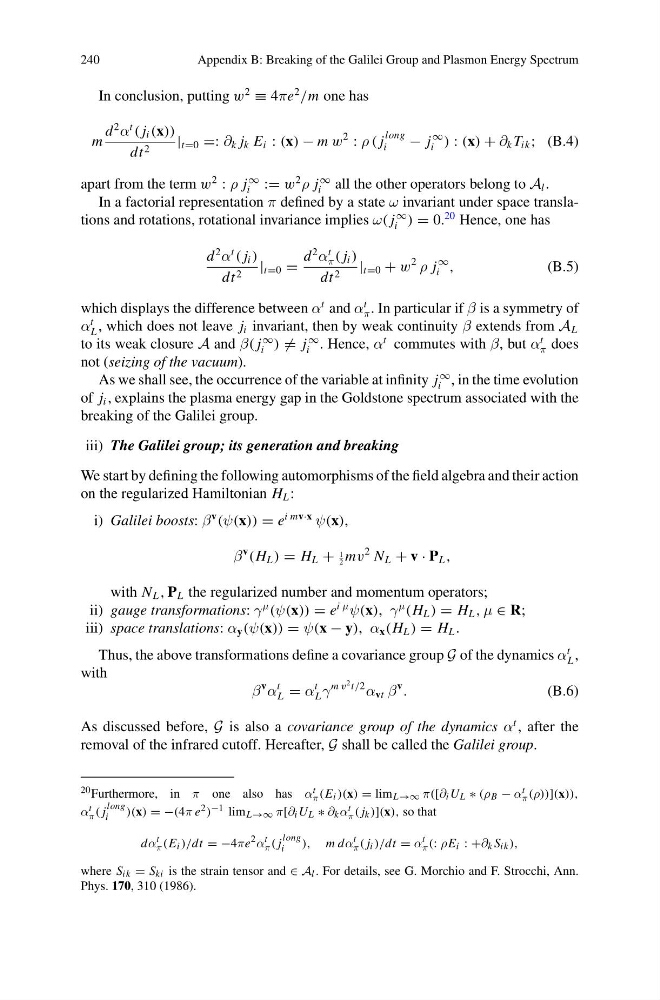
240
Appendix B: Breaking of the Galilei Group and Plasmon Energy Spectrum
In conclusion, putting w
2
≡ 4πe
2
/m one has
m
d
2
α
t
( j i (x))
dt 2
| t=0 =: ∂ k j k E i : (x) − m w
2
: ρ ( j
long
i
− j
∞
i ) : (x) + ∂ k T ik ; (B.4)
apart from the term w
2
: ρ j
∞
i := w
2
ρ j
∞
i all the other operators belong to A l .
In a factorial representation π defined by a state ω invariant under space translations and rotations, rotational invariance implies ω( j
∞
i ) = 0.
20 Hence, one has
d
2
α
t
( j i )
dt 2 | t=0 =
d
2
α
t
π ( j i )
dt 2 | t=0 + w
2
ρ j
∞
i ,
(B.5)
which displays the difference between α
t and α
t
π . In particular if β is a symmetry of
α
t
L , which does not leave j i invariant, then by weak continuity β extends from A L
to its weak closure A and β( j
∞
i ) = j
∞
i . Hence, α
t commutes with β, but α
t
π does
not (seizing of the vacuum).
As we shall see, the occurrence of the variable at infinity j
∞
i , in the time evolution
of j i , explains the plasma energy gap in the Goldstone spectrum associated with the
breaking of the Galilei group.
iii) The Galilei group; its generation and breaking
We start by defining the following automorphisms of the field algebra and their action
on the regularized Hamiltonian H L :
i) Galilei boosts: β
v
(ψ(x)) = e
i mv·x
ψ(x),
β
v
(H L ) = H L +
1
2 mv
2 N L + v · P L ,
with N L , P L the regularized number and momentum operators;
ii) gauge transformations: γ
μ
(ψ(x)) = e
i μ
ψ(x), γ
μ
(H L ) = H L , μ ∈ R;
iii) space translations: α y (ψ(x)) = ψ(x − y), α x (H L ) = H L .
Thus, the above transformations define a covariance group G of the dynamics α
t
L ,
with
β
v
α
t
L = α
t
L γ
m v
2 t/2
α vt β
v
.
(B.6)
As discussed before, G is also a covariance group of the dynamics α
t , after the
removal of the infrared cutoff. Hereafter, G shall be called the Galilei group.
20 Furthermore, in π one also has α t
π (E i )(x) = lim L→∞ π([∂ i U L ∗ (ρ B − α t
π (ρ))](x)),
α t
π ( j
long
i
)(x) = −(4π e 2 ) −1 lim L→∞ π[∂ i U L ∗ ∂ k α t
π ( j k )](x), so that
dα
t
π (E i )/dt = −4πe
2 α
t
π ( j
long
i
), m dα
t
π ( j i )/dt = α
t
π (: ρE i : +∂ k S ik ),
where S ik = S ki is the strain tensor and ∈ A l . For details, see G. Morchio and F. Strocchi, Ann.
Phys. 170, 310 (1986).
Appendix B: Breaking of the Galilei Group and Plasmon Energy Spectrum
In conclusion, putting w
2
≡ 4πe
2
/m one has
m
d
2
α
t
( j i (x))
dt 2
| t=0 =: ∂ k j k E i : (x) − m w
2
: ρ ( j
long
i
− j
∞
i ) : (x) + ∂ k T ik ; (B.4)
apart from the term w
2
: ρ j
∞
i := w
2
ρ j
∞
i all the other operators belong to A l .
In a factorial representation π defined by a state ω invariant under space translations and rotations, rotational invariance implies ω( j
∞
i ) = 0.
20 Hence, one has
d
2
α
t
( j i )
dt 2 | t=0 =
d
2
α
t
π ( j i )
dt 2 | t=0 + w
2
ρ j
∞
i ,
(B.5)
which displays the difference between α
t and α
t
π . In particular if β is a symmetry of
α
t
L , which does not leave j i invariant, then by weak continuity β extends from A L
to its weak closure A and β( j
∞
i ) = j
∞
i . Hence, α
t commutes with β, but α
t
π does
not (seizing of the vacuum).
As we shall see, the occurrence of the variable at infinity j
∞
i , in the time evolution
of j i , explains the plasma energy gap in the Goldstone spectrum associated with the
breaking of the Galilei group.
iii) The Galilei group; its generation and breaking
We start by defining the following automorphisms of the field algebra and their action
on the regularized Hamiltonian H L :
i) Galilei boosts: β
v
(ψ(x)) = e
i mv·x
ψ(x),
β
v
(H L ) = H L +
1
2 mv
2 N L + v · P L ,
with N L , P L the regularized number and momentum operators;
ii) gauge transformations: γ
μ
(ψ(x)) = e
i μ
ψ(x), γ
μ
(H L ) = H L , μ ∈ R;
iii) space translations: α y (ψ(x)) = ψ(x − y), α x (H L ) = H L .
Thus, the above transformations define a covariance group G of the dynamics α
t
L ,
with
β
v
α
t
L = α
t
L γ
m v
2 t/2
α vt β
v
.
(B.6)
As discussed before, G is also a covariance group of the dynamics α
t , after the
removal of the infrared cutoff. Hereafter, G shall be called the Galilei group.
20 Furthermore, in π one also has α t
π (E i )(x) = lim L→∞ π([∂ i U L ∗ (ρ B − α t
π (ρ))](x)),
α t
π ( j
long
i
)(x) = −(4π e 2 ) −1 lim L→∞ π[∂ i U L ∗ ∂ k α t
π ( j k )](x), so that
dα
t
π (E i )/dt = −4πe
2 α
t
π ( j
long
i
), m dα
t
π ( j i )/dt = α
t
π (: ρE i : +∂ k S ik ),
where S ik = S ki is the strain tensor and ∈ A l . For details, see G. Morchio and F. Strocchi, Ann.
Phys. 170, 310 (1986).