

Appendix A: Long Range Dynamics and Vacuum Seizing
233
For the role of boundary terms in the Hamiltonian, we recall that in the local case
the addition of a boundary term in the Lagrangian or in the Hamiltonian does not
affect the equations of motion of local variables.
12
However, this is no longer true in the case of long range dynamics involving variables at infinity. In fact, in the case of central delocalization, the effective dynamics
corresponding to different phases/factorial representations may all be obtained as the
infinite volume limit of finite volume dynamics defined by the addition of different
“boundary terms” (typically surface terms) to the Hamiltonian H V . This is possible
since the coupling with boundary variables gives rise to an effect similar to a coupling
with an external field which may be modified by the addition of boundary terms.
Indeed, given a factorial representation π one may add a boundary term ΔH V to
H V , so that in the limit V → ∞ one gets a dynamics which coincides with α
t
π and
leaves stable the essentially localized algebra A l .
This may be viewed as a sort of infrared renormalization. More precisely, given
a sequence of infrared cutoff Hamiltonians H V , and a given factorial representation
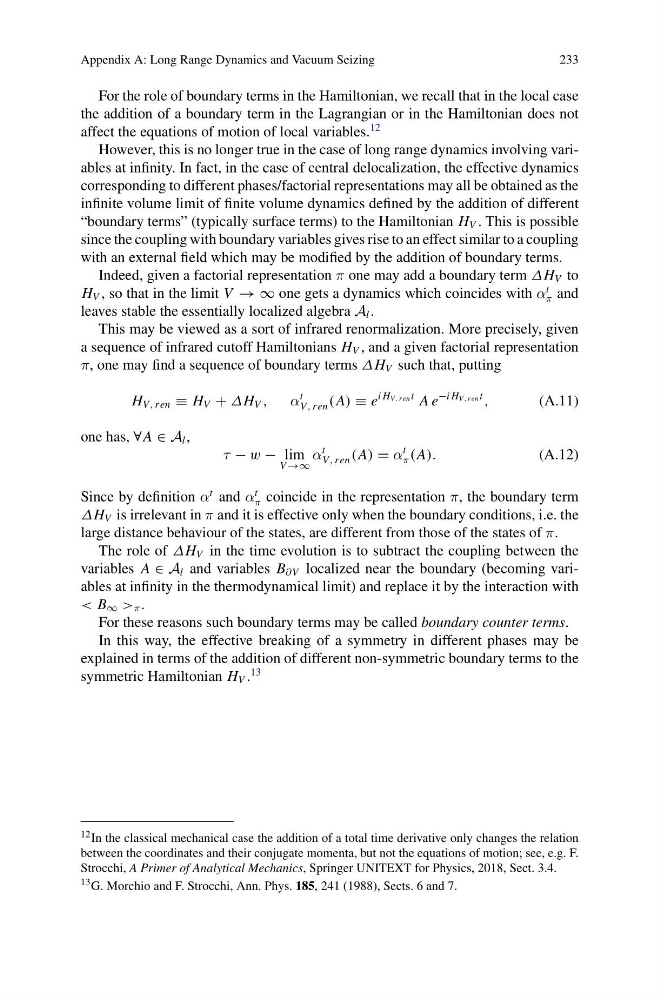
π, one may find a sequence of boundary terms ΔH V such that, putting
H V, ren ≡ H V + ΔH V ,
α
t
V, ren (A) ≡ e
i H V, ren t A e
−i H V, ren t
,
(A.11)
one has, ∀A ∈ A l ,
τ − w − lim
V →∞
α
t
V, ren (A) = α
t
π (A).
(A.12)
Since by definition α
t and α
t
π coincide in the representation π, the boundary term
ΔH V is irrelevant in π and it is effective only when the boundary conditions, i.e. the
large distance behaviour of the states, are different from those of the states of π.
The role of ΔH V in the time evolution is to subtract the coupling between the
variables A ∈ A l and variables B ∂V localized near the boundary (becoming variables at infinity in the thermodynamical limit) and replace it by the interaction with
< B ∞ > π .
For these reasons such boundary terms may be called boundary counter terms.
In this way, the effective breaking of a symmetry in different phases may be
explained in terms of the addition of different non-symmetric boundary terms to the
symmetric Hamiltonian H V .
13
12 In the classical mechanical case the addition of a total time derivative only changes the relation
between the coordinates and their conjugate momenta, but not the equations of motion; see, e.g. F.
Strocchi, A Primer of Analytical Mechanics, Springer UNITEXT for Physics, 2018, Sect. 3.4.
13 G. Morchio and F. Strocchi, Ann. Phys. 185, 241 (1988), Sects. 6 and 7.
233
For the role of boundary terms in the Hamiltonian, we recall that in the local case
the addition of a boundary term in the Lagrangian or in the Hamiltonian does not
affect the equations of motion of local variables.
12
However, this is no longer true in the case of long range dynamics involving variables at infinity. In fact, in the case of central delocalization, the effective dynamics
corresponding to different phases/factorial representations may all be obtained as the
infinite volume limit of finite volume dynamics defined by the addition of different
“boundary terms” (typically surface terms) to the Hamiltonian H V . This is possible
since the coupling with boundary variables gives rise to an effect similar to a coupling
with an external field which may be modified by the addition of boundary terms.
Indeed, given a factorial representation π one may add a boundary term ΔH V to
H V , so that in the limit V → ∞ one gets a dynamics which coincides with α
t
π and
leaves stable the essentially localized algebra A l .
This may be viewed as a sort of infrared renormalization. More precisely, given
a sequence of infrared cutoff Hamiltonians H V , and a given factorial representation
π, one may find a sequence of boundary terms ΔH V such that, putting
H V, ren ≡ H V + ΔH V ,
α
t
V, ren (A) ≡ e
i H V, ren t A e
−i H V, ren t
,
(A.11)
one has, ∀A ∈ A l ,
τ − w − lim
V →∞
α
t
V, ren (A) = α
t
π (A).
(A.12)
Since by definition α
t and α
t
π coincide in the representation π, the boundary term
ΔH V is irrelevant in π and it is effective only when the boundary conditions, i.e. the
large distance behaviour of the states, are different from those of the states of π.
The role of ΔH V in the time evolution is to subtract the coupling between the
variables A ∈ A l and variables B ∂V localized near the boundary (becoming variables at infinity in the thermodynamical limit) and replace it by the interaction with
< B ∞ > π .
For these reasons such boundary terms may be called boundary counter terms.
In this way, the effective breaking of a symmetry in different phases may be
explained in terms of the addition of different non-symmetric boundary terms to the
symmetric Hamiltonian H V .
13
12 In the classical mechanical case the addition of a total time derivative only changes the relation
between the coordinates and their conjugate momenta, but not the equations of motion; see, e.g. F.
Strocchi, A Primer of Analytical Mechanics, Springer UNITEXT for Physics, 2018, Sect. 3.4.
13 G. Morchio and F. Strocchi, Ann. Phys. 185, 241 (1988), Sects. 6 and 7.