

204
29 Symmetry Breaking in Gauge Theories
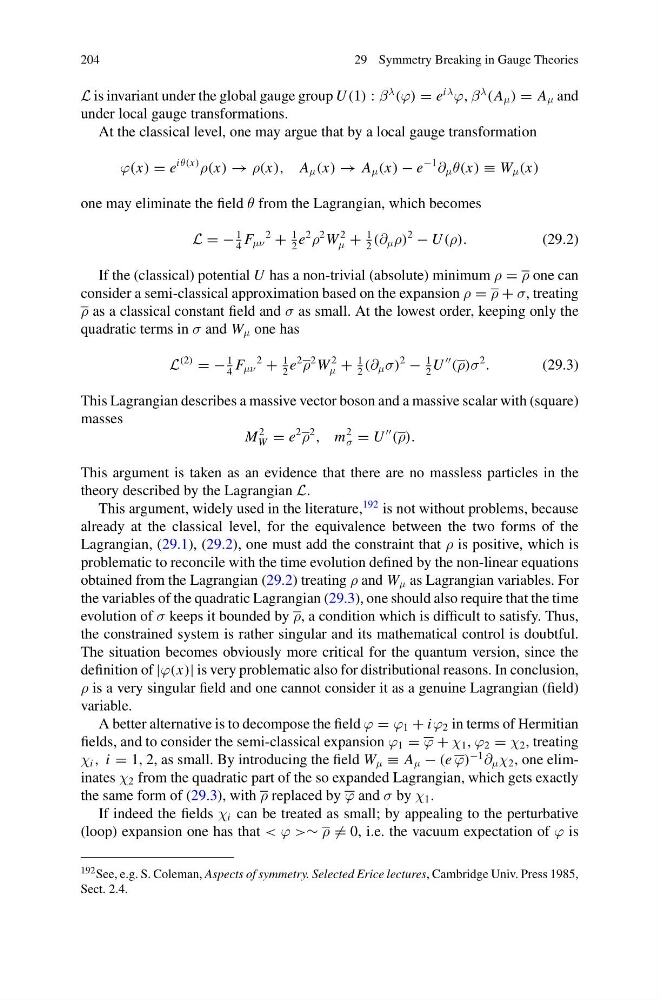
L is invariant under the global gauge group U (1) : β
λ
(ϕ) = e
iλ
ϕ, β
λ
(A μ ) = A μ and
under local gauge transformations.
At the classical level, one may argue that by a local gauge transformation
ϕ(x) = e
iθ(x)
ρ(x) → ρ(x), A μ (x) → A μ (x) − e
−1
∂ μ θ(x) ≡ W μ (x)
one may eliminate the field θ from the Lagrangian, which becomes
L = −
1
4
F μν
2
+
1
2
e
2
ρ
2 W
2
μ +
1
2
(∂ μ ρ)
2
− U (ρ).
(29.2)
If the (classical) potential U has a non-trivial (absolute) minimum ρ = ρ one can
consider a semi-classical approximation based on the expansion ρ = ρ + σ, treating
ρ as a classical constant field and σ as small. At the lowest order, keeping only the
quadratic terms in σ and W μ one has
L
(2)
= −
1
4
F μν
2
+
1
2
e
2
ρ
2 W
2
μ +
1
2
(∂ μ σ)
2
−
1
2
U
(ρ)σ
2
.
(29.3)
This Lagrangian describes a massive vector boson and a massive scalar with (square)
masses
M
2
W = e
2
ρ
2
, m
2
σ = U
(ρ).
This argument is taken as an evidence that there are no massless particles in the
theory described by the Lagrangian L.
This argument, widely used in the literature,
192 is not without problems, because
already at the classical level, for the equivalence between the two forms of the
Lagrangian, (29.1), (29.2), one must add the constraint that ρ is positive, which is
problematic to reconcile with the time evolution defined by the non-linear equations
obtained from the Lagrangian (29.2) treating ρ and W μ as Lagrangian variables. For
the variables of the quadratic Lagrangian (29.3), one should also require that the time
evolution of σ keeps it bounded by ρ, a condition which is difficult to satisfy. Thus,
the constrained system is rather singular and its mathematical control is doubtful.
The situation becomes obviously more critical for the quantum version, since the
definition of |ϕ(x)| is very problematic also for distributional reasons. In conclusion,
ρ is a very singular field and one cannot consider it as a genuine Lagrangian (field)
variable.
A better alternative is to decompose the field ϕ = ϕ 1 + iϕ 2 in terms of Hermitian
fields, and to consider the semi-classical expansion ϕ 1 = ϕ + χ 1 , ϕ 2 = χ 2 , treating
χ i , i = 1, 2, as small. By introducing the field W μ ≡ A μ − (e ϕ)
−1
∂ μ χ 2 , one eliminates χ 2 from the quadratic part of the so expanded Lagrangian, which gets exactly
the same form of (29.3), with ρ replaced by ϕ and σ by χ 1 .
If indeed the fields χ i can be treated as small; by appealing to the perturbative
(loop) expansion one has that < ϕ >∼ ρ = 0, i.e. the vacuum expectation of ϕ is
192 See, e.g. S. Coleman, Aspects of symmetry. Selected Erice lectures, Cambridge Univ. Press 1985,
Sect. 2.4.
29 Symmetry Breaking in Gauge Theories
L is invariant under the global gauge group U (1) : β
λ
(ϕ) = e
iλ
ϕ, β
λ
(A μ ) = A μ and
under local gauge transformations.
At the classical level, one may argue that by a local gauge transformation
ϕ(x) = e
iθ(x)
ρ(x) → ρ(x), A μ (x) → A μ (x) − e
−1
∂ μ θ(x) ≡ W μ (x)
one may eliminate the field θ from the Lagrangian, which becomes
L = −
1
4
F μν
2
+
1
2
e
2
ρ
2 W
2
μ +
1
2
(∂ μ ρ)
2
− U (ρ).
(29.2)
If the (classical) potential U has a non-trivial (absolute) minimum ρ = ρ one can
consider a semi-classical approximation based on the expansion ρ = ρ + σ, treating
ρ as a classical constant field and σ as small. At the lowest order, keeping only the
quadratic terms in σ and W μ one has
L
(2)
= −
1
4
F μν
2
+
1
2
e
2
ρ
2 W
2
μ +
1
2
(∂ μ σ)
2
−
1
2
U
(ρ)σ
2
.
(29.3)
This Lagrangian describes a massive vector boson and a massive scalar with (square)
masses
M
2
W = e
2
ρ
2
, m
2
σ = U
(ρ).
This argument is taken as an evidence that there are no massless particles in the
theory described by the Lagrangian L.
This argument, widely used in the literature,
192 is not without problems, because
already at the classical level, for the equivalence between the two forms of the
Lagrangian, (29.1), (29.2), one must add the constraint that ρ is positive, which is
problematic to reconcile with the time evolution defined by the non-linear equations
obtained from the Lagrangian (29.2) treating ρ and W μ as Lagrangian variables. For
the variables of the quadratic Lagrangian (29.3), one should also require that the time
evolution of σ keeps it bounded by ρ, a condition which is difficult to satisfy. Thus,
the constrained system is rather singular and its mathematical control is doubtful.
The situation becomes obviously more critical for the quantum version, since the
definition of |ϕ(x)| is very problematic also for distributional reasons. In conclusion,
ρ is a very singular field and one cannot consider it as a genuine Lagrangian (field)
variable.
A better alternative is to decompose the field ϕ = ϕ 1 + iϕ 2 in terms of Hermitian
fields, and to consider the semi-classical expansion ϕ 1 = ϕ + χ 1 , ϕ 2 = χ 2 , treating
χ i , i = 1, 2, as small. By introducing the field W μ ≡ A μ − (e ϕ)
−1
∂ μ χ 2 , one eliminates χ 2 from the quadratic part of the so expanded Lagrangian, which gets exactly
the same form of (29.3), with ρ replaced by ϕ and σ by χ 1 .
If indeed the fields χ i can be treated as small; by appealing to the perturbative
(loop) expansion one has that < ϕ >∼ ρ = 0, i.e. the vacuum expectation of ϕ is
192 See, e.g. S. Coleman, Aspects of symmetry. Selected Erice lectures, Cambridge Univ. Press 1985,
Sect. 2.4.