

26 ∗ The Goldstone Theorem at Non-zero Temperature
189
is a continuous function of k as a measure in ω and in particular that it is a measure
in ω in the limit k → 0.
165
Such a continuity in k as a measure in ω would hold if the charge density commutator is absolutely integrable, uniformly in time.
These mathematical delicate points are clearly displayed by the free Bose gas or
by the massless scalar field and it is instructive to work out these applications of the
general statements.
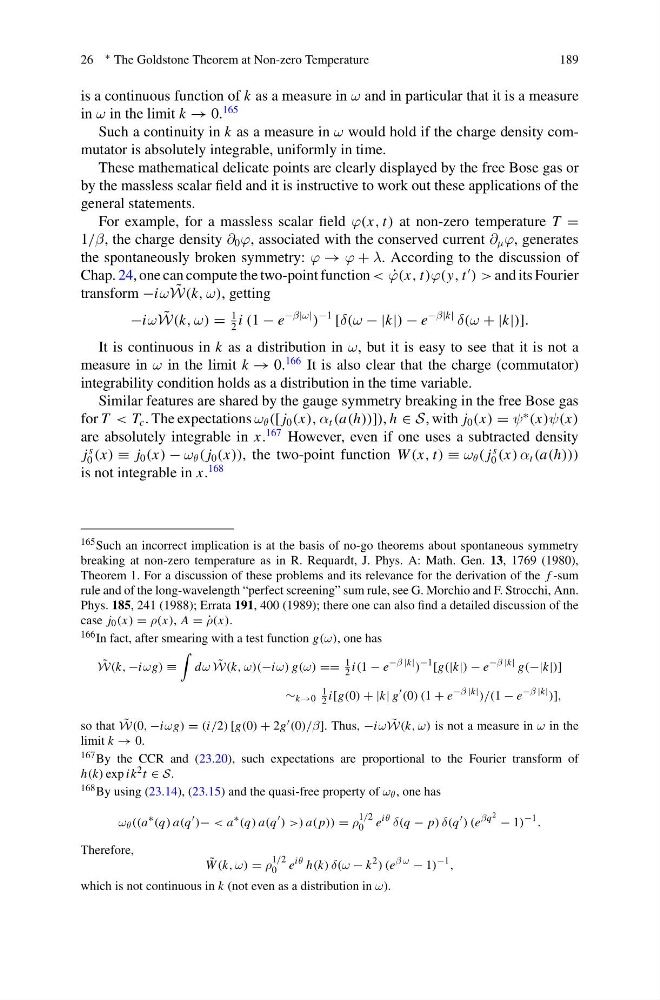
For example, for a massless scalar field ϕ(x, t) at non-zero temperature T =
1/β, the charge density ∂ 0 ϕ, associated with the conserved current ∂ μ ϕ, generates
the spontaneously broken symmetry: ϕ → ϕ + λ. According to the discussion of
Chap. 24, one can compute the two-point function < ˙
ϕ(x, t)ϕ(y, t
) > and its Fourier
transform −iω ˜
W(k, ω), getting
−iω ˜
W(k, ω) =
1
2
i (1 − e
−β|ω|
)
−1
[δ(ω − |k|) − e
−β|k|
δ(ω + |k|)].
It is continuous in k as a distribution in ω, but it is easy to see that it is not a
measure in ω in the limit k → 0.
166 It is also clear that the charge (commutator)
integrability condition holds as a distribution in the time variable.
Similar features are shared by the gauge symmetry breaking in the free Bose gas
for T < T c . The expectations ω θ ([ j 0 (x), α t (a(h))]), h ∈ S, with j 0 (x) = ψ
∗
(x)ψ(x)
are absolutely integrable in x.
167 However, even if one uses a subtracted density
j
s
0 (x) ≡ j 0 (x) − ω θ ( j 0 (x)), the two-point function W (x, t) ≡ ω θ ( j
s
0 (x) α t (a(h)))
is not integrable in x.
168
165 Such an incorrect implication is at the basis of no-go theorems about spontaneous symmetry
breaking at non-zero temperature as in R. Requardt, J. Phys. A: Math. Gen. 13, 1769 (1980),
Theorem 1. For a discussion of these problems and its relevance for the derivation of the f -sum
rule and of the long-wavelength “perfect screening” sum rule, see G. Morchio and F. Strocchi, Ann.
Phys. 185, 241 (1988); Errata 191, 400 (1989); there one can also find a detailed discussion of the
case j 0 (x) = ρ(x), A = ˙
ρ(x).
166 In fact, after smearing with a test function g(ω), one has
˜
W(k, −iωg) ≡
dω ˜
W(k, ω)(−iω) g(ω) ==
1
2 i(1 − e
−β |k| )
−1 [g(|k|) − e
−β |k| g(−|k|)]
∼ k→0
1
2 i[g(0) + |k| g
(0) (1 + e
−β |k| )/(1 − e
−β |k| )],
so that ˜
W(0, −iωg) = (i/2) [g(0) + 2g (0)/β]. Thus, −iω ˜
W(k, ω) is not a measure in ω in the
limit k → 0.
167 By the CCR and (23.20), such expectations are proportional to the Fourier transform of
h(k) exp ik 2 t ∈ S.
168 By using (23.14), (23.15) and the quasi-free property of ω θ , one has
ω θ ((a
∗ (q) a(q
)− < a
∗ (q) a(q
) >) a( p)) = ρ
1/2
0 e
iθ δ(q − p) δ(q
) (e
βq 2 − 1)
−1 .
Therefore,
˜
W (k, ω) = ρ
1/2
0 e
iθ h(k) δ(ω − k
2 ) (e
β ω − 1)
−1 ,
which is not continuous in k (not even as a distribution in ω).
189
is a continuous function of k as a measure in ω and in particular that it is a measure
in ω in the limit k → 0.
165
Such a continuity in k as a measure in ω would hold if the charge density commutator is absolutely integrable, uniformly in time.
These mathematical delicate points are clearly displayed by the free Bose gas or
by the massless scalar field and it is instructive to work out these applications of the
general statements.
For example, for a massless scalar field ϕ(x, t) at non-zero temperature T =
1/β, the charge density ∂ 0 ϕ, associated with the conserved current ∂ μ ϕ, generates
the spontaneously broken symmetry: ϕ → ϕ + λ. According to the discussion of
Chap. 24, one can compute the two-point function < ˙
ϕ(x, t)ϕ(y, t
) > and its Fourier
transform −iω ˜
W(k, ω), getting
−iω ˜
W(k, ω) =
1
2
i (1 − e
−β|ω|
)
−1
[δ(ω − |k|) − e
−β|k|
δ(ω + |k|)].
It is continuous in k as a distribution in ω, but it is easy to see that it is not a
measure in ω in the limit k → 0.
166 It is also clear that the charge (commutator)
integrability condition holds as a distribution in the time variable.
Similar features are shared by the gauge symmetry breaking in the free Bose gas
for T < T c . The expectations ω θ ([ j 0 (x), α t (a(h))]), h ∈ S, with j 0 (x) = ψ
∗
(x)ψ(x)
are absolutely integrable in x.
167 However, even if one uses a subtracted density
j
s
0 (x) ≡ j 0 (x) − ω θ ( j 0 (x)), the two-point function W (x, t) ≡ ω θ ( j
s
0 (x) α t (a(h)))
is not integrable in x.
168
165 Such an incorrect implication is at the basis of no-go theorems about spontaneous symmetry
breaking at non-zero temperature as in R. Requardt, J. Phys. A: Math. Gen. 13, 1769 (1980),
Theorem 1. For a discussion of these problems and its relevance for the derivation of the f -sum
rule and of the long-wavelength “perfect screening” sum rule, see G. Morchio and F. Strocchi, Ann.
Phys. 185, 241 (1988); Errata 191, 400 (1989); there one can also find a detailed discussion of the
case j 0 (x) = ρ(x), A = ˙
ρ(x).
166 In fact, after smearing with a test function g(ω), one has
˜
W(k, −iωg) ≡
dω ˜
W(k, ω)(−iω) g(ω) ==
1
2 i(1 − e
−β |k| )
−1 [g(|k|) − e
−β |k| g(−|k|)]
∼ k→0
1
2 i[g(0) + |k| g
(0) (1 + e
−β |k| )/(1 − e
−β |k| )],
so that ˜
W(0, −iωg) = (i/2) [g(0) + 2g (0)/β]. Thus, −iω ˜
W(k, ω) is not a measure in ω in the
limit k → 0.
167 By the CCR and (23.20), such expectations are proportional to the Fourier transform of
h(k) exp ik 2 t ∈ S.
168 By using (23.14), (23.15) and the quasi-free property of ω θ , one has
ω θ ((a
∗ (q) a(q
)− < a
∗ (q) a(q
) >) a( p)) = ρ
1/2
0 e
iθ δ(q − p) δ(q
) (e
βq 2 − 1)
−1 .
Therefore,
˜
W (k, ω) = ρ
1/2
0 e
iθ h(k) δ(ω − k
2 ) (e
β ω − 1)
−1 ,
which is not continuous in k (not even as a distribution in ω).