

23.3 Free Bose Gas in the Thermodynamical Limit
163
23.3 Free Bose Gas in the Thermodynamical Limit
In the Bose case the thermodynamical limit is much more delicate and interesting.
First, to discuss the thermodynamical limit of the finite volume dynamics, one
must use the Weyl operators and, as already seen in Sect. 17.2, α
V
t does not converge
to α t in the uniform (or norm) topology on the quasi-local algebra generated by the
local Weyl operators. However, it is not difficult to see that α
V
t converges strongly to
α t on the algebra generated by the L
2 -delocalized Weyl operators U ( f ), V (g), f , g
real and ∈ L
2
(R
s
).
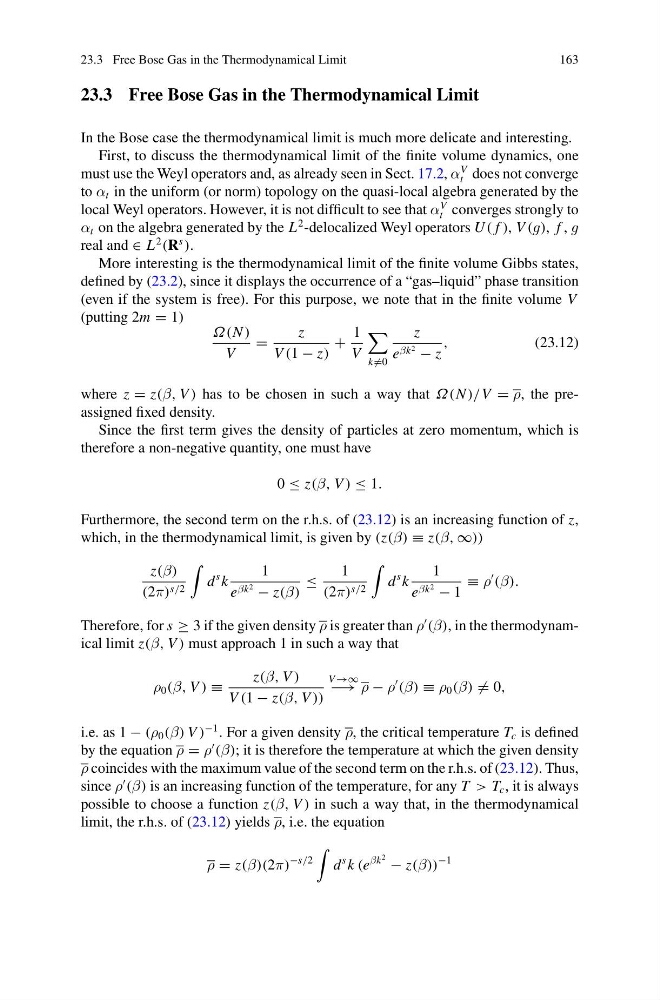
More interesting is the thermodynamical limit of the finite volume Gibbs states,
defined by (23.2), since it displays the occurrence of a “gas–liquid” phase transition
(even if the system is free). For this purpose, we note that in the finite volume V
(putting 2m = 1)
Ω(N )
V
=
z
V (1 − z)
+
1
V
k =0
z
e βk 2 − z
,
(23.12)
where z = z(β, V ) has to be chosen in such a way that Ω(N )/V = ρ, the preassigned fixed density.
Since the first term gives the density of particles at zero momentum, which is
therefore a non-negative quantity, one must have
0 ≤ z(β, V ) ≤ 1.
Furthermore, the second term on the r.h.s. of (23.12) is an increasing function of z,
which, in the thermodynamical limit, is given by (z(β) ≡ z(β, ∞))
z(β)
(2π) s/2
d
s k
1
e βk 2 − z(β)
≤
1
(2π) s/2
d
s k
1
e βk 2 − 1
≡ ρ
(β).
Therefore, for s ≥ 3 if the given density ρ is greater than ρ
(β), in the thermodynamical limit z(β, V ) must approach 1 in such a way that
ρ 0 (β, V ) ≡
z(β, V )
V (1 − z(β, V ))
V →∞
−→ ρ − ρ
(β) ≡ ρ 0 (β) = 0,
i.e. as 1 − (ρ 0 (β) V )
−1 . For a given density ρ, the critical temperature T c is defined
by the equation ρ = ρ
(β); it is therefore the temperature at which the given density
ρ coincides with the maximum value of the second term on the r.h.s. of (23.12). Thus,
since ρ
(β) is an increasing function of the temperature, for any T > T c , it is always
possible to choose a function z(β, V ) in such a way that, in the thermodynamical
limit, the r.h.s. of (23.12) yields ρ, i.e. the equation
ρ = z(β)(2π)
−s/2
d
s k (e
βk
2 − z(β))
−1
163
23.3 Free Bose Gas in the Thermodynamical Limit
In the Bose case the thermodynamical limit is much more delicate and interesting.
First, to discuss the thermodynamical limit of the finite volume dynamics, one
must use the Weyl operators and, as already seen in Sect. 17.2, α
V
t does not converge
to α t in the uniform (or norm) topology on the quasi-local algebra generated by the
local Weyl operators. However, it is not difficult to see that α
V
t converges strongly to
α t on the algebra generated by the L
2 -delocalized Weyl operators U ( f ), V (g), f , g
real and ∈ L
2
(R
s
).
More interesting is the thermodynamical limit of the finite volume Gibbs states,
defined by (23.2), since it displays the occurrence of a “gas–liquid” phase transition
(even if the system is free). For this purpose, we note that in the finite volume V
(putting 2m = 1)
Ω(N )
V
=
z
V (1 − z)
+
1
V
k =0
z
e βk 2 − z
,
(23.12)
where z = z(β, V ) has to be chosen in such a way that Ω(N )/V = ρ, the preassigned fixed density.
Since the first term gives the density of particles at zero momentum, which is
therefore a non-negative quantity, one must have
0 ≤ z(β, V ) ≤ 1.
Furthermore, the second term on the r.h.s. of (23.12) is an increasing function of z,
which, in the thermodynamical limit, is given by (z(β) ≡ z(β, ∞))
z(β)
(2π) s/2
d
s k
1
e βk 2 − z(β)
≤
1
(2π) s/2
d
s k
1
e βk 2 − 1
≡ ρ
(β).
Therefore, for s ≥ 3 if the given density ρ is greater than ρ
(β), in the thermodynamical limit z(β, V ) must approach 1 in such a way that
ρ 0 (β, V ) ≡
z(β, V )
V (1 − z(β, V ))
V →∞
−→ ρ − ρ
(β) ≡ ρ 0 (β) = 0,
i.e. as 1 − (ρ 0 (β) V )
−1 . For a given density ρ, the critical temperature T c is defined
by the equation ρ = ρ
(β); it is therefore the temperature at which the given density
ρ coincides with the maximum value of the second term on the r.h.s. of (23.12). Thus,
since ρ
(β) is an increasing function of the temperature, for any T > T c , it is always
possible to choose a function z(β, V ) in such a way that, in the thermodynamical
limit, the r.h.s. of (23.12) yields ρ, i.e. the equation
ρ = z(β)(2π)
−s/2
d
s k (e
βk
2 − z(β))
−1