

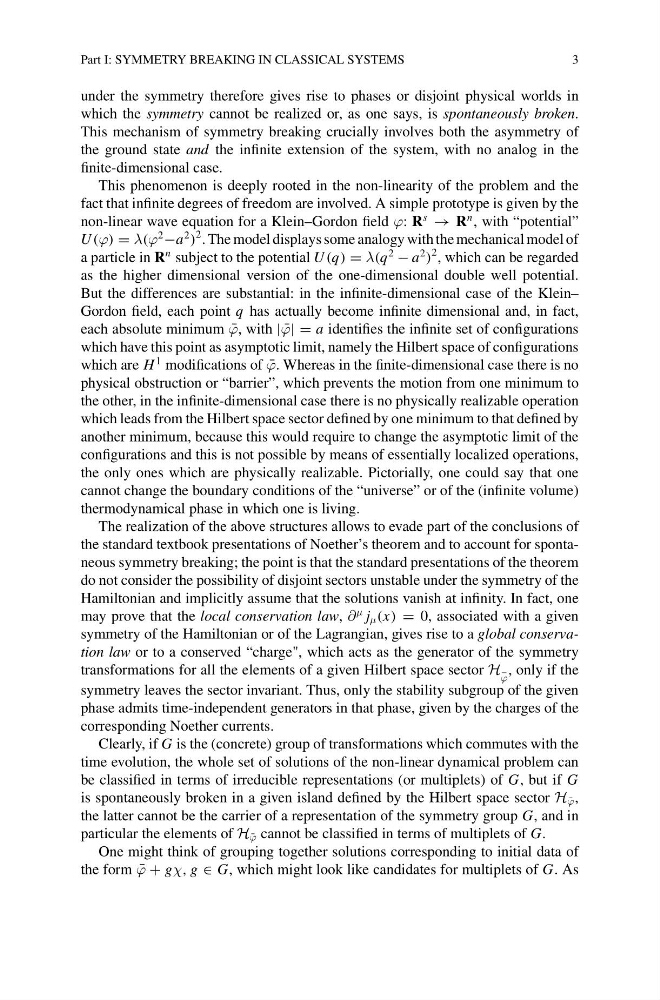
Part I: SYMMETRY BREAKING IN CLASSICAL SYSTEMS
3
under the symmetry therefore gives rise to phases or disjoint physical worlds in
which the symmetry cannot be realized or, as one says, is spontaneously broken.
This mechanism of symmetry breaking crucially involves both the asymmetry of
the ground state and the infinite extension of the system, with no analog in the
finite-dimensional case.
This phenomenon is deeply rooted in the non-linearity of the problem and the
fact that infinite degrees of freedom are involved. A simple prototype is given by the
non-linear wave equation for a Klein–Gordon field ϕ: R
s
→ R
n , with “potential”
U (ϕ) = λ(ϕ
2
−a
2
)
2 . The model displays some analogy with the mechanical model of
a particle in R
n subject to the potential U (q) = λ(q
2
− a
2
)
2 , which can be regarded
as the higher dimensional version of the one-dimensional double well potential.
But the differences are substantial: in the infinite-dimensional case of the Klein–
Gordon field, each point q has actually become infinite dimensional and, in fact,
each absolute minimum ¯
ϕ, with | ¯
ϕ| = a identifies the infinite set of configurations
which have this point as asymptotic limit, namely the Hilbert space of configurations
which are H
1 modifications of ¯
ϕ. Whereas in the finite-dimensional case there is no
physical obstruction or “barrier”, which prevents the motion from one minimum to
the other, in the infinite-dimensional case there is no physically realizable operation
which leads from the Hilbert space sector defined by one minimum to that defined by
another minimum, because this would require to change the asymptotic limit of the
configurations and this is not possible by means of essentially localized operations,
the only ones which are physically realizable. Pictorially, one could say that one
cannot change the boundary conditions of the “universe” or of the (infinite volume)
thermodynamical phase in which one is living.
The realization of the above structures allows to evade part of the conclusions of
the standard textbook presentations of Noether’s theorem and to account for spontaneous symmetry breaking; the point is that the standard presentations of the theorem
do not consider the possibility of disjoint sectors unstable under the symmetry of the
Hamiltonian and implicitly assume that the solutions vanish at infinity. In fact, one
may prove that the local conservation law, ∂
μ j μ (x) = 0, associated with a given
symmetry of the Hamiltonian or of the Lagrangian, gives rise to a global conservation law or to a conserved “charge", which acts as the generator of the symmetry
transformations for all the elements of a given Hilbert space sector H− ϕ , only if the
symmetry leaves the sector invariant. Thus, only the stability subgroup of the given
phase admits time-independent generators in that phase, given by the charges of the
corresponding Noether currents.
Clearly, if G is the (concrete) group of transformations which commutes with the
time evolution, the whole set of solutions of the non-linear dynamical problem can
be classified in terms of irreducible representations (or multiplets) of G, but if G
is spontaneously broken in a given island defined by the Hilbert space sector H ¯
ϕ ,
the latter cannot be the carrier of a representation of the symmetry group G, and in
particular the elements of H ¯
ϕ cannot be classified in terms of multiplets of G.
One might think of grouping together solutions corresponding to initial data of
the form ¯
ϕ + gχ, g ∈ G, which might look like candidates for multiplets of G. As
3
under the symmetry therefore gives rise to phases or disjoint physical worlds in
which the symmetry cannot be realized or, as one says, is spontaneously broken.
This mechanism of symmetry breaking crucially involves both the asymmetry of
the ground state and the infinite extension of the system, with no analog in the
finite-dimensional case.
This phenomenon is deeply rooted in the non-linearity of the problem and the
fact that infinite degrees of freedom are involved. A simple prototype is given by the
non-linear wave equation for a Klein–Gordon field ϕ: R
s
→ R
n , with “potential”
U (ϕ) = λ(ϕ
2
−a
2
)
2 . The model displays some analogy with the mechanical model of
a particle in R
n subject to the potential U (q) = λ(q
2
− a
2
)
2 , which can be regarded
as the higher dimensional version of the one-dimensional double well potential.
But the differences are substantial: in the infinite-dimensional case of the Klein–
Gordon field, each point q has actually become infinite dimensional and, in fact,
each absolute minimum ¯
ϕ, with | ¯
ϕ| = a identifies the infinite set of configurations
which have this point as asymptotic limit, namely the Hilbert space of configurations
which are H
1 modifications of ¯
ϕ. Whereas in the finite-dimensional case there is no
physical obstruction or “barrier”, which prevents the motion from one minimum to
the other, in the infinite-dimensional case there is no physically realizable operation
which leads from the Hilbert space sector defined by one minimum to that defined by
another minimum, because this would require to change the asymptotic limit of the
configurations and this is not possible by means of essentially localized operations,
the only ones which are physically realizable. Pictorially, one could say that one
cannot change the boundary conditions of the “universe” or of the (infinite volume)
thermodynamical phase in which one is living.
The realization of the above structures allows to evade part of the conclusions of
the standard textbook presentations of Noether’s theorem and to account for spontaneous symmetry breaking; the point is that the standard presentations of the theorem
do not consider the possibility of disjoint sectors unstable under the symmetry of the
Hamiltonian and implicitly assume that the solutions vanish at infinity. In fact, one
may prove that the local conservation law, ∂
μ j μ (x) = 0, associated with a given
symmetry of the Hamiltonian or of the Lagrangian, gives rise to a global conservation law or to a conserved “charge", which acts as the generator of the symmetry
transformations for all the elements of a given Hilbert space sector H− ϕ , only if the
symmetry leaves the sector invariant. Thus, only the stability subgroup of the given
phase admits time-independent generators in that phase, given by the charges of the
corresponding Noether currents.
Clearly, if G is the (concrete) group of transformations which commutes with the
time evolution, the whole set of solutions of the non-linear dynamical problem can
be classified in terms of irreducible representations (or multiplets) of G, but if G
is spontaneously broken in a given island defined by the Hilbert space sector H ¯
ϕ ,
the latter cannot be the carrier of a representation of the symmetry group G, and in
particular the elements of H ¯
ϕ cannot be classified in terms of multiplets of G.
One might think of grouping together solutions corresponding to initial data of
the form ¯
ϕ + gχ, g ∈ G, which might look like candidates for multiplets of G. As