

148
22 ∗ Thermal States
22.1 Gibbs States and KMS Condition
According to the principles of quantum statistical mechanics,
122 the equilibrium
states of a system in a finite volume V are described by density matrices. For the
description of a system in terms of Gibbs canonical ensemble (fixed number of particles), the equilibrium states are given by the following expectations, for any bounded
operator A,
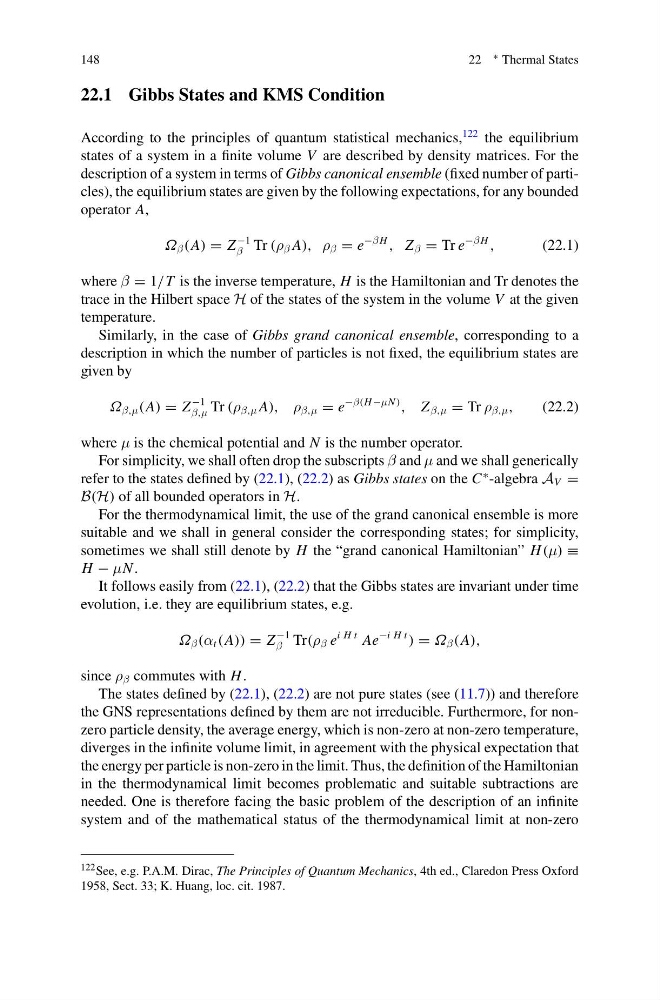
Ω β (A) = Z
−1
β Tr (ρ β A), ρ β = e
−β H
, Z β = Tr e
−β H
,
(22.1)
where β = 1/T is the inverse temperature, H is the Hamiltonian and Tr denotes the
trace in the Hilbert space H of the states of the system in the volume V at the given
temperature.
Similarly, in the case of Gibbs grand canonical ensemble, corresponding to a
description in which the number of particles is not fixed, the equilibrium states are
given by
Ω β,μ (A) = Z
−1
β,μ Tr (ρ β,μ A), ρ β,μ = e
−β(H −μN )
, Z β,μ = Tr ρ β,μ ,
(22.2)
where μ is the chemical potential and N is the number operator.
For simplicity, we shall often drop the subscripts β and μ and we shall generically
refer to the states defined by (22.1), (22.2) as Gibbs states on the C
∗ -algebra A V =
B(H) of all bounded operators in H.
For the thermodynamical limit, the use of the grand canonical ensemble is more
suitable and we shall in general consider the corresponding states; for simplicity,
sometimes we shall still denote by H the “grand canonical Hamiltonian” H (μ) ≡
H − μN .
It follows easily from (22.1), (22.2) that the Gibbs states are invariant under time
evolution, i.e. they are equilibrium states, e.g.
Ω β (α t (A)) = Z
−1
β Tr(ρ β e
i H t Ae
−i H t
) = Ω β (A),
since ρ β commutes with H .
The states defined by (22.1), (22.2) are not pure states (see (11.7)) and therefore
the GNS representations defined by them are not irreducible. Furthermore, for nonzero particle density, the average energy, which is non-zero at non-zero temperature,
diverges in the infinite volume limit, in agreement with the physical expectation that
the energy per particle is non-zero in the limit. Thus, the definition of the Hamiltonian
in the thermodynamical limit becomes problematic and suitable subtractions are
needed. One is therefore facing the basic problem of the description of an infinite
system and of the mathematical status of the thermodynamical limit at non-zero
122 See, e.g. P.A.M. Dirac, The Principles of Quantum Mechanics, 4th ed., Claredon Press Oxford
1958, Sect. 33; K. Huang, loc. cit. 1987.
22 ∗ Thermal States
22.1 Gibbs States and KMS Condition
According to the principles of quantum statistical mechanics,
122 the equilibrium
states of a system in a finite volume V are described by density matrices. For the
description of a system in terms of Gibbs canonical ensemble (fixed number of particles), the equilibrium states are given by the following expectations, for any bounded
operator A,
Ω β (A) = Z
−1
β Tr (ρ β A), ρ β = e
−β H
, Z β = Tr e
−β H
,
(22.1)
where β = 1/T is the inverse temperature, H is the Hamiltonian and Tr denotes the
trace in the Hilbert space H of the states of the system in the volume V at the given
temperature.
Similarly, in the case of Gibbs grand canonical ensemble, corresponding to a
description in which the number of particles is not fixed, the equilibrium states are
given by
Ω β,μ (A) = Z
−1
β,μ Tr (ρ β,μ A), ρ β,μ = e
−β(H −μN )
, Z β,μ = Tr ρ β,μ ,
(22.2)
where μ is the chemical potential and N is the number operator.
For simplicity, we shall often drop the subscripts β and μ and we shall generically
refer to the states defined by (22.1), (22.2) as Gibbs states on the C
∗ -algebra A V =
B(H) of all bounded operators in H.
For the thermodynamical limit, the use of the grand canonical ensemble is more
suitable and we shall in general consider the corresponding states; for simplicity,
sometimes we shall still denote by H the “grand canonical Hamiltonian” H (μ) ≡
H − μN .
It follows easily from (22.1), (22.2) that the Gibbs states are invariant under time
evolution, i.e. they are equilibrium states, e.g.
Ω β (α t (A)) = Z
−1
β Tr(ρ β e
i H t Ae
−i H t
) = Ω β (A),
since ρ β commutes with H .
The states defined by (22.1), (22.2) are not pure states (see (11.7)) and therefore
the GNS representations defined by them are not irreducible. Furthermore, for nonzero particle density, the average energy, which is non-zero at non-zero temperature,
diverges in the infinite volume limit, in agreement with the physical expectation that
the energy per particle is non-zero in the limit. Thus, the definition of the Hamiltonian
in the thermodynamical limit becomes problematic and suitable subtractions are
needed. One is therefore facing the basic problem of the description of an infinite
system and of the mathematical status of the thermodynamical limit at non-zero
122 See, e.g. P.A.M. Dirac, The Principles of Quantum Mechanics, 4th ed., Claredon Press Oxford
1958, Sect. 33; K. Huang, loc. cit. 1987.