

146
21 Symmetry Breaking in the Ising Model
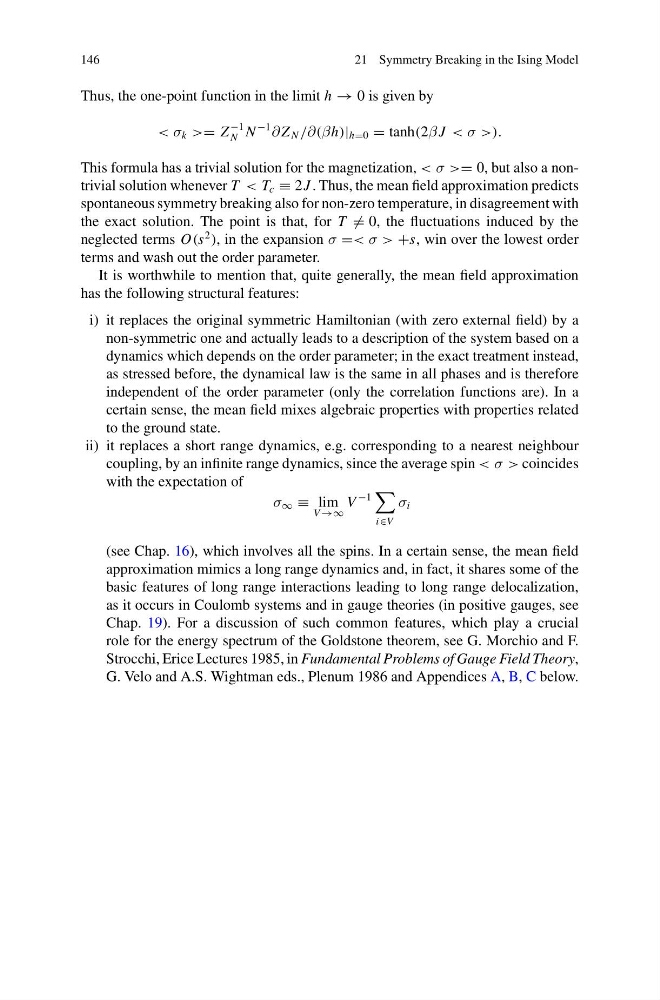
Thus, the one-point function in the limit h → 0 is given by
< σ k >= Z
−1
N N
−1
∂ Z N /∂(βh)| h=0 = tanh(2β J < σ >).
This formula has a trivial solution for the magnetization, < σ >= 0, but also a nontrivial solution whenever T < T c ≡ 2J . Thus, the mean field approximation predicts
spontaneous symmetry breaking also for non-zero temperature, in disagreement with
the exact solution. The point is that, for T = 0, the fluctuations induced by the
neglected terms O(s
2
), in the expansion σ =< σ > +s, win over the lowest order
terms and wash out the order parameter.
It is worthwhile to mention that, quite generally, the mean field approximation
has the following structural features:
i) it replaces the original symmetric Hamiltonian (with zero external field) by a
non-symmetric one and actually leads to a description of the system based on a
dynamics which depends on the order parameter; in the exact treatment instead,
as stressed before, the dynamical law is the same in all phases and is therefore
independent of the order parameter (only the correlation functions are). In a
certain sense, the mean field mixes algebraic properties with properties related
to the ground state.
ii) it replaces a short range dynamics, e.g. corresponding to a nearest neighbour
coupling, by an infinite range dynamics, since the average spin < σ > coincides
with the expectation of
σ ∞ ≡ lim
V →∞
V
−1
i∈V
σ i
(see Chap. 16), which involves all the spins. In a certain sense, the mean field
approximation mimics a long range dynamics and, in fact, it shares some of the
basic features of long range interactions leading to long range delocalization,
as it occurs in Coulomb systems and in gauge theories (in positive gauges, see
Chap. 19). For a discussion of such common features, which play a crucial
role for the energy spectrum of the Goldstone theorem, see G. Morchio and F.
Strocchi, Erice Lectures 1985, in Fundamental Problems of Gauge Field Theory,
G. Velo and A.S. Wightman eds., Plenum 1986 and Appendices A, B, C below.
21 Symmetry Breaking in the Ising Model
Thus, the one-point function in the limit h → 0 is given by
< σ k >= Z
−1
N N
−1
∂ Z N /∂(βh)| h=0 = tanh(2β J < σ >).
This formula has a trivial solution for the magnetization, < σ >= 0, but also a nontrivial solution whenever T < T c ≡ 2J . Thus, the mean field approximation predicts
spontaneous symmetry breaking also for non-zero temperature, in disagreement with
the exact solution. The point is that, for T = 0, the fluctuations induced by the
neglected terms O(s
2
), in the expansion σ =< σ > +s, win over the lowest order
terms and wash out the order parameter.
It is worthwhile to mention that, quite generally, the mean field approximation
has the following structural features:
i) it replaces the original symmetric Hamiltonian (with zero external field) by a
non-symmetric one and actually leads to a description of the system based on a
dynamics which depends on the order parameter; in the exact treatment instead,
as stressed before, the dynamical law is the same in all phases and is therefore
independent of the order parameter (only the correlation functions are). In a
certain sense, the mean field mixes algebraic properties with properties related
to the ground state.
ii) it replaces a short range dynamics, e.g. corresponding to a nearest neighbour
coupling, by an infinite range dynamics, since the average spin < σ > coincides
with the expectation of
σ ∞ ≡ lim
V →∞
V
−1
i∈V
σ i
(see Chap. 16), which involves all the spins. In a certain sense, the mean field
approximation mimics a long range dynamics and, in fact, it shares some of the
basic features of long range interactions leading to long range delocalization,
as it occurs in Coulomb systems and in gauge theories (in positive gauges, see
Chap. 19). For a discussion of such common features, which play a crucial
role for the energy spectrum of the Goldstone theorem, see G. Morchio and F.
Strocchi, Erice Lectures 1985, in Fundamental Problems of Gauge Field Theory,
G. Velo and A.S. Wightman eds., Plenum 1986 and Appendices A, B, C below.