

21 Symmetry Breaking in the Ising Model
141
All the correlation functions are γ symmetric (see (20.5)). In fact, by a change of
variables (σ → σ
= −σ) one has, ∀β,
< σ k 1 . . . σ k n > N = Z
−1
N
σ
σ k 1 . . . σ k n e
β J Σ
N −1
i=1 σ i σ i+1 =
Z
−1
N
(−1)
n
σ
k 1
. . . σ
k n
e
β J Σ
N −1
i=1 σ
i σ
i+1 = (−1)
n
< σ k 1 . . . σ k n > N .
Thus, all the correlation functions of an odd number of spins vanish, i.e. all the
correlation functions are symmetric. To say something on symmetry breaking, one
has to control what happens in the pure phases, i.e. one must check the cluster property
in the thermodynamical limit.
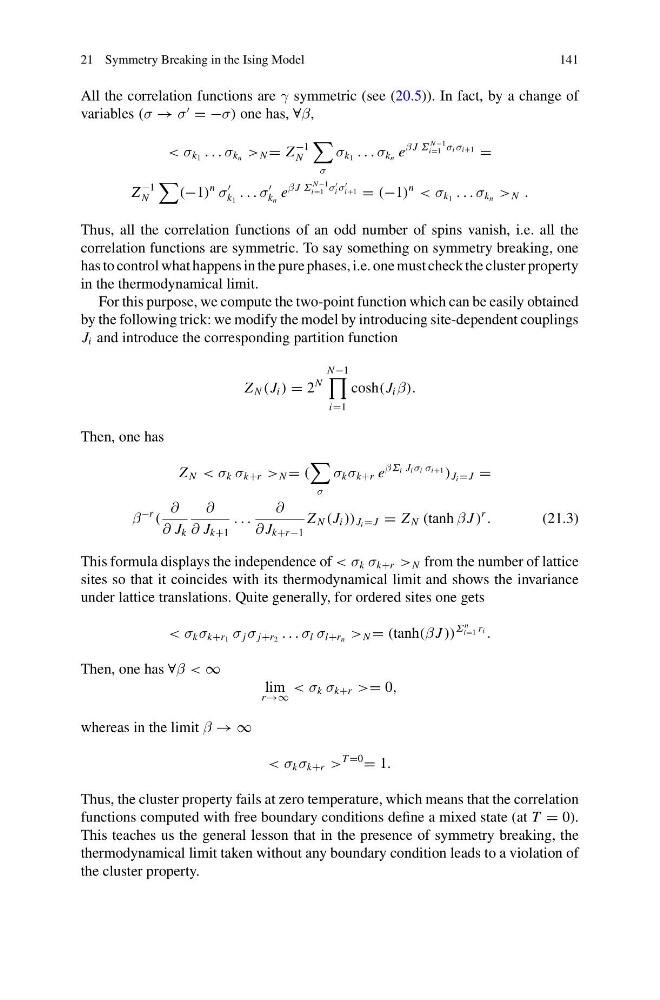
For this purpose, we compute the two-point function which can be easily obtained
by the following trick: we modify the model by introducing site-dependent couplings
J i and introduce the corresponding partition function
Z N (J i ) = 2
N
N −1
i=1
cosh(J i β).
Then, one has
Z N < σ k σ k+r > N = (
σ
σ k σ k+r e
βΣ i J i σ i σ i+1 ) J i =J =
β
−r
(
∂
∂ J k
∂
∂ J k+1
. . .
∂
∂ J k+r −1
Z N (J i )) J i =J = Z N (tanh β J )
r
.
(21.3)
This formula displays the independence of < σ k σ k+r > N from the number of lattice
sites so that it coincides with its thermodynamical limit and shows the invariance
under lattice translations. Quite generally, for ordered sites one gets
< σ k σ k+r 1 σ j σ j+r 2 . . . σ l σ l+r n > N = (tanh(β J ))
Σ
n
i=1 r i .
Then, one has ∀β < ∞
lim
r →∞
< σ k σ k+r >= 0,
whereas in the limit β → ∞
< σ k σ k+r >
T =0
= 1.
Thus, the cluster property fails at zero temperature, which means that the correlation
functions computed with free boundary conditions define a mixed state (at T = 0).
This teaches us the general lesson that in the presence of symmetry breaking, the
thermodynamical limit taken without any boundary condition leads to a violation of
the cluster property.
141
All the correlation functions are γ symmetric (see (20.5)). In fact, by a change of
variables (σ → σ
= −σ) one has, ∀β,
< σ k 1 . . . σ k n > N = Z
−1
N
σ
σ k 1 . . . σ k n e
β J Σ
N −1
i=1 σ i σ i+1 =
Z
−1
N
(−1)
n
σ
k 1
. . . σ
k n
e
β J Σ
N −1
i=1 σ
i σ
i+1 = (−1)
n
< σ k 1 . . . σ k n > N .
Thus, all the correlation functions of an odd number of spins vanish, i.e. all the
correlation functions are symmetric. To say something on symmetry breaking, one
has to control what happens in the pure phases, i.e. one must check the cluster property
in the thermodynamical limit.
For this purpose, we compute the two-point function which can be easily obtained
by the following trick: we modify the model by introducing site-dependent couplings
J i and introduce the corresponding partition function
Z N (J i ) = 2
N
N −1
i=1
cosh(J i β).
Then, one has
Z N < σ k σ k+r > N = (
σ
σ k σ k+r e
βΣ i J i σ i σ i+1 ) J i =J =
β
−r
(
∂
∂ J k
∂
∂ J k+1
. . .
∂
∂ J k+r −1
Z N (J i )) J i =J = Z N (tanh β J )
r
.
(21.3)
This formula displays the independence of < σ k σ k+r > N from the number of lattice
sites so that it coincides with its thermodynamical limit and shows the invariance
under lattice translations. Quite generally, for ordered sites one gets
< σ k σ k+r 1 σ j σ j+r 2 . . . σ l σ l+r n > N = (tanh(β J ))
Σ
n
i=1 r i .
Then, one has ∀β < ∞
lim
r →∞
< σ k σ k+r >= 0,
whereas in the limit β → ∞
< σ k σ k+r >
T =0
= 1.
Thus, the cluster property fails at zero temperature, which means that the correlation
functions computed with free boundary conditions define a mixed state (at T = 0).
This teaches us the general lesson that in the presence of symmetry breaking, the
thermodynamical limit taken without any boundary condition leads to a violation of
the cluster property.