

20 Constructive Symmetry Breaking
135
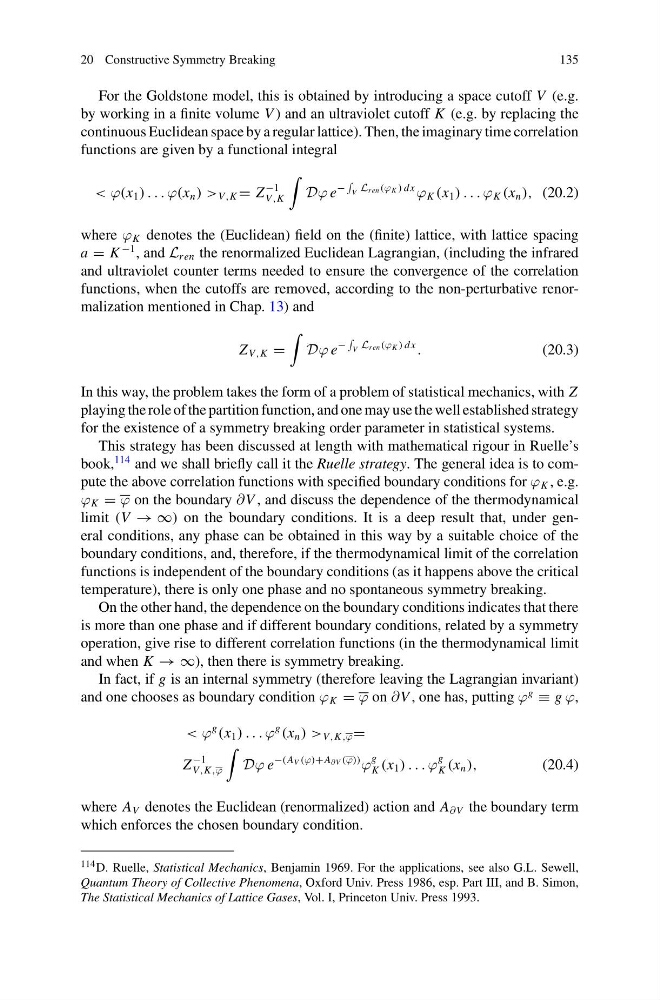
For the Goldstone model, this is obtained by introducing a space cutoff V (e.g.
by working in a finite volume V ) and an ultraviolet cutoff K (e.g. by replacing the
continuous Euclidean space by a regular lattice). Then, the imaginary time correlation
functions are given by a functional integral
< ϕ(x 1 ) . . . ϕ(x n ) > V,K = Z
−1
V,K
Dϕ e
−
V L ren (ϕ K ) dx
ϕ K (x 1 ) . . . ϕ K (x n ), (20.2)
where ϕ K denotes the (Euclidean) field on the (finite) lattice, with lattice spacing
a = K
−1 , and L ren the renormalized Euclidean Lagrangian, (including the infrared
and ultraviolet counter terms needed to ensure the convergence of the correlation
functions, when the cutoffs are removed, according to the non-perturbative renormalization mentioned in Chap. 13) and
Z V,K =
Dϕ e
−
V L ren (ϕ K ) dx
.
(20.3)
In this way, the problem takes the form of a problem of statistical mechanics, with Z
playing the role of the partition function, and one may use the well established strategy
for the existence of a symmetry breaking order parameter in statistical systems.
This strategy has been discussed at length with mathematical rigour in Ruelle’s
book,
114 and we shall briefly call it the Ruelle strategy. The general idea is to compute the above correlation functions with specified boundary conditions for ϕ K , e.g.
ϕ K = ϕ on the boundary ∂V , and discuss the dependence of the thermodynamical
limit (V → ∞) on the boundary conditions. It is a deep result that, under general conditions, any phase can be obtained in this way by a suitable choice of the
boundary conditions, and, therefore, if the thermodynamical limit of the correlation
functions is independent of the boundary conditions (as it happens above the critical
temperature), there is only one phase and no spontaneous symmetry breaking.
On the other hand, the dependence on the boundary conditions indicates that there
is more than one phase and if different boundary conditions, related by a symmetry
operation, give rise to different correlation functions (in the thermodynamical limit
and when K → ∞), then there is symmetry breaking.
In fact, if g is an internal symmetry (therefore leaving the Lagrangian invariant)
and one chooses as boundary condition ϕ K = ϕ on ∂V , one has, putting ϕ
g
≡ g ϕ,
< ϕ
g
(x 1 ) . . . ϕ
g
(x n ) > V,K ,ϕ =
Z
−1
V,K ,ϕ
Dϕ e
−(A V (ϕ)+A ∂V (ϕ))
ϕ
g
K (x 1 ) . . . ϕ
g
K (x n ),
(20.4)
where A V denotes the Euclidean (renormalized) action and A ∂V the boundary term
which enforces the chosen boundary condition.
114 D. Ruelle, Statistical Mechanics, Benjamin 1969. For the applications, see also G.L. Sewell,
Quantum Theory of Collective Phenomena, Oxford Univ. Press 1986, esp. Part III, and B. Simon,
The Statistical Mechanics of Lattice Gases, Vol. I, Princeton Univ. Press 1993.
135
For the Goldstone model, this is obtained by introducing a space cutoff V (e.g.
by working in a finite volume V ) and an ultraviolet cutoff K (e.g. by replacing the
continuous Euclidean space by a regular lattice). Then, the imaginary time correlation
functions are given by a functional integral
< ϕ(x 1 ) . . . ϕ(x n ) > V,K = Z
−1
V,K
Dϕ e
−
V L ren (ϕ K ) dx
ϕ K (x 1 ) . . . ϕ K (x n ), (20.2)
where ϕ K denotes the (Euclidean) field on the (finite) lattice, with lattice spacing
a = K
−1 , and L ren the renormalized Euclidean Lagrangian, (including the infrared
and ultraviolet counter terms needed to ensure the convergence of the correlation
functions, when the cutoffs are removed, according to the non-perturbative renormalization mentioned in Chap. 13) and
Z V,K =
Dϕ e
−
V L ren (ϕ K ) dx
.
(20.3)
In this way, the problem takes the form of a problem of statistical mechanics, with Z
playing the role of the partition function, and one may use the well established strategy
for the existence of a symmetry breaking order parameter in statistical systems.
This strategy has been discussed at length with mathematical rigour in Ruelle’s
book,
114 and we shall briefly call it the Ruelle strategy. The general idea is to compute the above correlation functions with specified boundary conditions for ϕ K , e.g.
ϕ K = ϕ on the boundary ∂V , and discuss the dependence of the thermodynamical
limit (V → ∞) on the boundary conditions. It is a deep result that, under general conditions, any phase can be obtained in this way by a suitable choice of the
boundary conditions, and, therefore, if the thermodynamical limit of the correlation
functions is independent of the boundary conditions (as it happens above the critical
temperature), there is only one phase and no spontaneous symmetry breaking.
On the other hand, the dependence on the boundary conditions indicates that there
is more than one phase and if different boundary conditions, related by a symmetry
operation, give rise to different correlation functions (in the thermodynamical limit
and when K → ∞), then there is symmetry breaking.
In fact, if g is an internal symmetry (therefore leaving the Lagrangian invariant)
and one chooses as boundary condition ϕ K = ϕ on ∂V , one has, putting ϕ
g
≡ g ϕ,
< ϕ
g
(x 1 ) . . . ϕ
g
(x n ) > V,K ,ϕ =
Z
−1
V,K ,ϕ
Dϕ e
−(A V (ϕ)+A ∂V (ϕ))
ϕ
g
K (x 1 ) . . . ϕ
g
K (x n ),
(20.4)
where A V denotes the Euclidean (renormalized) action and A ∂V the boundary term
which enforces the chosen boundary condition.
114 D. Ruelle, Statistical Mechanics, Benjamin 1969. For the applications, see also G.L. Sewell,
Quantum Theory of Collective Phenomena, Oxford Univ. Press 1986, esp. Part III, and B. Simon,
The Statistical Mechanics of Lattice Gases, Vol. I, Princeton Univ. Press 1993.