

128
18 Symmetry Breaking in Quantum Systems
the non-invariance of a ground state ω implies the asymmetry of the corresponding
physical world Γ ω defined by it.
The above criterion of spontaneous symmetry breaking crucially relies on the
uniqueness of the translationally invariant state and therefore it applies to pure phases.
Symmetric correlation functions defined by a mixed state do not imply that the
symmetry is unbroken in the pure phases in which the theory (defined by such
correlation functions) decomposes. The check of the symmetry of the correlation
functions should then be accompanied by the check of the cluster property.
The criterion of Proposition 18.2 also holds if β is only assumed to commute with
the time translations, π is irreducible, satisfies conditions I, II, III i) of Chapter 5 and,
instead of III ii), the uniqueness of the state invariant under time translations.
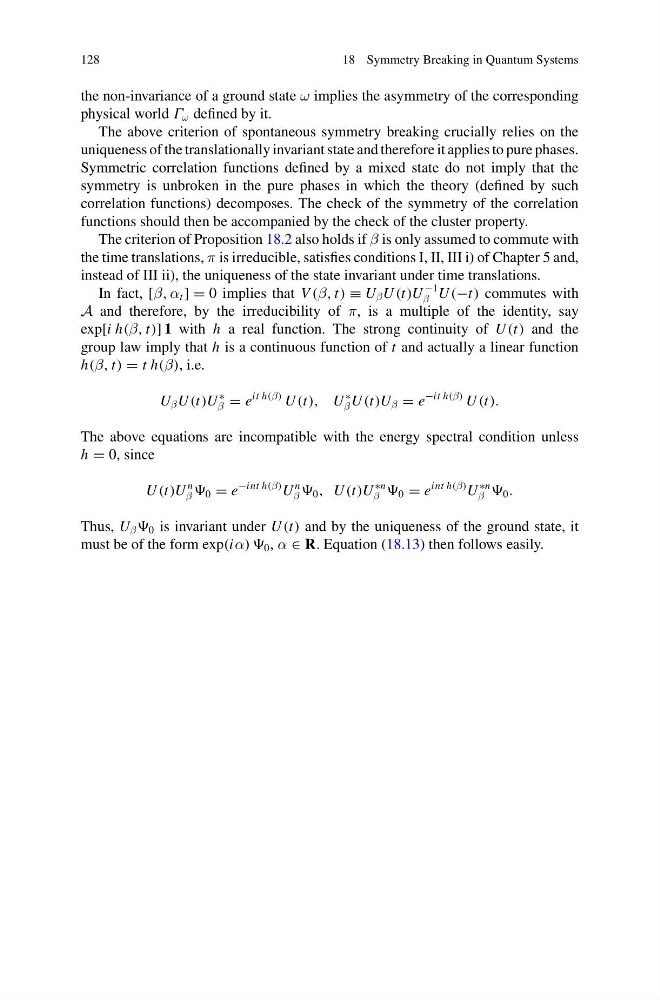
In fact, [β, α t ] = 0 implies that V (β, t) ≡ U β U (t)U
−1
β U (−t) commutes with
A and therefore, by the irreducibility of π, is a multiple of the identity, say
exp[i h(β, t)] 1 with h a real function. The strong continuity of U (t) and the
group law imply that h is a continuous function of t and actually a linear function
h(β, t) = t h(β), i.e.
U β U (t)U
∗
β = e
it h(β) U (t), U
∗
β U (t)U β = e
−it h(β) U (t).
The above equations are incompatible with the energy spectral condition unless
h = 0, since
U (t)U
n
β 0 = e
−int h(β) U
n
β 0 , U (t)U
∗n
β 0 = e
int h(β) U
∗n
β 0 .
Thus, U β 0 is invariant under U (t) and by the uniqueness of the ground state, it
must be of the form exp(iα) ) 0 , α ∈ R. Equation (18.13) then follows easily.
18 Symmetry Breaking in Quantum Systems
the non-invariance of a ground state ω implies the asymmetry of the corresponding
physical world Γ ω defined by it.
The above criterion of spontaneous symmetry breaking crucially relies on the
uniqueness of the translationally invariant state and therefore it applies to pure phases.
Symmetric correlation functions defined by a mixed state do not imply that the
symmetry is unbroken in the pure phases in which the theory (defined by such
correlation functions) decomposes. The check of the symmetry of the correlation
functions should then be accompanied by the check of the cluster property.
The criterion of Proposition 18.2 also holds if β is only assumed to commute with
the time translations, π is irreducible, satisfies conditions I, II, III i) of Chapter 5 and,
instead of III ii), the uniqueness of the state invariant under time translations.
In fact, [β, α t ] = 0 implies that V (β, t) ≡ U β U (t)U
−1
β U (−t) commutes with
A and therefore, by the irreducibility of π, is a multiple of the identity, say
exp[i h(β, t)] 1 with h a real function. The strong continuity of U (t) and the
group law imply that h is a continuous function of t and actually a linear function
h(β, t) = t h(β), i.e.
U β U (t)U
∗
β = e
it h(β) U (t), U
∗
β U (t)U β = e
−it h(β) U (t).
The above equations are incompatible with the energy spectral condition unless
h = 0, since
U (t)U
n
β 0 = e
−int h(β) U
n
β 0 , U (t)U
∗n
β 0 = e
int h(β) U
∗n
β 0 .
Thus, U β 0 is invariant under U (t) and by the uniqueness of the ground state, it
must be of the form exp(iα) ) 0 , α ∈ R. Equation (18.13) then follows easily.