

17.3 ∗ Appendix: The Infinite Volume Dynamics for Short-Range Spin Interactions
119
=
n−1
m=0
[U Φ 1 (V ), . . . [U Φ 1 −Φ (V ), [U Φ (V ), . . . A]
m
] ]
n−m−1
,
(17.14)
where U Φ 1 (V ) ≡
X ⊂V Φ 1 (V ),
[U Φ , . . . A]
m
≡ [U Φ , [U Φ , A]
m−1
], [U Φ , A]
1
= [U Φ , A].
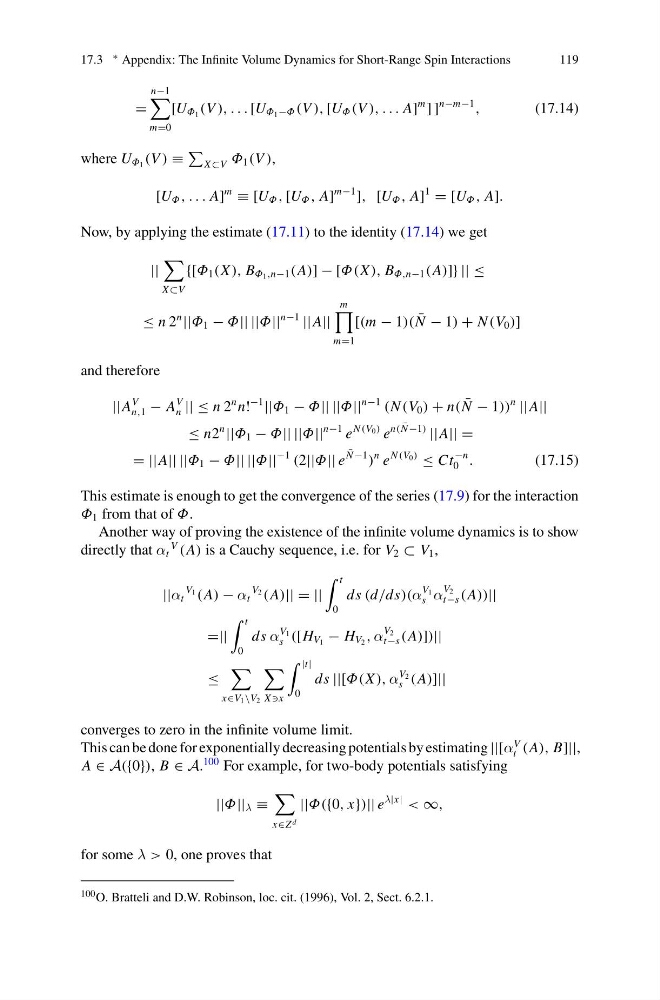
Now, by applying the estimate (17.11) to the identity (17.14) we get
||
X ⊂V
{[Φ 1 (X ), B Φ 1 ,n−1 (A)] − [Φ(X ), B Φ,n−1 (A)]} || ≤
≤ n 2
n
||Φ 1 − Φ|| ||Φ||
n−1
||A||
m
m=1
[(m − 1)( ¯
N − 1) + N (V 0 )]
and therefore
||A
V
n,1 − A
V
n || ≤ n 2
n n!
−1
||Φ 1 − Φ|| ||Φ||
n−1
(N (V 0 ) + n( ¯
N − 1))
n
||A||
≤ n2
n
||Φ 1 − Φ|| ||Φ||
n−1 e
N (V 0 ) e
n( ¯
N −1)
||A|| =
= ||A|| ||Φ 1 − Φ|| ||Φ||
−1
(2||Φ|| e
¯
N −1
)
n e
N (V 0 )
≤ Ct
−n
0 .
(17.15)
This estimate is enough to get the convergence of the series (17.9) for the interaction
Φ 1 from that of Φ.
Another way of proving the existence of the infinite volume dynamics is to show
directly that α t
V
(A) is a Cauchy sequence, i.e. for V 2 ⊂ V 1 ,
||α t
V 1 (A) − α t
V 2 (A)|| = ||
t
0
ds (d/ds)(α
V 1
s α
V 2
t−s (A))||
=||
t
0
ds α
V 1
s ([H V 1 − H V 2 , α
V 2
t−s (A)])||
≤
x∈V 1 \V 2
X x
|t|
0
ds ||[Φ(X ), α
V 2
s (A)]||
converges to zero in the infinite volume limit.
This can be done for exponentially decreasing potentials by estimating ||[α
V
t (A), B]||,
A ∈ A({0}), B ∈ A.
100 For example, for two-body potentials satisfying
||Φ|| λ ≡
x∈Z d
||Φ({0, x})|| e
λ|x|
< ∞,
for some λ > 0, one proves that
100 O. Bratteli and D.W. Robinson, loc. cit. (1996), Vol. 2, Sect. 6.2.1.
119
=
n−1
m=0
[U Φ 1 (V ), . . . [U Φ 1 −Φ (V ), [U Φ (V ), . . . A]
m
] ]
n−m−1
,
(17.14)
where U Φ 1 (V ) ≡
X ⊂V Φ 1 (V ),
[U Φ , . . . A]
m
≡ [U Φ , [U Φ , A]
m−1
], [U Φ , A]
1
= [U Φ , A].
Now, by applying the estimate (17.11) to the identity (17.14) we get
||
X ⊂V
{[Φ 1 (X ), B Φ 1 ,n−1 (A)] − [Φ(X ), B Φ,n−1 (A)]} || ≤
≤ n 2
n
||Φ 1 − Φ|| ||Φ||
n−1
||A||
m
m=1
[(m − 1)( ¯
N − 1) + N (V 0 )]
and therefore
||A
V
n,1 − A
V
n || ≤ n 2
n n!
−1
||Φ 1 − Φ|| ||Φ||
n−1
(N (V 0 ) + n( ¯
N − 1))
n
||A||
≤ n2
n
||Φ 1 − Φ|| ||Φ||
n−1 e
N (V 0 ) e
n( ¯
N −1)
||A|| =
= ||A|| ||Φ 1 − Φ|| ||Φ||
−1
(2||Φ|| e
¯
N −1
)
n e
N (V 0 )
≤ Ct
−n
0 .
(17.15)
This estimate is enough to get the convergence of the series (17.9) for the interaction
Φ 1 from that of Φ.
Another way of proving the existence of the infinite volume dynamics is to show
directly that α t
V
(A) is a Cauchy sequence, i.e. for V 2 ⊂ V 1 ,
||α t
V 1 (A) − α t
V 2 (A)|| = ||
t
0
ds (d/ds)(α
V 1
s α
V 2
t−s (A))||
=||
t
0
ds α
V 1
s ([H V 1 − H V 2 , α
V 2
t−s (A)])||
≤
x∈V 1 \V 2
X x
|t|
0
ds ||[Φ(X ), α
V 2
s (A)]||
converges to zero in the infinite volume limit.
This can be done for exponentially decreasing potentials by estimating ||[α
V
t (A), B]||,
A ∈ A({0}), B ∈ A.
100 For example, for two-body potentials satisfying
||Φ|| λ ≡
x∈Z d
||Φ({0, x})|| e
λ|x|
< ∞,
for some λ > 0, one proves that
100 O. Bratteli and D.W. Robinson, loc. cit. (1996), Vol. 2, Sect. 6.2.1.