

17.2 Free Bose Gas. Bose–Einstein Condensation
113
17.2 Free Bose Gas. Bose–Einstein Condensation
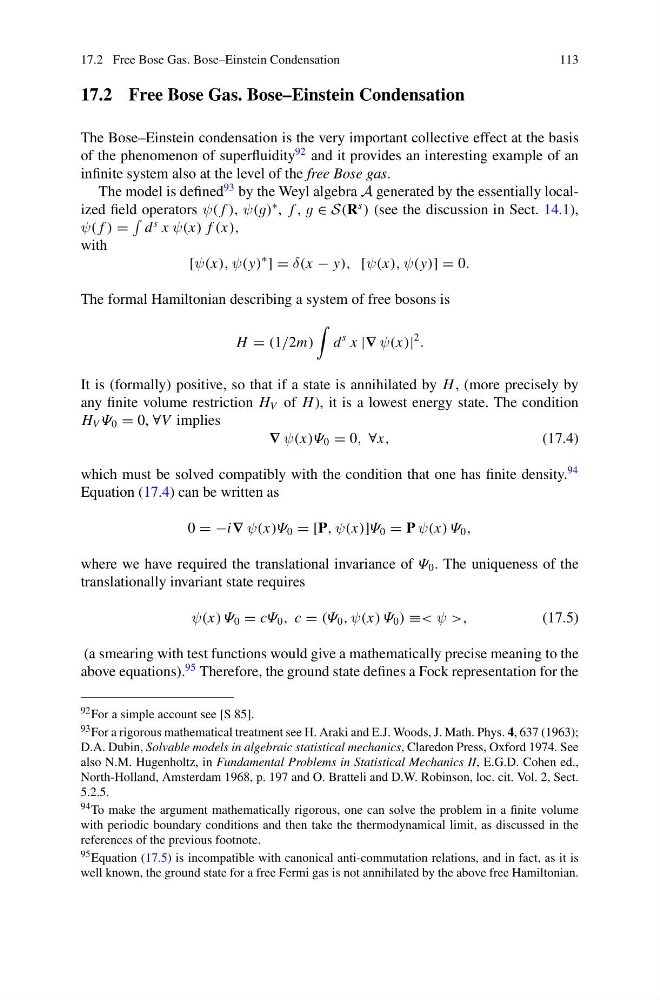
The Bose–Einstein condensation is the very important collective effect at the basis
of the phenomenon of superfluidity
92 and it provides an interesting example of an
infinite system also at the level of the free Bose gas.
The model is defined
93 by the Weyl algebra A generated by the essentially localized field operators ψ( f ), ψ(g)
∗ , f , g ∈ S(R
s
) (see the discussion in Sect. 14.1),
ψ( f ) =
d
s x ψ(x) f (x),
with
[ψ(x), ψ(y)
∗
] = δ(x − y), [ψ(x), ψ(y)] = 0.
The formal Hamiltonian describing a system of free bosons is
H = (1/2m)
d
s x |∇ ψ(x)|
2
.
It is (formally) positive, so that if a state is annihilated by H , (more precisely by
any finite volume restriction H V of H ), it is a lowest energy state. The condition
H V Ψ 0 = 0, ∀V implies
∇ ψ(x)Ψ 0 = 0, ∀x,
(17.4)
which must be solved compatibly with the condition that one has finite density.
94
Equation (17.4) can be written as
0 = −i∇ ψ(x)Ψ 0 = [P, ψ(x)]Ψ 0 = P ψ(x) Ψ 0 ,
where we have required the translational invariance of Ψ 0 . The uniqueness of the
translationally invariant state requires
ψ(x) Ψ 0 = cΨ 0 , c = (Ψ 0 , ψ(x) Ψ 0 ) ≡< ψ >,
(17.5)
(a smearing with test functions would give a mathematically precise meaning to the
above equations).
95 Therefore, the ground state defines a Fock representation for the
92 For a simple account see [S 85].
93 For a rigorous mathematical treatment see H. Araki and E.J. Woods, J. Math. Phys. 4, 637 (1963);
D.A. Dubin, Solvable models in algebraic statistical mechanics, Claredon Press, Oxford 1974. See
also N.M. Hugenholtz, in Fundamental Problems in Statistical Mechanics II, E.G.D. Cohen ed.,
North-Holland, Amsterdam 1968, p. 197 and O. Bratteli and D.W. Robinson, loc. cit. Vol. 2, Sect.
5.2.5.
94 To make the argument mathematically rigorous, one can solve the problem in a finite volume
with periodic boundary conditions and then take the thermodynamical limit, as discussed in the
references of the previous footnote.
95 Equation (17.5) is incompatible with canonical anti-commutation relations, and in fact, as it is
well known, the ground state for a free Fermi gas is not annihilated by the above free Hamiltonian.
113
17.2 Free Bose Gas. Bose–Einstein Condensation
The Bose–Einstein condensation is the very important collective effect at the basis
of the phenomenon of superfluidity
92 and it provides an interesting example of an
infinite system also at the level of the free Bose gas.
The model is defined
93 by the Weyl algebra A generated by the essentially localized field operators ψ( f ), ψ(g)
∗ , f , g ∈ S(R
s
) (see the discussion in Sect. 14.1),
ψ( f ) =
d
s x ψ(x) f (x),
with
[ψ(x), ψ(y)
∗
] = δ(x − y), [ψ(x), ψ(y)] = 0.
The formal Hamiltonian describing a system of free bosons is
H = (1/2m)
d
s x |∇ ψ(x)|
2
.
It is (formally) positive, so that if a state is annihilated by H , (more precisely by
any finite volume restriction H V of H ), it is a lowest energy state. The condition
H V Ψ 0 = 0, ∀V implies
∇ ψ(x)Ψ 0 = 0, ∀x,
(17.4)
which must be solved compatibly with the condition that one has finite density.
94
Equation (17.4) can be written as
0 = −i∇ ψ(x)Ψ 0 = [P, ψ(x)]Ψ 0 = P ψ(x) Ψ 0 ,
where we have required the translational invariance of Ψ 0 . The uniqueness of the
translationally invariant state requires
ψ(x) Ψ 0 = cΨ 0 , c = (Ψ 0 , ψ(x) Ψ 0 ) ≡< ψ >,
(17.5)
(a smearing with test functions would give a mathematically precise meaning to the
above equations).
95 Therefore, the ground state defines a Fock representation for the
92 For a simple account see [S 85].
93 For a rigorous mathematical treatment see H. Araki and E.J. Woods, J. Math. Phys. 4, 637 (1963);
D.A. Dubin, Solvable models in algebraic statistical mechanics, Claredon Press, Oxford 1974. See
also N.M. Hugenholtz, in Fundamental Problems in Statistical Mechanics II, E.G.D. Cohen ed.,
North-Holland, Amsterdam 1968, p. 197 and O. Bratteli and D.W. Robinson, loc. cit. Vol. 2, Sect.
5.2.5.
94 To make the argument mathematically rigorous, one can solve the problem in a finite volume
with periodic boundary conditions and then take the thermodynamical limit, as discussed in the
references of the previous footnote.
95 Equation (17.5) is incompatible with canonical anti-commutation relations, and in fact, as it is
well known, the ground state for a free Fermi gas is not annihilated by the above free Hamiltonian.