

16 Cluster Property and Pure Phases
107
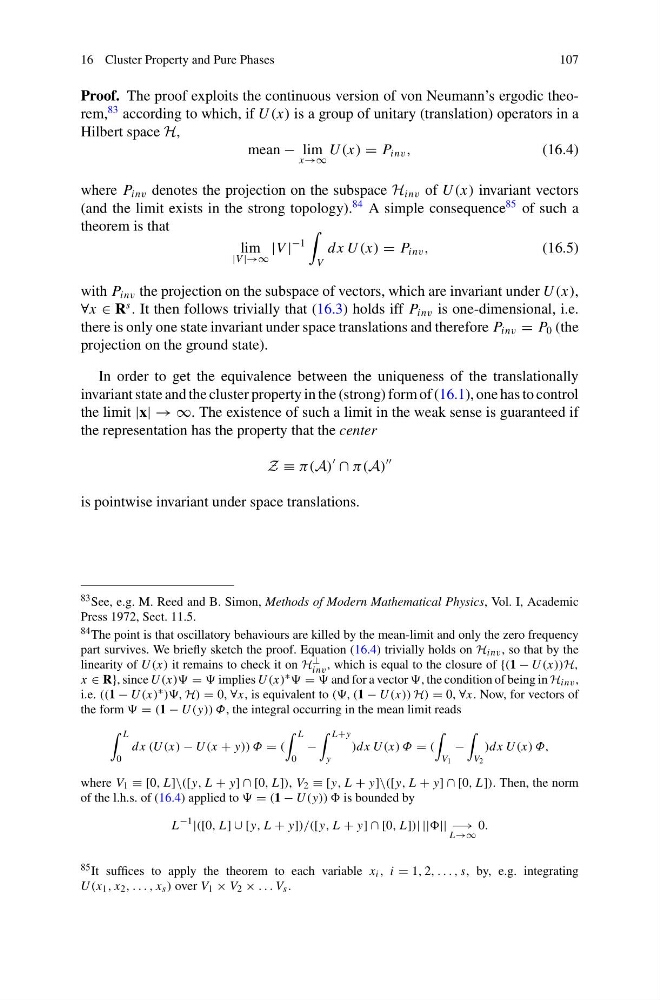
Proof. The proof exploits the continuous version of von Neumann’s ergodic theorem,
83 according to which, if U (x) is a group of unitary (translation) operators in a
Hilbert space H,
mean − lim
x→∞
U (x) = P inv ,
(16.4)
where P inv denotes the projection on the subspace H inv of U (x) invariant vectors
(and the limit exists in the strong topology).
84 A simple consequence
85 of such a
theorem is that
lim
|V |→∞
|V |
−1
V
dx U (x) = P inv ,
(16.5)
with P inv the projection on the subspace of vectors, which are invariant under U (x),
∀x ∈ R
s . It then follows trivially that (16.3) holds iff P inv is one-dimensional, i.e.
there is only one state invariant under space translations and therefore P inv = P 0 (the
projection on the ground state).
In order to get the equivalence between the uniqueness of the translationally
invariant state and the cluster property in the (strong) form of (16.1), one has to control
the limit |x| → ∞. The existence of such a limit in the weak sense is guaranteed if
the representation has the property that the center
Z ≡ π(A)
∩ π(A)
is pointwise invariant under space translations.
83 See, e.g. M. Reed and B. Simon, Methods of Modern Mathematical Physics, Vol. I, Academic
Press 1972, Sect. 11.5.
84 The point is that oscillatory behaviours are killed by the mean-limit and only the zero frequency
part survives. We briefly sketch the proof. Equation (16.4) trivially holds on H inv , so that by the
linearity of U (x) it remains to check it on H ⊥
inv , which is equal to the closure of {(1 − U (x))H,
x ∈ R}, since U (x)) = implies U (x) ∗ = and for a vector , the condition of being in H inv ,
i.e. ((1 − U (x) ∗ )), H) = 0, ∀x, is equivalent to ((, (1 − U (x)) H) = 0, ∀x. Now, for vectors of
the form = (1 − U (y)) Φ, the integral occurring in the mean limit reads
L
0
dx (U (x) − U (x + y)) Φ = (
L
0
−
L+y
y
)dx U (x) Φ = (
V1
−
V2
)dx U (x) Φ,
where V 1 ≡ [0, L]\([y, L + y] ∩ [0, L]), V 2 ≡ [y, L + y]\([y, L + y] ∩ [0, L]). Then, the norm
of the l.h.s. of (16.4) applied to = (1 − U (y)) ) is bounded by
L
−1 |([0, L] ∪ [y, L + y])/([y, L + y] ∩ [0, L])| |||| −→
L→∞
0.
85 It suffices to apply the theorem to each variable x i , i = 1, 2, . . . , s, by, e.g. integrating
U (x 1 , x 2 , . . . , x s ) over V 1 × V 2 × . . . V s .
107
Proof. The proof exploits the continuous version of von Neumann’s ergodic theorem,
83 according to which, if U (x) is a group of unitary (translation) operators in a
Hilbert space H,
mean − lim
x→∞
U (x) = P inv ,
(16.4)
where P inv denotes the projection on the subspace H inv of U (x) invariant vectors
(and the limit exists in the strong topology).
84 A simple consequence
85 of such a
theorem is that
lim
|V |→∞
|V |
−1
V
dx U (x) = P inv ,
(16.5)
with P inv the projection on the subspace of vectors, which are invariant under U (x),
∀x ∈ R
s . It then follows trivially that (16.3) holds iff P inv is one-dimensional, i.e.
there is only one state invariant under space translations and therefore P inv = P 0 (the
projection on the ground state).
In order to get the equivalence between the uniqueness of the translationally
invariant state and the cluster property in the (strong) form of (16.1), one has to control
the limit |x| → ∞. The existence of such a limit in the weak sense is guaranteed if
the representation has the property that the center
Z ≡ π(A)
∩ π(A)
is pointwise invariant under space translations.
83 See, e.g. M. Reed and B. Simon, Methods of Modern Mathematical Physics, Vol. I, Academic
Press 1972, Sect. 11.5.
84 The point is that oscillatory behaviours are killed by the mean-limit and only the zero frequency
part survives. We briefly sketch the proof. Equation (16.4) trivially holds on H inv , so that by the
linearity of U (x) it remains to check it on H ⊥
inv , which is equal to the closure of {(1 − U (x))H,
x ∈ R}, since U (x)) = implies U (x) ∗ = and for a vector , the condition of being in H inv ,
i.e. ((1 − U (x) ∗ )), H) = 0, ∀x, is equivalent to ((, (1 − U (x)) H) = 0, ∀x. Now, for vectors of
the form = (1 − U (y)) Φ, the integral occurring in the mean limit reads
L
0
dx (U (x) − U (x + y)) Φ = (
L
0
−
L+y
y
)dx U (x) Φ = (
V1
−
V2
)dx U (x) Φ,
where V 1 ≡ [0, L]\([y, L + y] ∩ [0, L]), V 2 ≡ [y, L + y]\([y, L + y] ∩ [0, L]). Then, the norm
of the l.h.s. of (16.4) applied to = (1 − U (y)) ) is bounded by
L
−1 |([0, L] ∪ [y, L + y])/([y, L + y] ∩ [0, L])| |||| −→
L→∞
0.
85 It suffices to apply the theorem to each variable x i , i = 1, 2, . . . , s, by, e.g. integrating
U (x 1 , x 2 , . . . , x s ) over V 1 × V 2 × . . . V s .