

98
14 Mathematical Description of Infinitely Extended Quantum Systems
limit in which A is translated at infinite space distance. Clearly, the validity of such
a property for the algebra of observables is a necessary prerequisite for a reasonable
quantum description of the corresponding system; otherwise, the measurement of
the observable B would be influenced by possible measurements of observables at
infinite space distances.
Asymptotic abelianess is obviously satisfied by local relativistic systems since in
the limit |x| → ∞ the localization of A x becomes space-like separated with respect
to any fixed bounded region of space–time, and therefore the vanishing of the commutator is a consequence of Einstein causality.
Asymptotic abelianess is clearly satisfied by the local algebra A L of a nonrelativistic system, as a consequence of (14.1). It also holds for the quasi-local algebra
A defined as the norm closure of A L .
76
As stated in (14.5), asymptotic abelianess is an algebraic property (independent
of the representation); from a physical point of view, it could be enough to require
it to hold only in a class F of physically relevant representations and therefore the
limit could be taken in the weak topology
77 defined by such representations
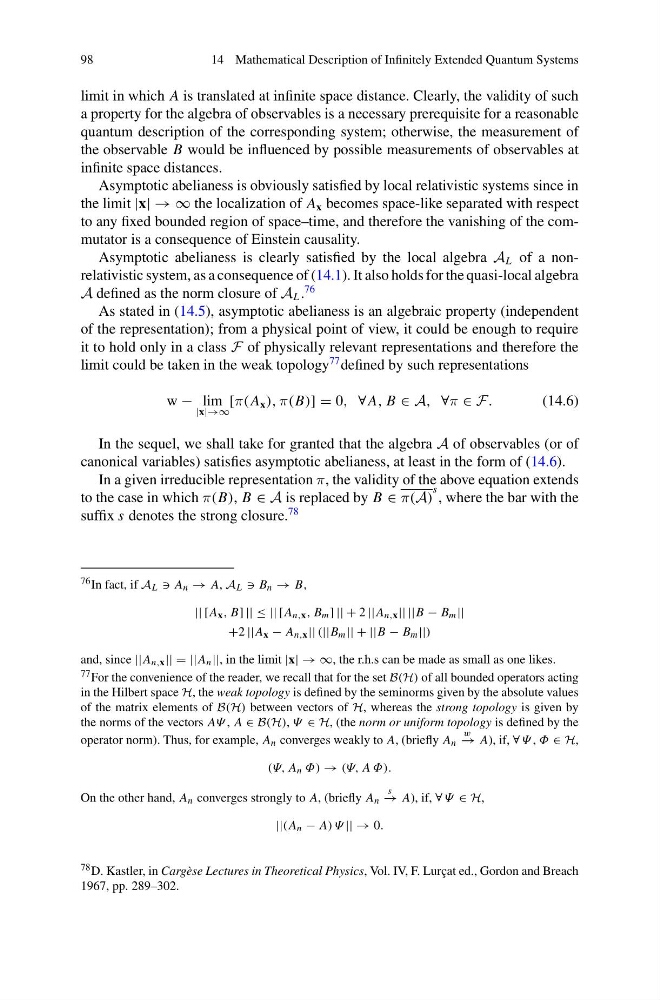
w − lim
|x|→∞
[π(A x ), π(B)] = 0, ∀A, B ∈ A, ∀π ∈ F.
(14.6)
In the sequel, we shall take for granted that the algebra A of observables (or of
canonical variables) satisfies asymptotic abelianess, at least in the form of (14.6).
In a given irreducible representation π, the validity of the above equation extends
to the case in which π(B), B ∈ A is replaced by B ∈ π(A)
s , where the bar with the
suffix s denotes the strong closure.
78
76 In fact, if A L A n → A, A L B n → B,
|| [A x , B] || ≤ || [A n,x , B m ] || + 2 ||A n,x || ||B − B m ||
+2 ||A x − A n,x || (||B m || + ||B − B m ||)
and, since ||A n,x || = ||A n ||, in the limit |x| → ∞, the r.h.s can be made as small as one likes.
77 For the convenience of the reader, we recall that for the set B(H) of all bounded operators acting
in the Hilbert space H, the weak topology is defined by the seminorms given by the absolute values
of the matrix elements of B(H) between vectors of H, whereas the strong topology is given by
the norms of the vectors AΨ , A ∈ B(H), Ψ ∈ H, (the norm or uniform topology is defined by the
operator norm). Thus, for example, A n converges weakly to A, (briefly A n
w
− → A), if, ∀ Ψ , Φ ∈ H,
(Ψ, A n Φ) → (Ψ, A Φ).
On the other hand, A n converges strongly to A, (briefly A n
s
− → A), if, ∀ Ψ ∈ H,
||(A n − A) Ψ || → 0.
78 D. Kastler, in Cargèse Lectures in Theoretical Physics, Vol. IV, F. Lurçat ed., Gordon and Breach
1967, pp. 289–302.
14 Mathematical Description of Infinitely Extended Quantum Systems
limit in which A is translated at infinite space distance. Clearly, the validity of such
a property for the algebra of observables is a necessary prerequisite for a reasonable
quantum description of the corresponding system; otherwise, the measurement of
the observable B would be influenced by possible measurements of observables at
infinite space distances.
Asymptotic abelianess is obviously satisfied by local relativistic systems since in
the limit |x| → ∞ the localization of A x becomes space-like separated with respect
to any fixed bounded region of space–time, and therefore the vanishing of the commutator is a consequence of Einstein causality.
Asymptotic abelianess is clearly satisfied by the local algebra A L of a nonrelativistic system, as a consequence of (14.1). It also holds for the quasi-local algebra
A defined as the norm closure of A L .
76
As stated in (14.5), asymptotic abelianess is an algebraic property (independent
of the representation); from a physical point of view, it could be enough to require
it to hold only in a class F of physically relevant representations and therefore the
limit could be taken in the weak topology
77 defined by such representations
w − lim
|x|→∞
[π(A x ), π(B)] = 0, ∀A, B ∈ A, ∀π ∈ F.
(14.6)
In the sequel, we shall take for granted that the algebra A of observables (or of
canonical variables) satisfies asymptotic abelianess, at least in the form of (14.6).
In a given irreducible representation π, the validity of the above equation extends
to the case in which π(B), B ∈ A is replaced by B ∈ π(A)
s , where the bar with the
suffix s denotes the strong closure.
78
76 In fact, if A L A n → A, A L B n → B,
|| [A x , B] || ≤ || [A n,x , B m ] || + 2 ||A n,x || ||B − B m ||
+2 ||A x − A n,x || (||B m || + ||B − B m ||)
and, since ||A n,x || = ||A n ||, in the limit |x| → ∞, the r.h.s can be made as small as one likes.
77 For the convenience of the reader, we recall that for the set B(H) of all bounded operators acting
in the Hilbert space H, the weak topology is defined by the seminorms given by the absolute values
of the matrix elements of B(H) between vectors of H, whereas the strong topology is given by
the norms of the vectors AΨ , A ∈ B(H), Ψ ∈ H, (the norm or uniform topology is defined by the
operator norm). Thus, for example, A n converges weakly to A, (briefly A n
w
− → A), if, ∀ Ψ , Φ ∈ H,
(Ψ, A n Φ) → (Ψ, A Φ).
On the other hand, A n converges strongly to A, (briefly A n
s
− → A), if, ∀ Ψ ∈ H,
||(A n − A) Ψ || → 0.
78 D. Kastler, in Cargèse Lectures in Theoretical Physics, Vol. IV, F. Lurçat ed., Gordon and Breach
1967, pp. 289–302.