

3.3 Gas Hydrate Inhibitors
75
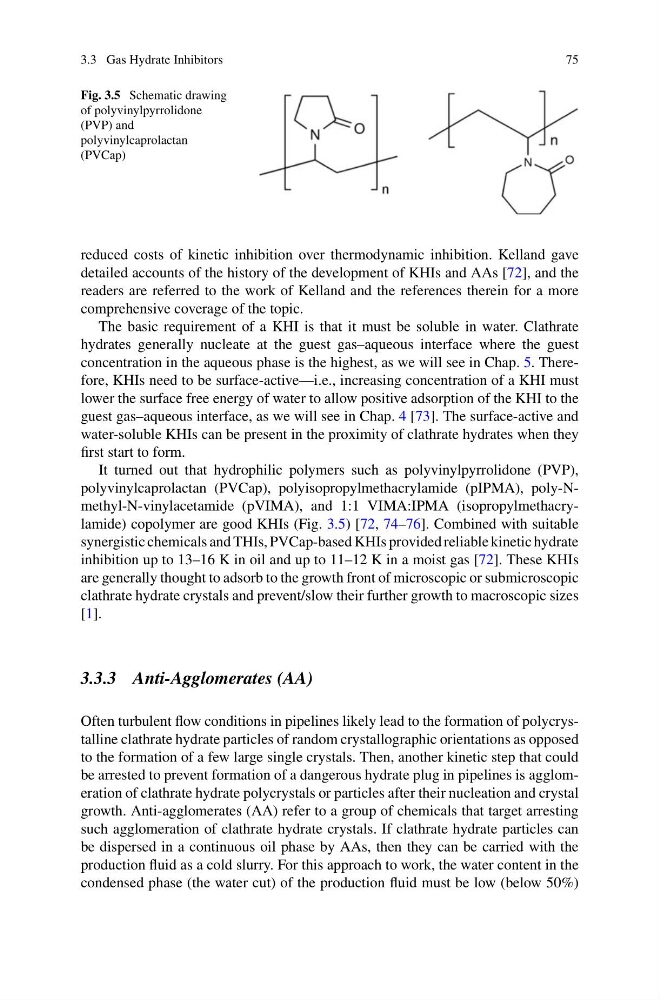
Fig. 3.5 Schematic drawing
of polyvinylpyrrolidone
(PVP) and
polyvinylcaprolactan
(PVCap)
reduced costs of kinetic inhibition over thermodynamic inhibition. Kelland gave
detailed accounts of the history of the development of KHIs and AAs [72], and the
readers are referred to the work of Kelland and the references therein for a more
comprehensive coverage of the topic.
The basic requirement of a KHI is that it must be soluble in water. Clathrate
hydrates generally nucleate at the guest gas–aqueous interface where the guest
concentration in the aqueous phase is the highest, as we will see in Chap. 5. Therefore, KHIs need to be surface-active—i.e., increasing concentration of a KHI must
lower the surface free energy of water to allow positive adsorption of the KHI to the
guest gas–aqueous interface, as we will see in Chap. 4 [73]. The surface-active and
water-soluble KHIs can be present in the proximity of clathrate hydrates when they
first start to form.
It turned out that hydrophilic polymers such as polyvinylpyrrolidone (PVP),
polyvinylcaprolactan (PVCap), polyisopropylmethacrylamide (pIPMA), poly-Nmethyl-N-vinylacetamide (pVIMA), and 1:1 VIMA:IPMA (isopropylmethacrylamide) copolymer are good KHIs (Fig. 3.5) [72, 74–76]. Combined with suitable
synergistic chemicals and THIs, PVCap-based KHIs provided reliable kinetic hydrate
inhibition up to 13–16 K in oil and up to 11–12 K in a moist gas [72]. These KHIs
are generally thought to adsorb to the growth front of microscopic or submicroscopic
clathrate hydrate crystals and prevent/slow their further growth to macroscopic sizes
[1].
3.3.3 Anti-Agglomerates (AA)
Often turbulent flow conditions in pipelines likely lead to the formation of polycrystalline clathrate hydrate particles of random crystallographic orientations as opposed
to the formation of a few large single crystals. Then, another kinetic step that could
be arrested to prevent formation of a dangerous hydrate plug in pipelines is agglomeration of clathrate hydrate polycrystals or particles after their nucleation and crystal
growth. Anti-agglomerates (AA) refer to a group of chemicals that target arresting
such agglomeration of clathrate hydrate crystals. If clathrate hydrate particles can
be dispersed in a continuous oil phase by AAs, then they can be carried with the
production fluid as a cold slurry. For this approach to work, the water content in the
condensed phase (the water cut) of the production fluid must be low (below 50%)
75
Fig. 3.5 Schematic drawing
of polyvinylpyrrolidone
(PVP) and
polyvinylcaprolactan
(PVCap)
reduced costs of kinetic inhibition over thermodynamic inhibition. Kelland gave
detailed accounts of the history of the development of KHIs and AAs [72], and the
readers are referred to the work of Kelland and the references therein for a more
comprehensive coverage of the topic.
The basic requirement of a KHI is that it must be soluble in water. Clathrate
hydrates generally nucleate at the guest gas–aqueous interface where the guest
concentration in the aqueous phase is the highest, as we will see in Chap. 5. Therefore, KHIs need to be surface-active—i.e., increasing concentration of a KHI must
lower the surface free energy of water to allow positive adsorption of the KHI to the
guest gas–aqueous interface, as we will see in Chap. 4 [73]. The surface-active and
water-soluble KHIs can be present in the proximity of clathrate hydrates when they
first start to form.
It turned out that hydrophilic polymers such as polyvinylpyrrolidone (PVP),
polyvinylcaprolactan (PVCap), polyisopropylmethacrylamide (pIPMA), poly-Nmethyl-N-vinylacetamide (pVIMA), and 1:1 VIMA:IPMA (isopropylmethacrylamide) copolymer are good KHIs (Fig. 3.5) [72, 74–76]. Combined with suitable
synergistic chemicals and THIs, PVCap-based KHIs provided reliable kinetic hydrate
inhibition up to 13–16 K in oil and up to 11–12 K in a moist gas [72]. These KHIs
are generally thought to adsorb to the growth front of microscopic or submicroscopic
clathrate hydrate crystals and prevent/slow their further growth to macroscopic sizes
[1].
3.3.3 Anti-Agglomerates (AA)
Often turbulent flow conditions in pipelines likely lead to the formation of polycrystalline clathrate hydrate particles of random crystallographic orientations as opposed
to the formation of a few large single crystals. Then, another kinetic step that could
be arrested to prevent formation of a dangerous hydrate plug in pipelines is agglomeration of clathrate hydrate polycrystals or particles after their nucleation and crystal
growth. Anti-agglomerates (AA) refer to a group of chemicals that target arresting
such agglomeration of clathrate hydrate crystals. If clathrate hydrate particles can
be dispersed in a continuous oil phase by AAs, then they can be carried with the
production fluid as a cold slurry. For this approach to work, the water content in the
condensed phase (the water cut) of the production fluid must be low (below 50%)