

3.2 Thermodynamic Aspects of Gas Hydrates
67
Two phases can coexist on a curved surface in a three-dimensional phase diagram.
Two such curved surfaces may intersect at a curve on which three phases can coexist,
i.e., form a triple-phase curve. Three such curved surfaces may intersect at a single
point on which four phases can coexist. This is equivalent to state that a triple-phase
curve may intersect a double-phase curved surface at a single point. Such a special
single point is called a quadruple point. Since up to four phases can coexist in a
two-component system before the degree of freedom is exhausted, a quadruple point
has the maximum allowable number of four phases in the system.
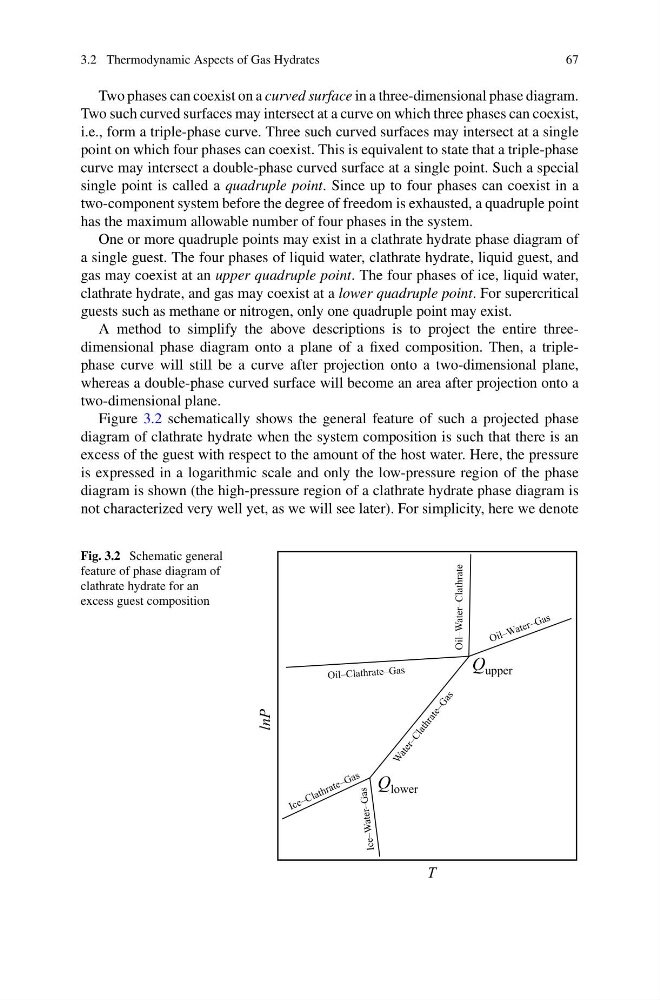
One or more quadruple points may exist in a clathrate hydrate phase diagram of
a single guest. The four phases of liquid water, clathrate hydrate, liquid guest, and
gas may coexist at an upper quadruple point. The four phases of ice, liquid water,
clathrate hydrate, and gas may coexist at a lower quadruple point. For supercritical
guests such as methane or nitrogen, only one quadruple point may exist.
A method to simplify the above descriptions is to project the entire threedimensional phase diagram onto a plane of a fixed composition. Then, a triplephase curve will still be a curve after projection onto a two-dimensional plane,
whereas a double-phase curved surface will become an area after projection onto a
two-dimensional plane.
Figure 3.2 schematically shows the general feature of such a projected phase
diagram of clathrate hydrate when the system composition is such that there is an
excess of the guest with respect to the amount of the host water. Here, the pressure
is expressed in a logarithmic scale and only the low-pressure region of the phase
diagram is shown (the high-pressure region of a clathrate hydrate phase diagram is
not characterized very well yet, as we will see later). For simplicity, here we denote
Fig. 3.2 Schematic general
feature of phase diagram of
clathrate hydrate for an
excess guest composition
T
lnP
Q lower
Q upper
Oil–Water–Clathrate
67
Two phases can coexist on a curved surface in a three-dimensional phase diagram.
Two such curved surfaces may intersect at a curve on which three phases can coexist,
i.e., form a triple-phase curve. Three such curved surfaces may intersect at a single
point on which four phases can coexist. This is equivalent to state that a triple-phase
curve may intersect a double-phase curved surface at a single point. Such a special
single point is called a quadruple point. Since up to four phases can coexist in a
two-component system before the degree of freedom is exhausted, a quadruple point
has the maximum allowable number of four phases in the system.
One or more quadruple points may exist in a clathrate hydrate phase diagram of
a single guest. The four phases of liquid water, clathrate hydrate, liquid guest, and
gas may coexist at an upper quadruple point. The four phases of ice, liquid water,
clathrate hydrate, and gas may coexist at a lower quadruple point. For supercritical
guests such as methane or nitrogen, only one quadruple point may exist.
A method to simplify the above descriptions is to project the entire threedimensional phase diagram onto a plane of a fixed composition. Then, a triplephase curve will still be a curve after projection onto a two-dimensional plane,
whereas a double-phase curved surface will become an area after projection onto a
two-dimensional plane.
Figure 3.2 schematically shows the general feature of such a projected phase
diagram of clathrate hydrate when the system composition is such that there is an
excess of the guest with respect to the amount of the host water. Here, the pressure
is expressed in a logarithmic scale and only the low-pressure region of the phase
diagram is shown (the high-pressure region of a clathrate hydrate phase diagram is
not characterized very well yet, as we will see later). For simplicity, here we denote
Fig. 3.2 Schematic general
feature of phase diagram of
clathrate hydrate for an
excess guest composition
T
lnP
Q lower
Q upper
Oil–Water–Clathrate