

62
3 Gas Hydrates
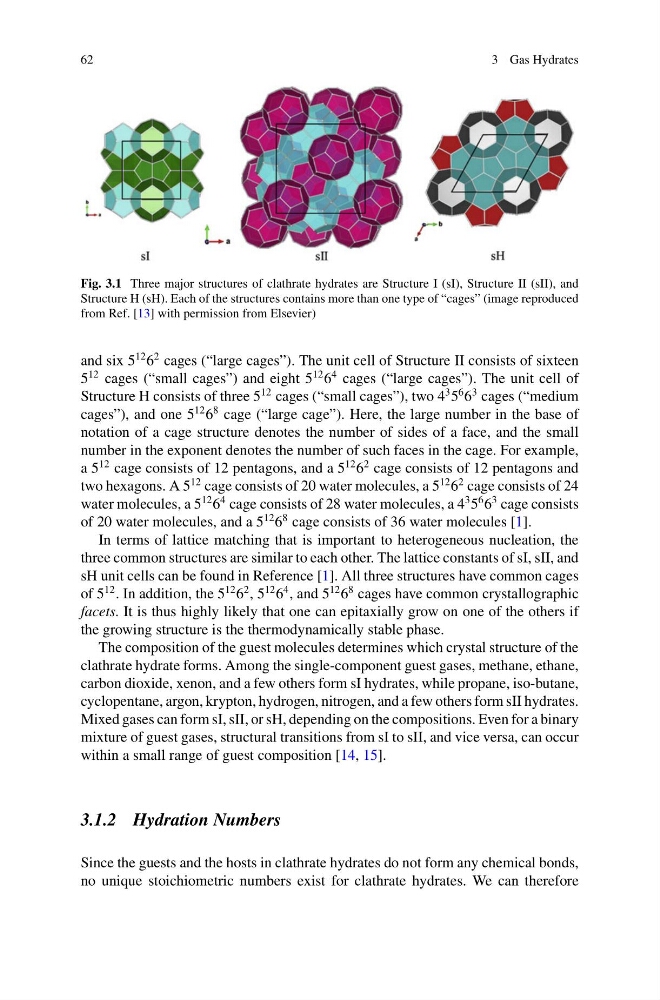
Fig. 3.1 Three major structures of clathrate hydrates are Structure I (sI), Structure II (sII), and
Structure H (sH). Each of the structures contains more than one type of “cages” (image reproduced
from Ref. [13] with permission from Elsevier)
and six 5
12 6
2 cages (“large cages”). The unit cell of Structure II consists of sixteen
5
12 cages (“small cages”) and eight 5
12 6
4 cages (“large cages”). The unit cell of
Structure H consists of three 5
12 cages (“small cages”), two 4
3 5
6 6
3 cages (“medium
cages”), and one 5
12 6
8 cage (“large cage”). Here, the large number in the base of
notation of a cage structure denotes the number of sides of a face, and the small
number in the exponent denotes the number of such faces in the cage. For example,
a 5
12 cage consists of 12 pentagons, and a 5
12 6
2 cage consists of 12 pentagons and
two hexagons. A 5
12 cage consists of 20 water molecules, a 5
12 6
2 cage consists of 24
water molecules, a 5
12 6
4 cage consists of 28 water molecules, a 4
3 5
6 6
3 cage consists
of 20 water molecules, and a 5
12 6
8 cage consists of 36 water molecules [1].
In terms of lattice matching that is important to heterogeneous nucleation, the
three common structures are similar to each other. The lattice constants of sI, sII, and
sH unit cells can be found in Reference [1]. All three structures have common cages
of 5
12 . In addition, the 5
12 6
2 , 5
12 6
4 , and 5
12 6
8 cages have common crystallographic
facets. It is thus highly likely that one can epitaxially grow on one of the others if
the growing structure is the thermodynamically stable phase.
The composition of the guest molecules determines which crystal structure of the
clathrate hydrate forms. Among the single-component guest gases, methane, ethane,
carbon dioxide, xenon, and a few others form sI hydrates, while propane, iso-butane,
cyclopentane, argon, krypton, hydrogen, nitrogen, and a few others form sII hydrates.
Mixed gases can form sI, sII, or sH, depending on the compositions. Even for a binary
mixture of guest gases, structural transitions from sI to sII, and vice versa, can occur
within a small range of guest composition [14, 15].
3.1.2 Hydration Numbers
Since the guests and the hosts in clathrate hydrates do not form any chemical bonds,
no unique stoichiometric numbers exist for clathrate hydrates. We can therefore
3 Gas Hydrates
Fig. 3.1 Three major structures of clathrate hydrates are Structure I (sI), Structure II (sII), and
Structure H (sH). Each of the structures contains more than one type of “cages” (image reproduced
from Ref. [13] with permission from Elsevier)
and six 5
12 6
2 cages (“large cages”). The unit cell of Structure II consists of sixteen
5
12 cages (“small cages”) and eight 5
12 6
4 cages (“large cages”). The unit cell of
Structure H consists of three 5
12 cages (“small cages”), two 4
3 5
6 6
3 cages (“medium
cages”), and one 5
12 6
8 cage (“large cage”). Here, the large number in the base of
notation of a cage structure denotes the number of sides of a face, and the small
number in the exponent denotes the number of such faces in the cage. For example,
a 5
12 cage consists of 12 pentagons, and a 5
12 6
2 cage consists of 12 pentagons and
two hexagons. A 5
12 cage consists of 20 water molecules, a 5
12 6
2 cage consists of 24
water molecules, a 5
12 6
4 cage consists of 28 water molecules, a 4
3 5
6 6
3 cage consists
of 20 water molecules, and a 5
12 6
8 cage consists of 36 water molecules [1].
In terms of lattice matching that is important to heterogeneous nucleation, the
three common structures are similar to each other. The lattice constants of sI, sII, and
sH unit cells can be found in Reference [1]. All three structures have common cages
of 5
12 . In addition, the 5
12 6
2 , 5
12 6
4 , and 5
12 6
8 cages have common crystallographic
facets. It is thus highly likely that one can epitaxially grow on one of the others if
the growing structure is the thermodynamically stable phase.
The composition of the guest molecules determines which crystal structure of the
clathrate hydrate forms. Among the single-component guest gases, methane, ethane,
carbon dioxide, xenon, and a few others form sI hydrates, while propane, iso-butane,
cyclopentane, argon, krypton, hydrogen, nitrogen, and a few others form sII hydrates.
Mixed gases can form sI, sII, or sH, depending on the compositions. Even for a binary
mixture of guest gases, structural transitions from sI to sII, and vice versa, can occur
within a small range of guest composition [14, 15].
3.1.2 Hydration Numbers
Since the guests and the hosts in clathrate hydrates do not form any chemical bonds,
no unique stoichiometric numbers exist for clathrate hydrates. We can therefore