

2.3 Tea Time Break: The Fourier Transform and the Laplace Transform
53
2.3 Tea Time Break: The Fourier Transform
and the Laplace Transform
2.3.1 Orthogonality
One of the greatest inventions of modern times is electronics. There are many useful
electronic devices but here we only focus on lock-in amplifiers that can detect minute
signals buried in a noisy environment. Good lock-in amplifiers can pick up signals
much (~10
−6 ) smaller than the noise components. How is this possible?
A lock-in amplifier effectively extracts a signal of a given Fourier component from
a mixture of waves that include noise components. Its principle utilizes the orthogonality of the sine waves, namely, that any two Fourier components are “perpendicular”
to each other.
To understand what is meant by orthogonal or “perpendicular”, we follow the footsteps of J. J. Sakurai [19]. In our three-dimensional environment, we intuitively know
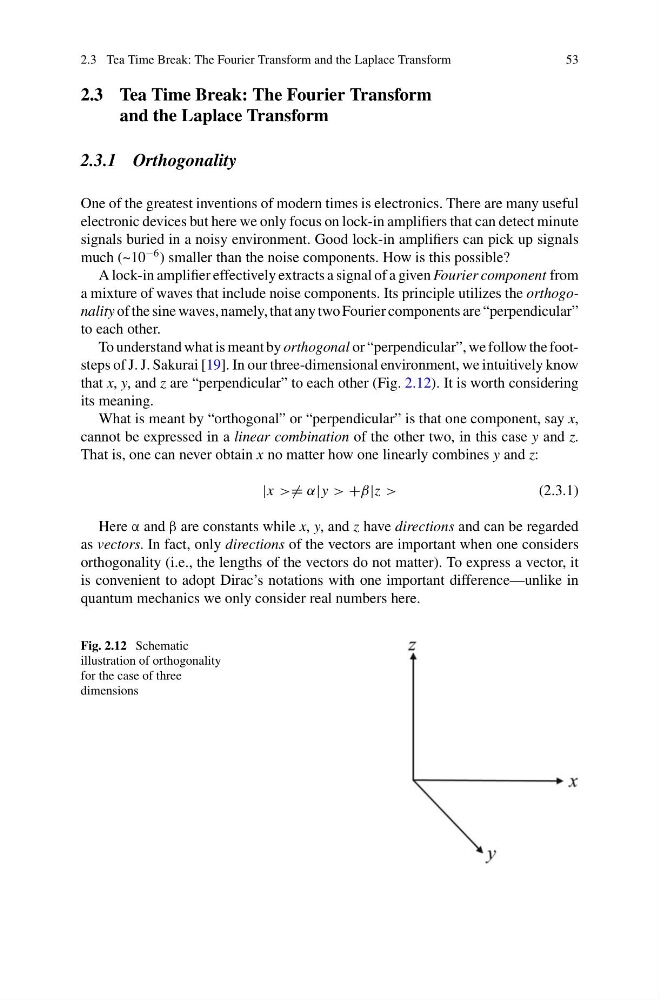
that x, y, and z are “perpendicular” to each other (Fig. 2.12). It is worth considering
its meaning.
What is meant by “orthogonal” or “perpendicular” is that one component, say x,
cannot be expressed in a linear combination of the other two, in this case y and z.
That is, one can never obtain x no matter how one linearly combines y and z:
|x > = α|y > +β|z >
(2.3.1)
Here α and β are constants while x, y, and z have directions and can be regarded
as vectors. In fact, only directions of the vectors are important when one considers
orthogonality (i.e., the lengths of the vectors do not matter). To express a vector, it
is convenient to adopt Dirac’s notations with one important difference—unlike in
quantum mechanics we only consider real numbers here.
Fig. 2.12 Schematic
illustration of orthogonality
for the case of three
dimensions
53
2.3 Tea Time Break: The Fourier Transform
and the Laplace Transform
2.3.1 Orthogonality
One of the greatest inventions of modern times is electronics. There are many useful
electronic devices but here we only focus on lock-in amplifiers that can detect minute
signals buried in a noisy environment. Good lock-in amplifiers can pick up signals
much (~10
−6 ) smaller than the noise components. How is this possible?
A lock-in amplifier effectively extracts a signal of a given Fourier component from
a mixture of waves that include noise components. Its principle utilizes the orthogonality of the sine waves, namely, that any two Fourier components are “perpendicular”
to each other.
To understand what is meant by orthogonal or “perpendicular”, we follow the footsteps of J. J. Sakurai [19]. In our three-dimensional environment, we intuitively know
that x, y, and z are “perpendicular” to each other (Fig. 2.12). It is worth considering
its meaning.
What is meant by “orthogonal” or “perpendicular” is that one component, say x,
cannot be expressed in a linear combination of the other two, in this case y and z.
That is, one can never obtain x no matter how one linearly combines y and z:
|x > = α|y > +β|z >
(2.3.1)
Here α and β are constants while x, y, and z have directions and can be regarded
as vectors. In fact, only directions of the vectors are important when one considers
orthogonality (i.e., the lengths of the vectors do not matter). To express a vector, it
is convenient to adopt Dirac’s notations with one important difference—unlike in
quantum mechanics we only consider real numbers here.
Fig. 2.12 Schematic
illustration of orthogonality
for the case of three
dimensions