

30
1 Nucleation Theory
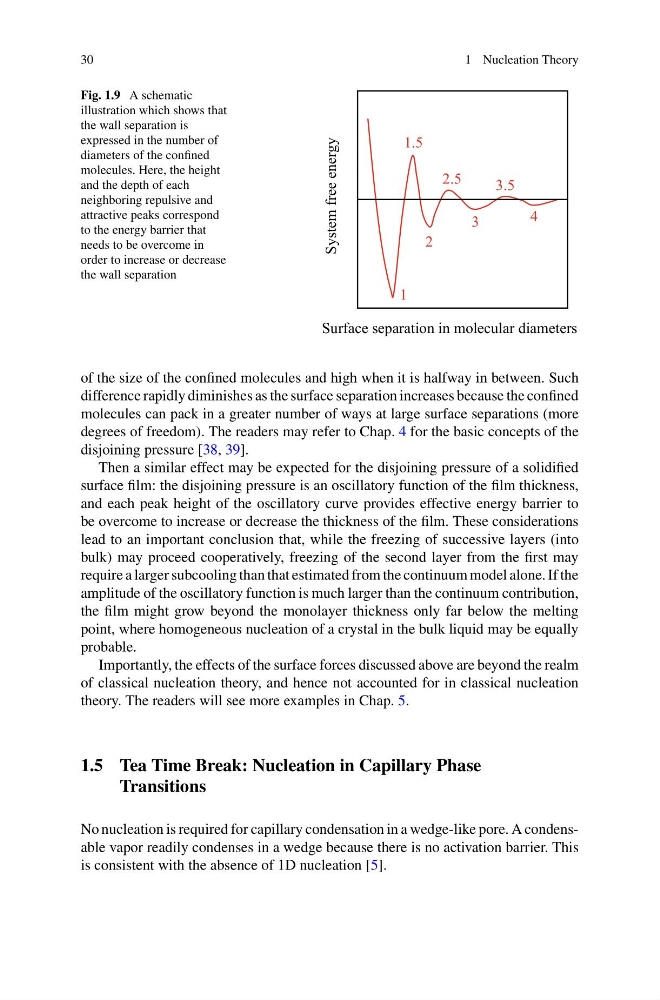
Fig. 1.9 A schematic
illustration which shows that
the wall separation is
expressed in the number of
diameters of the confined
molecules. Here, the height
and the depth of each
neighboring repulsive and
attractive peaks correspond
to the energy barrier that
needs to be overcome in
order to increase or decrease
the wall separation
System free energy
Surface separation in molecular diameters
1
2
1.5
2.5
3.5
3
4
of the size of the confined molecules and high when it is halfway in between. Such
difference rapidly diminishes as the surface separation increases because the confined
molecules can pack in a greater number of ways at large surface separations (more
degrees of freedom). The readers may refer to Chap. 4 for the basic concepts of the
disjoining pressure [38, 39].
Then a similar effect may be expected for the disjoining pressure of a solidified
surface film: the disjoining pressure is an oscillatory function of the film thickness,
and each peak height of the oscillatory curve provides effective energy barrier to
be overcome to increase or decrease the thickness of the film. These considerations
lead to an important conclusion that, while the freezing of successive layers (into
bulk) may proceed cooperatively, freezing of the second layer from the first may
require a larger subcooling than that estimated from the continuum model alone. If the
amplitude of the oscillatory function is much larger than the continuum contribution,
the film might grow beyond the monolayer thickness only far below the melting
point, where homogeneous nucleation of a crystal in the bulk liquid may be equally
probable.
Importantly, the effects of the surface forces discussed above are beyond the realm
of classical nucleation theory, and hence not accounted for in classical nucleation
theory. The readers will see more examples in Chap. 5.
1.5 Tea Time Break: Nucleation in Capillary Phase
Transitions
No nucleation is required for capillary condensation in a wedge-like pore. A condensable vapor readily condenses in a wedge because there is no activation barrier. This
is consistent with the absence of 1D nucleation [5].
1 Nucleation Theory
Fig. 1.9 A schematic
illustration which shows that
the wall separation is
expressed in the number of
diameters of the confined
molecules. Here, the height
and the depth of each
neighboring repulsive and
attractive peaks correspond
to the energy barrier that
needs to be overcome in
order to increase or decrease
the wall separation
System free energy
Surface separation in molecular diameters
1
2
1.5
2.5
3.5
3
4
of the size of the confined molecules and high when it is halfway in between. Such
difference rapidly diminishes as the surface separation increases because the confined
molecules can pack in a greater number of ways at large surface separations (more
degrees of freedom). The readers may refer to Chap. 4 for the basic concepts of the
disjoining pressure [38, 39].
Then a similar effect may be expected for the disjoining pressure of a solidified
surface film: the disjoining pressure is an oscillatory function of the film thickness,
and each peak height of the oscillatory curve provides effective energy barrier to
be overcome to increase or decrease the thickness of the film. These considerations
lead to an important conclusion that, while the freezing of successive layers (into
bulk) may proceed cooperatively, freezing of the second layer from the first may
require a larger subcooling than that estimated from the continuum model alone. If the
amplitude of the oscillatory function is much larger than the continuum contribution,
the film might grow beyond the monolayer thickness only far below the melting
point, where homogeneous nucleation of a crystal in the bulk liquid may be equally
probable.
Importantly, the effects of the surface forces discussed above are beyond the realm
of classical nucleation theory, and hence not accounted for in classical nucleation
theory. The readers will see more examples in Chap. 5.
1.5 Tea Time Break: Nucleation in Capillary Phase
Transitions
No nucleation is required for capillary condensation in a wedge-like pore. A condensable vapor readily condenses in a wedge because there is no activation barrier. This
is consistent with the absence of 1D nucleation [5].