

1.4 Nucleation of Two-Dimensional Solid Layers
23
1.4 Nucleation of Two-Dimensional Solid Layers
1.4.1 Introduction
As we will see in Chap. 5, clathrate hydrate typically forms as thin films at an
aqueous–guest gas interface due to the typically low solubility of the guest gas in
water. When the only water present in a system is a droplet floated in the background
of the guest gas, clathrate hydrate forms a rind at the surface of the water droplet.
This is an example of nucleation of a two-dimensional crystal.
Truly two-dimensional crystals are rare in nature but do exist. Straight-chain
hydrocarbons (normal alkanes) and straight-chain alcohols of intermediate chain
lengths exhibit a rare phenomenon known as surface freezing. Briefly, when a normal
alkane solid is heated from below the bulk melting point (T m ), the top monolayer of
the solid surface remains frozen up to the surface freezing point (T sf ), which is a few
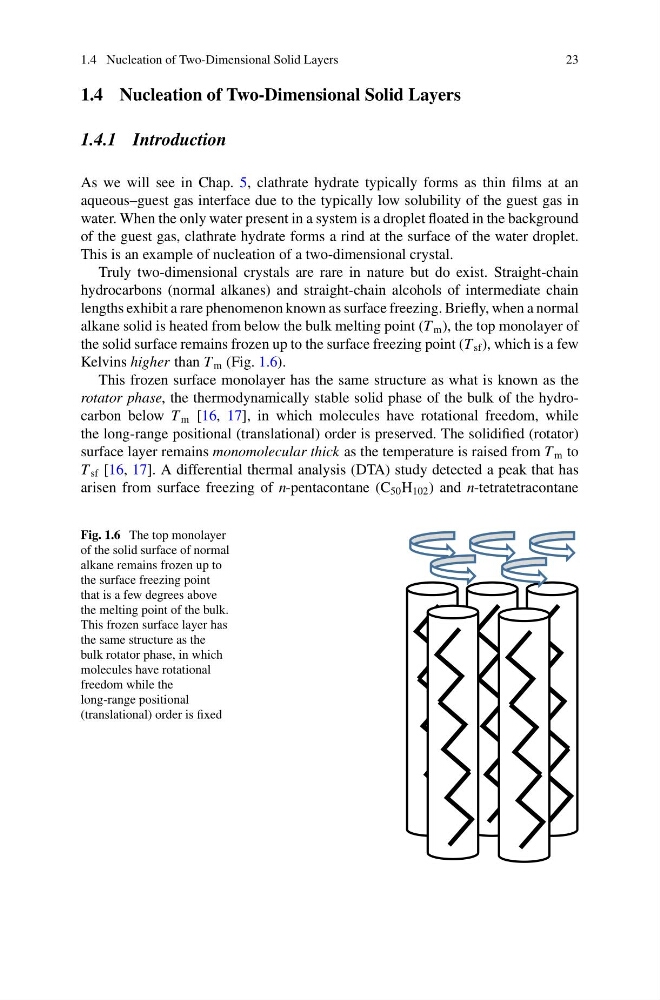
Kelvins higher than T m (Fig. 1.6).
This frozen surface monolayer has the same structure as what is known as the
rotator phase, the thermodynamically stable solid phase of the bulk of the hydrocarbon below T m [16, 17], in which molecules have rotational freedom, while
the long-range positional (translational) order is preserved. The solidified (rotator)
surface layer remains monomolecular thick as the temperature is raised from T m to
T sf [16, 17]. A differential thermal analysis (DTA) study detected a peak that has
arisen from surface freezing of n-pentacontane (C 50 H 102 ) and n-tetratetracontane
Fig. 1.6 The top monolayer
of the solid surface of normal
alkane remains frozen up to
the surface freezing point
that is a few degrees above
the melting point of the bulk.
This frozen surface layer has
the same structure as the
bulk rotator phase, in which
molecules have rotational
freedom while the
long-range positional
(translational) order is fixed
23
1.4 Nucleation of Two-Dimensional Solid Layers
1.4.1 Introduction
As we will see in Chap. 5, clathrate hydrate typically forms as thin films at an
aqueous–guest gas interface due to the typically low solubility of the guest gas in
water. When the only water present in a system is a droplet floated in the background
of the guest gas, clathrate hydrate forms a rind at the surface of the water droplet.
This is an example of nucleation of a two-dimensional crystal.
Truly two-dimensional crystals are rare in nature but do exist. Straight-chain
hydrocarbons (normal alkanes) and straight-chain alcohols of intermediate chain
lengths exhibit a rare phenomenon known as surface freezing. Briefly, when a normal
alkane solid is heated from below the bulk melting point (T m ), the top monolayer of
the solid surface remains frozen up to the surface freezing point (T sf ), which is a few
Kelvins higher than T m (Fig. 1.6).
This frozen surface monolayer has the same structure as what is known as the
rotator phase, the thermodynamically stable solid phase of the bulk of the hydrocarbon below T m [16, 17], in which molecules have rotational freedom, while
the long-range positional (translational) order is preserved. The solidified (rotator)
surface layer remains monomolecular thick as the temperature is raised from T m to
T sf [16, 17]. A differential thermal analysis (DTA) study detected a peak that has
arisen from surface freezing of n-pentacontane (C 50 H 102 ) and n-tetratetracontane
Fig. 1.6 The top monolayer
of the solid surface of normal
alkane remains frozen up to
the surface freezing point
that is a few degrees above
the melting point of the bulk.
This frozen surface layer has
the same structure as the
bulk rotator phase, in which
molecules have rotational
freedom while the
long-range positional
(translational) order is fixed