

1.2 Classical Nucleation Theory
15
expected to be proportional to the system volume [5]. Likewise, it has been traditionally considered that a suitable measure of the system size for heterogeneous
nucleation is the area of a surface or an interface that is responsible for providing the
heterogeneous nucleation sites.
1.2.3 Scaling Laws for Nucleation Rates
We now consider how nucleation rates might scale with the system size. Once again,
we start from ab initio considerations and apply this line of thought to a thought
experiment. Suppose we have two identical droplets and denote that the nucleation
probability per unit time of one of them is P. The same probability also applies to the
other droplet which is supposed to be identical. Then the nucleation probability per
unit time in either one or both of the two droplets becomes one minus the probability
that neither droplet nucleates in the unit time:
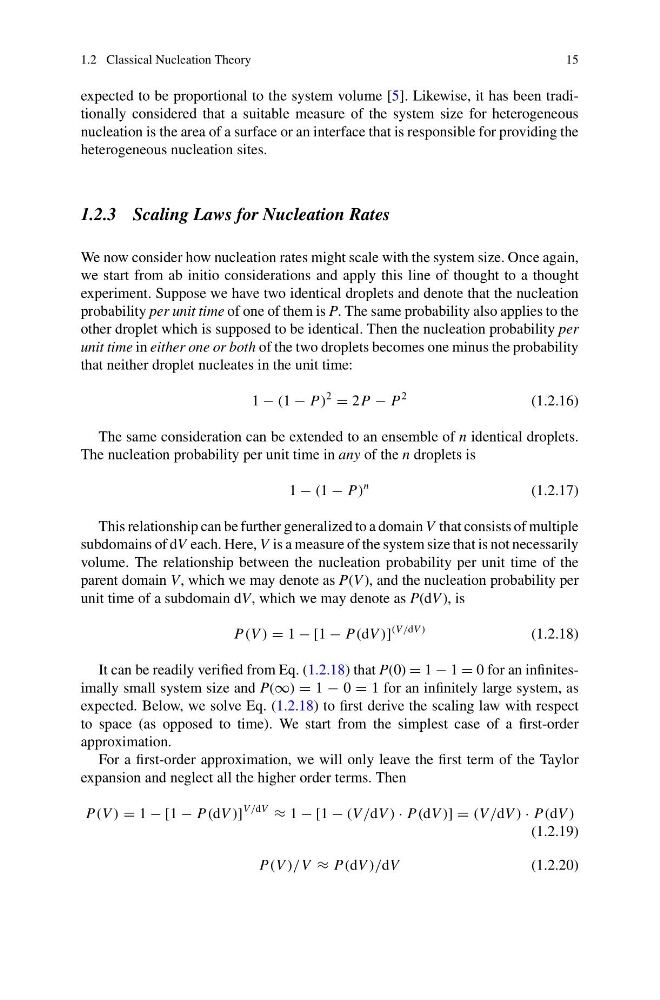
1 − (1 − P)
2
= 2P − P
2
(1.2.16)
The same consideration can be extended to an ensemble of n identical droplets.
The nucleation probability per unit time in any of the n droplets is
1 − (1 − P)
n
(1.2.17)
This relationship can be further generalized to a domain V that consists of multiple
subdomains of dV each. Here, V is a measure of the system size that is not necessarily
volume. The relationship between the nucleation probability per unit time of the
parent domain V, which we may denote as P(V ), and the nucleation probability per
unit time of a subdomain dV, which we may denote as P(dV ), is
P(V ) = 1 − [1 − P(dV )]
(V /dV )
(1.2.18)
It can be readily verified from Eq. (1.2.18) that P(0) = 1 − 1 = 0 for an infinitesimally small system size and P(∞) = 1 − 0 = 1 for an infinitely large system, as
expected. Below, we solve Eq. (1.2.18) to first derive the scaling law with respect
to space (as opposed to time). We start from the simplest case of a first-order
approximation.
For a first-order approximation, we will only leave the first term of the Taylor
expansion and neglect all the higher order terms. Then
P(V ) = 1 − [1 − P(dV )]
V /dV
≈ 1 − [1 − (V /dV ) · P(dV )] = (V /dV ) · P(dV )
(1.2.19)
P(V )/V ≈ P(dV )/dV
(1.2.20)
15
expected to be proportional to the system volume [5]. Likewise, it has been traditionally considered that a suitable measure of the system size for heterogeneous
nucleation is the area of a surface or an interface that is responsible for providing the
heterogeneous nucleation sites.
1.2.3 Scaling Laws for Nucleation Rates
We now consider how nucleation rates might scale with the system size. Once again,
we start from ab initio considerations and apply this line of thought to a thought
experiment. Suppose we have two identical droplets and denote that the nucleation
probability per unit time of one of them is P. The same probability also applies to the
other droplet which is supposed to be identical. Then the nucleation probability per
unit time in either one or both of the two droplets becomes one minus the probability
that neither droplet nucleates in the unit time:
1 − (1 − P)
2
= 2P − P
2
(1.2.16)
The same consideration can be extended to an ensemble of n identical droplets.
The nucleation probability per unit time in any of the n droplets is
1 − (1 − P)
n
(1.2.17)
This relationship can be further generalized to a domain V that consists of multiple
subdomains of dV each. Here, V is a measure of the system size that is not necessarily
volume. The relationship between the nucleation probability per unit time of the
parent domain V, which we may denote as P(V ), and the nucleation probability per
unit time of a subdomain dV, which we may denote as P(dV ), is
P(V ) = 1 − [1 − P(dV )]
(V /dV )
(1.2.18)
It can be readily verified from Eq. (1.2.18) that P(0) = 1 − 1 = 0 for an infinitesimally small system size and P(∞) = 1 − 0 = 1 for an infinitely large system, as
expected. Below, we solve Eq. (1.2.18) to first derive the scaling law with respect
to space (as opposed to time). We start from the simplest case of a first-order
approximation.
For a first-order approximation, we will only leave the first term of the Taylor
expansion and neglect all the higher order terms. Then
P(V ) = 1 − [1 − P(dV )]
V /dV
≈ 1 − [1 − (V /dV ) · P(dV )] = (V /dV ) · P(dV )
(1.2.19)
P(V )/V ≈ P(dV )/dV
(1.2.20)