

1.1 Phase Equilibria and Phase Behavior
7
Another example is laser. It is known that a laser requires at least three, preferably four, energy levels (electronic states) to create a population inversion that must
precede before any stimulated emission can be induced. Why is it impossible to create
a population inversion with only two energy levels? The principle of detailed balance
states that the rate of transfer of an electron from one energy level to the other is the
same. At the beginning of an excitation process, the vast majority of the electrons
are in the lower energy level. As the pumping progresses, more and more electrons
are transferred to the upper energy level. However, the rate of the downward transfer
increases as the upper energy level is increasingly more populated. The rate of the
downward transfer matches that of the upward transfer by the time the population of
both levels become equal, so it is impossible to populate the upper level more than
the lower level—i.e., impossible to attain a population inversion. Thus, at least three
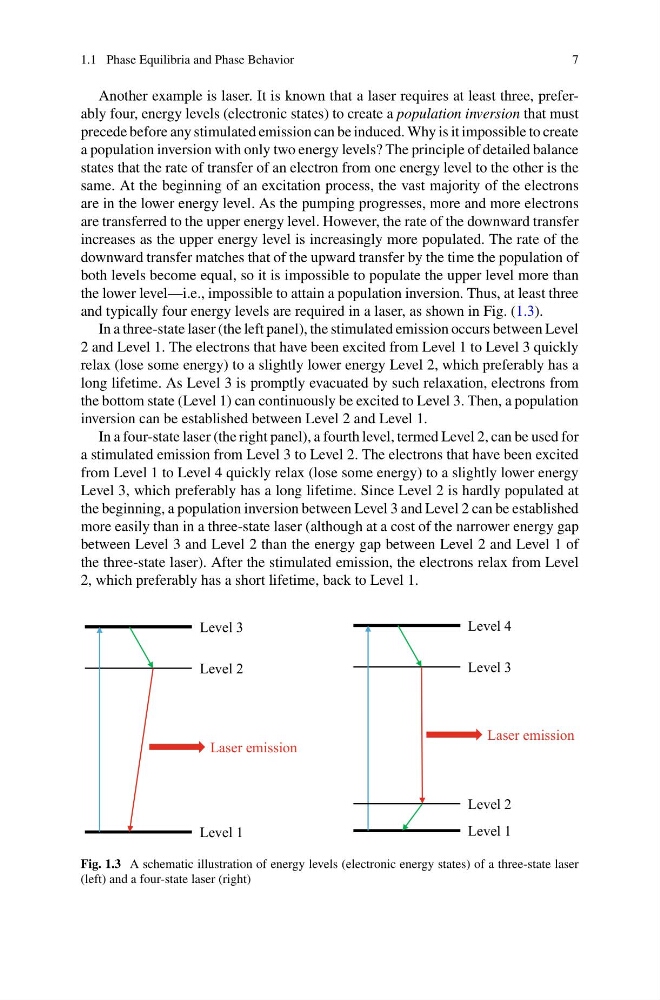
and typically four energy levels are required in a laser, as shown in Fig. (1.3).
In a three-state laser (the left panel), the stimulated emission occurs between Level
2 and Level 1. The electrons that have been excited from Level 1 to Level 3 quickly
relax (lose some energy) to a slightly lower energy Level 2, which preferably has a
long lifetime. As Level 3 is promptly evacuated by such relaxation, electrons from
the bottom state (Level 1) can continuously be excited to Level 3. Then, a population
inversion can be established between Level 2 and Level 1.
In a four-state laser (the right panel), a fourth level, termed Level 2, can be used for
a stimulated emission from Level 3 to Level 2. The electrons that have been excited
from Level 1 to Level 4 quickly relax (lose some energy) to a slightly lower energy
Level 3, which preferably has a long lifetime. Since Level 2 is hardly populated at
the beginning, a population inversion between Level 3 and Level 2 can be established
more easily than in a three-state laser (although at a cost of the narrower energy gap
between Level 3 and Level 2 than the energy gap between Level 2 and Level 1 of
the three-state laser). After the stimulated emission, the electrons relax from Level
2, which preferably has a short lifetime, back to Level 1.
Level 3
Level 1
Level 2
Laser emission
Level 4
Level 1
Level 3
Laser emission
Level 2
Fig. 1.3 A schematic illustration of energy levels (electronic energy states) of a three-state laser
(left) and a four-state laser (right)
7
Another example is laser. It is known that a laser requires at least three, preferably four, energy levels (electronic states) to create a population inversion that must
precede before any stimulated emission can be induced. Why is it impossible to create
a population inversion with only two energy levels? The principle of detailed balance
states that the rate of transfer of an electron from one energy level to the other is the
same. At the beginning of an excitation process, the vast majority of the electrons
are in the lower energy level. As the pumping progresses, more and more electrons
are transferred to the upper energy level. However, the rate of the downward transfer
increases as the upper energy level is increasingly more populated. The rate of the
downward transfer matches that of the upward transfer by the time the population of
both levels become equal, so it is impossible to populate the upper level more than
the lower level—i.e., impossible to attain a population inversion. Thus, at least three
and typically four energy levels are required in a laser, as shown in Fig. (1.3).
In a three-state laser (the left panel), the stimulated emission occurs between Level
2 and Level 1. The electrons that have been excited from Level 1 to Level 3 quickly
relax (lose some energy) to a slightly lower energy Level 2, which preferably has a
long lifetime. As Level 3 is promptly evacuated by such relaxation, electrons from
the bottom state (Level 1) can continuously be excited to Level 3. Then, a population
inversion can be established between Level 2 and Level 1.
In a four-state laser (the right panel), a fourth level, termed Level 2, can be used for
a stimulated emission from Level 3 to Level 2. The electrons that have been excited
from Level 1 to Level 4 quickly relax (lose some energy) to a slightly lower energy
Level 3, which preferably has a long lifetime. Since Level 2 is hardly populated at
the beginning, a population inversion between Level 3 and Level 2 can be established
more easily than in a three-state laser (although at a cost of the narrower energy gap
between Level 3 and Level 2 than the energy gap between Level 2 and Level 1 of
the three-state laser). After the stimulated emission, the electrons relax from Level
2, which preferably has a short lifetime, back to Level 1.
Level 3
Level 1
Level 2
Laser emission
Level 4
Level 1
Level 3
Laser emission
Level 2
Fig. 1.3 A schematic illustration of energy levels (electronic energy states) of a three-state laser
(left) and a four-state laser (right)