

134
5 Nucleation of Gas Hydrates
Interfacial
nanobubble
–susceptible
region
Interfacial nanobubbles
& other interfacial
gaseous states
Water
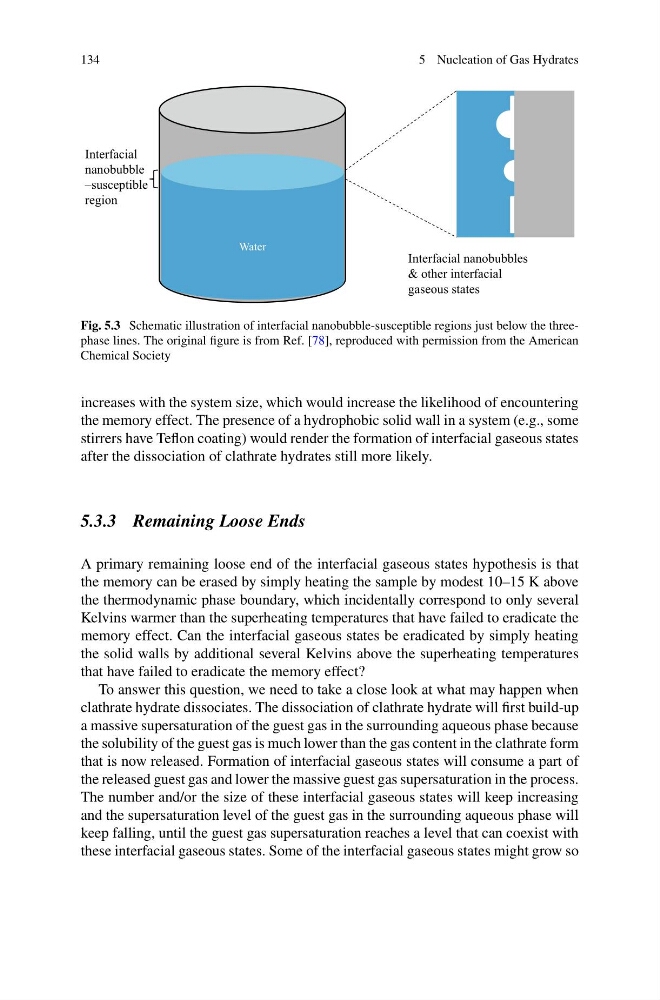
Fig. 5.3 Schematic illustration of interfacial nanobubble-susceptible regions just below the threephase lines. The original figure is from Ref. [78], reproduced with permission from the American
Chemical Society
increases with the system size, which would increase the likelihood of encountering
the memory effect. The presence of a hydrophobic solid wall in a system (e.g., some
stirrers have Teflon coating) would render the formation of interfacial gaseous states
after the dissociation of clathrate hydrates still more likely.
5.3.3 Remaining Loose Ends
A primary remaining loose end of the interfacial gaseous states hypothesis is that
the memory can be erased by simply heating the sample by modest 10–15 K above
the thermodynamic phase boundary, which incidentally correspond to only several
Kelvins warmer than the superheating temperatures that have failed to eradicate the
memory effect. Can the interfacial gaseous states be eradicated by simply heating
the solid walls by additional several Kelvins above the superheating temperatures
that have failed to eradicate the memory effect?
To answer this question, we need to take a close look at what may happen when
clathrate hydrate dissociates. The dissociation of clathrate hydrate will first build-up
a massive supersaturation of the guest gas in the surrounding aqueous phase because
the solubility of the guest gas is much lower than the gas content in the clathrate form
that is now released. Formation of interfacial gaseous states will consume a part of
the released guest gas and lower the massive guest gas supersaturation in the process.
The number and/or the size of these interfacial gaseous states will keep increasing
and the supersaturation level of the guest gas in the surrounding aqueous phase will
keep falling, until the guest gas supersaturation reaches a level that can coexist with
these interfacial gaseous states. Some of the interfacial gaseous states might grow so
5 Nucleation of Gas Hydrates
Interfacial
nanobubble
–susceptible
region
Interfacial nanobubbles
& other interfacial
gaseous states
Water
Fig. 5.3 Schematic illustration of interfacial nanobubble-susceptible regions just below the threephase lines. The original figure is from Ref. [78], reproduced with permission from the American
Chemical Society
increases with the system size, which would increase the likelihood of encountering
the memory effect. The presence of a hydrophobic solid wall in a system (e.g., some
stirrers have Teflon coating) would render the formation of interfacial gaseous states
after the dissociation of clathrate hydrates still more likely.
5.3.3 Remaining Loose Ends
A primary remaining loose end of the interfacial gaseous states hypothesis is that
the memory can be erased by simply heating the sample by modest 10–15 K above
the thermodynamic phase boundary, which incidentally correspond to only several
Kelvins warmer than the superheating temperatures that have failed to eradicate the
memory effect. Can the interfacial gaseous states be eradicated by simply heating
the solid walls by additional several Kelvins above the superheating temperatures
that have failed to eradicate the memory effect?
To answer this question, we need to take a close look at what may happen when
clathrate hydrate dissociates. The dissociation of clathrate hydrate will first build-up
a massive supersaturation of the guest gas in the surrounding aqueous phase because
the solubility of the guest gas is much lower than the gas content in the clathrate form
that is now released. Formation of interfacial gaseous states will consume a part of
the released guest gas and lower the massive guest gas supersaturation in the process.
The number and/or the size of these interfacial gaseous states will keep increasing
and the supersaturation level of the guest gas in the surrounding aqueous phase will
keep falling, until the guest gas supersaturation reaches a level that can coexist with
these interfacial gaseous states. Some of the interfacial gaseous states might grow so