

4.3 Is the Surface of Gas Hydrates Dry?
103
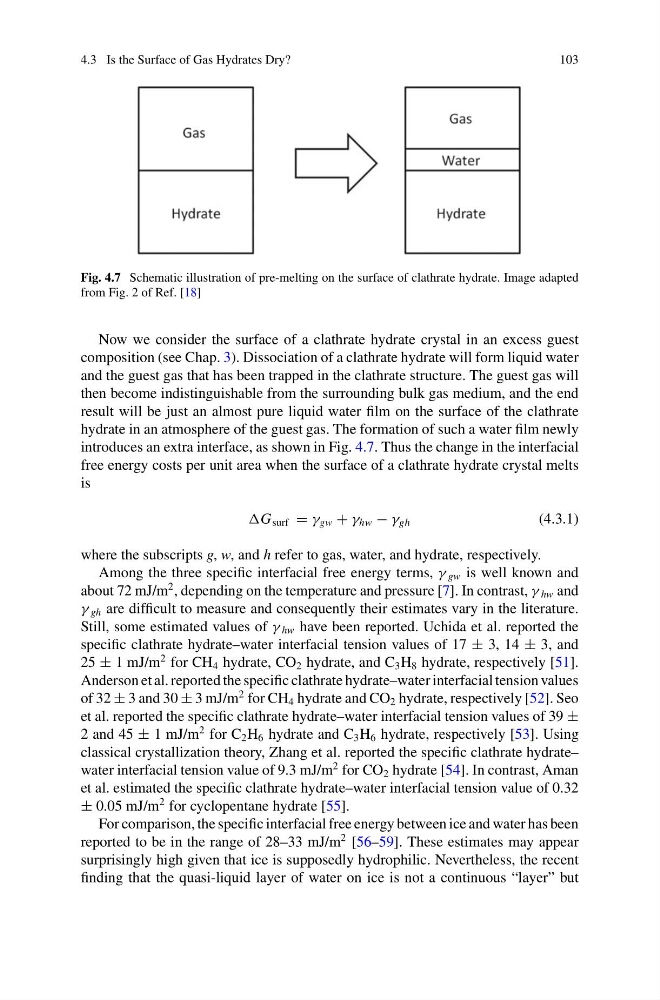
Fig. 4.7 Schematic illustration of pre-melting on the surface of clathrate hydrate. Image adapted
from Fig. 2 of Ref. [18]
Now we consider the surface of a clathrate hydrate crystal in an excess guest
composition (see Chap. 3). Dissociation of a clathrate hydrate will form liquid water
and the guest gas that has been trapped in the clathrate structure. The guest gas will
then become indistinguishable from the surrounding bulk gas medium, and the end
result will be just an almost pure liquid water film on the surface of the clathrate
hydrate in an atmosphere of the guest gas. The formation of such a water film newly
introduces an extra interface, as shown in Fig. 4.7. Thus the change in the interfacial
free energy costs per unit area when the surface of a clathrate hydrate crystal melts
is
G surf = γ gw + γ hw − γ gh
(4.3.1)
where the subscripts g, w, and h refer to gas, water, and hydrate, respectively.
Among the three specific interfacial free energy terms, γ gw is well known and
about 72 mJ/m
2 , depending on the temperature and pressure [7]. In contrast, γ hw and
γ gh are difficult to measure and consequently their estimates vary in the literature.
Still, some estimated values of γ hw have been reported. Uchida et al. reported the
specific clathrate hydrate–water interfacial tension values of 17 ± 3, 14 ± 3, and
25 ± 1 mJ/m
2 for CH 4 hydrate, CO 2 hydrate, and C 3 H 8 hydrate, respectively [51].
Anderson et al. reported the specific clathrate hydrate–water interfacial tension values
of 32 ± 3 and 30 ± 3 mJ/m
2 for CH 4 hydrate and CO 2 hydrate, respectively [52]. Seo
et al. reported the specific clathrate hydrate–water interfacial tension values of 39 ±
2 and 45 ± 1 mJ/m
2 for C 2 H 6 hydrate and C 3 H 6 hydrate, respectively [53]. Using
classical crystallization theory, Zhang et al. reported the specific clathrate hydrate–
water interfacial tension value of 9.3 mJ/m
2 for CO 2 hydrate [54]. In contrast, Aman
et al. estimated the specific clathrate hydrate–water interfacial tension value of 0.32
± 0.05 mJ/m
2 for cyclopentane hydrate [55].
For comparison, the specific interfacial free energy between ice and water has been
reported to be in the range of 28–33 mJ/m
2 [56–59]. These estimates may appear
surprisingly high given that ice is supposedly hydrophilic. Nevertheless, the recent
finding that the quasi-liquid layer of water on ice is not a continuous “layer” but
103
Fig. 4.7 Schematic illustration of pre-melting on the surface of clathrate hydrate. Image adapted
from Fig. 2 of Ref. [18]
Now we consider the surface of a clathrate hydrate crystal in an excess guest
composition (see Chap. 3). Dissociation of a clathrate hydrate will form liquid water
and the guest gas that has been trapped in the clathrate structure. The guest gas will
then become indistinguishable from the surrounding bulk gas medium, and the end
result will be just an almost pure liquid water film on the surface of the clathrate
hydrate in an atmosphere of the guest gas. The formation of such a water film newly
introduces an extra interface, as shown in Fig. 4.7. Thus the change in the interfacial
free energy costs per unit area when the surface of a clathrate hydrate crystal melts
is
G surf = γ gw + γ hw − γ gh
(4.3.1)
where the subscripts g, w, and h refer to gas, water, and hydrate, respectively.
Among the three specific interfacial free energy terms, γ gw is well known and
about 72 mJ/m
2 , depending on the temperature and pressure [7]. In contrast, γ hw and
γ gh are difficult to measure and consequently their estimates vary in the literature.
Still, some estimated values of γ hw have been reported. Uchida et al. reported the
specific clathrate hydrate–water interfacial tension values of 17 ± 3, 14 ± 3, and
25 ± 1 mJ/m
2 for CH 4 hydrate, CO 2 hydrate, and C 3 H 8 hydrate, respectively [51].
Anderson et al. reported the specific clathrate hydrate–water interfacial tension values
of 32 ± 3 and 30 ± 3 mJ/m
2 for CH 4 hydrate and CO 2 hydrate, respectively [52]. Seo
et al. reported the specific clathrate hydrate–water interfacial tension values of 39 ±
2 and 45 ± 1 mJ/m
2 for C 2 H 6 hydrate and C 3 H 6 hydrate, respectively [53]. Using
classical crystallization theory, Zhang et al. reported the specific clathrate hydrate–
water interfacial tension value of 9.3 mJ/m
2 for CO 2 hydrate [54]. In contrast, Aman
et al. estimated the specific clathrate hydrate–water interfacial tension value of 0.32
± 0.05 mJ/m
2 for cyclopentane hydrate [55].
For comparison, the specific interfacial free energy between ice and water has been
reported to be in the range of 28–33 mJ/m
2 [56–59]. These estimates may appear
surprisingly high given that ice is supposedly hydrophilic. Nevertheless, the recent
finding that the quasi-liquid layer of water on ice is not a continuous “layer” but