

4.3 Is the Surface of Gas Hydrates Dry?
101
increase in U (energy is required to break bonds), is the source of the interfacial free
energy, which is the free energy required to bring atoms or molecules from inside of
a bulk to a surface. Each material has a specific value for this interfacial free energy
when normalized to unit area, which is the specific interfacial free energy, γ .
A disordered liquid has reduced bonding density than an ordered, crystalline bulk
solid of the same material. The extent of the reduction depends on the number of
chemical bonds per atom or molecule that would be broken as a result of the melting.
In a hexagonal close-packed structure, for example, each atom or molecule has twelve
nearest neighbors. These twelve bonds will be broken when the crystal melts. An
atom or molecule in the bulk of the resulting liquid has less than twelve nearest
neighbors that will decrease with further heating.
In contrast, an atom or molecule on a mathematically flat and smooth surface of
a material has, on average, already lost half of its bonds when it has come to the
surface from inside of the bulk material. On the surface of a hexagonal close-packed
structure, for example, each atom or molecule has on average six nearest neighbors.
These six bonds will be broken when the crystal melts. An atom or molecule on
the surface of the resulting liquid will have less than six nearest neighbors that will
decrease with further heating.
A salient point here is that more bonds will be broken in the bulk of a material than
on the surface of the same material as the material melts, unless the molten liquid
retains unusually high degrees of structural order. Straight-chain hydrocarbons are
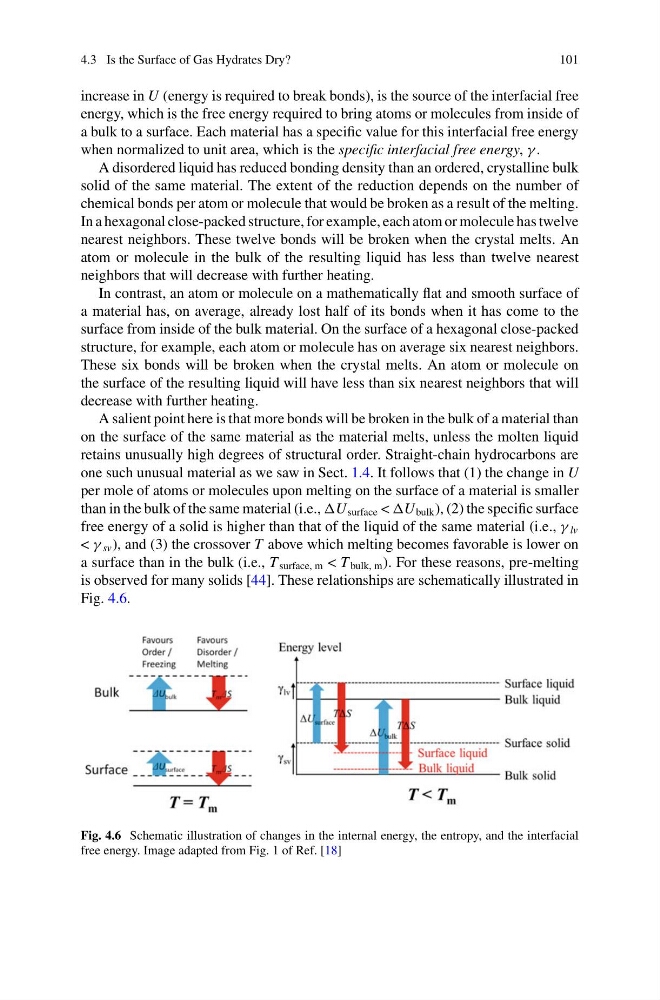
one such unusual material as we saw in Sect. 1.4. It follows that (1) the change in U
per mole of atoms or molecules upon melting on the surface of a material is smaller
than in the bulk of the same material (i.e., U surface < U bulk ), (2) the specific surface
free energy of a solid is higher than that of the liquid of the same material (i.e., γ lv
< γ sv ), and (3) the crossover T above which melting becomes favorable is lower on
a surface than in the bulk (i.e., T surface, m < T bulk, m ). For these reasons, pre-melting
is observed for many solids [44]. These relationships are schematically illustrated in
Fig. 4.6.
Fig. 4.6 Schematic illustration of changes in the internal energy, the entropy, and the interfacial
free energy. Image adapted from Fig. 1 of Ref. [18]
101
increase in U (energy is required to break bonds), is the source of the interfacial free
energy, which is the free energy required to bring atoms or molecules from inside of
a bulk to a surface. Each material has a specific value for this interfacial free energy
when normalized to unit area, which is the specific interfacial free energy, γ .
A disordered liquid has reduced bonding density than an ordered, crystalline bulk
solid of the same material. The extent of the reduction depends on the number of
chemical bonds per atom or molecule that would be broken as a result of the melting.
In a hexagonal close-packed structure, for example, each atom or molecule has twelve
nearest neighbors. These twelve bonds will be broken when the crystal melts. An
atom or molecule in the bulk of the resulting liquid has less than twelve nearest
neighbors that will decrease with further heating.
In contrast, an atom or molecule on a mathematically flat and smooth surface of
a material has, on average, already lost half of its bonds when it has come to the
surface from inside of the bulk material. On the surface of a hexagonal close-packed
structure, for example, each atom or molecule has on average six nearest neighbors.
These six bonds will be broken when the crystal melts. An atom or molecule on
the surface of the resulting liquid will have less than six nearest neighbors that will
decrease with further heating.
A salient point here is that more bonds will be broken in the bulk of a material than
on the surface of the same material as the material melts, unless the molten liquid
retains unusually high degrees of structural order. Straight-chain hydrocarbons are
one such unusual material as we saw in Sect. 1.4. It follows that (1) the change in U
per mole of atoms or molecules upon melting on the surface of a material is smaller
than in the bulk of the same material (i.e., U surface < U bulk ), (2) the specific surface
free energy of a solid is higher than that of the liquid of the same material (i.e., γ lv
< γ sv ), and (3) the crossover T above which melting becomes favorable is lower on
a surface than in the bulk (i.e., T surface, m < T bulk, m ). For these reasons, pre-melting
is observed for many solids [44]. These relationships are schematically illustrated in
Fig. 4.6.
Fig. 4.6 Schematic illustration of changes in the internal energy, the entropy, and the interfacial
free energy. Image adapted from Fig. 1 of Ref. [18]