

96
4 Interfacial Gaseous States
The flat shape of a micro gas pancake means that a micro gas pancake exposes a
larger gas–aqueous interfacial area than an interfacial nanobubble for a given amount
of gas. At a first glance, the free energy cost of forming a micro gas pancake appears
greater than that of forming an interfacial nanobubble. Then, the chemical potential
of a gas molecule inside a micro gas pancake must be higher than that inside an
interfacial nanobubble, which in turn should result in mass transfer of the gas from
the underlying micro gas pancake to the interfacial nanobubble above it. The end
result of such a process would be a total annihilation of micro gas pancakes and
growth of the interfacial nanobubbles. That this expectation has not materialized in
experimental observations suggests that another factor must be in play. This point
will be examined in the next section.
4.2.3 Thermodynamic Considerations
That some interfacial nanobubbles coexisted with micro gas pancakes for extend time
periods suggests that the chemical potential of a gas molecule inside an interfacial
nanobubble cannot be very different from that inside a micro gas pancake. Then
we may assume that such a system in which interfacial nanobubbles and micro gas
pancakes can metastably coexist (that is not in the global free energy minimum) is
in a temporary or a local equilibrium. We may then apply the principle of virtual
work to predict the direction of a potential change of the system with an infinitesimal
change in a parameter of interest.
Once we assume a quasi-static condition, we may analyze the chemical potential
of a gas molecule inside an interfacial nanobubble in terms of the Laplace pressure
and the chemical potential of a gas molecule inside a micro gas pancake in terms
of the disjoining pressure. Then the chemical potential of a gas molecule inside an
interfacial nanobubble and that inside a micro gas pancake, at a constant temperature,
become functions of the saturation of the gas in the surrounding aqueous phase and
of their respective characteristic sizes (the radius, r, for the interfacial nanobubbles
and the thickness, h, for the micro gas pancakes).
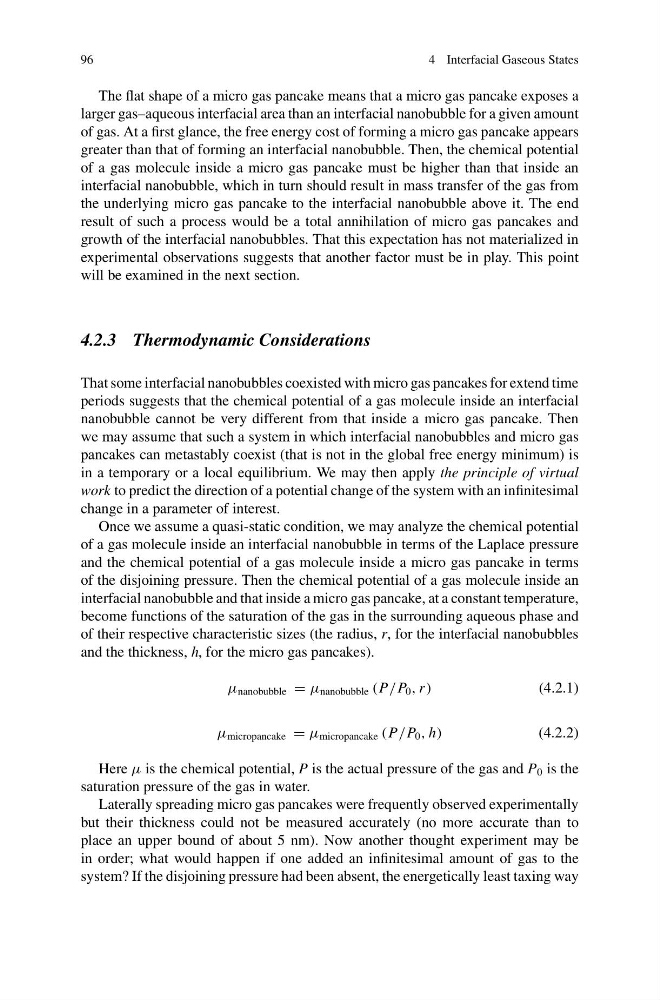
μ nanobubble = μ nanobubble (P/P 0 , r )
(4.2.1)
μ micropancake = μ micropancake (P/P 0 , h)
(4.2.2)
Here μ is the chemical potential, P is the actual pressure of the gas and P 0 is the
saturation pressure of the gas in water.
Laterally spreading micro gas pancakes were frequently observed experimentally
but their thickness could not be measured accurately (no more accurate than to
place an upper bound of about 5 nm). Now another thought experiment may be
in order; what would happen if one added an infinitesimal amount of gas to the
system? If the disjoining pressure had been absent, the energetically least taxing way
4 Interfacial Gaseous States
The flat shape of a micro gas pancake means that a micro gas pancake exposes a
larger gas–aqueous interfacial area than an interfacial nanobubble for a given amount
of gas. At a first glance, the free energy cost of forming a micro gas pancake appears
greater than that of forming an interfacial nanobubble. Then, the chemical potential
of a gas molecule inside a micro gas pancake must be higher than that inside an
interfacial nanobubble, which in turn should result in mass transfer of the gas from
the underlying micro gas pancake to the interfacial nanobubble above it. The end
result of such a process would be a total annihilation of micro gas pancakes and
growth of the interfacial nanobubbles. That this expectation has not materialized in
experimental observations suggests that another factor must be in play. This point
will be examined in the next section.
4.2.3 Thermodynamic Considerations
That some interfacial nanobubbles coexisted with micro gas pancakes for extend time
periods suggests that the chemical potential of a gas molecule inside an interfacial
nanobubble cannot be very different from that inside a micro gas pancake. Then
we may assume that such a system in which interfacial nanobubbles and micro gas
pancakes can metastably coexist (that is not in the global free energy minimum) is
in a temporary or a local equilibrium. We may then apply the principle of virtual
work to predict the direction of a potential change of the system with an infinitesimal
change in a parameter of interest.
Once we assume a quasi-static condition, we may analyze the chemical potential
of a gas molecule inside an interfacial nanobubble in terms of the Laplace pressure
and the chemical potential of a gas molecule inside a micro gas pancake in terms
of the disjoining pressure. Then the chemical potential of a gas molecule inside an
interfacial nanobubble and that inside a micro gas pancake, at a constant temperature,
become functions of the saturation of the gas in the surrounding aqueous phase and
of their respective characteristic sizes (the radius, r, for the interfacial nanobubbles
and the thickness, h, for the micro gas pancakes).
μ nanobubble = μ nanobubble (P/P 0 , r )
(4.2.1)
μ micropancake = μ micropancake (P/P 0 , h)
(4.2.2)
Here μ is the chemical potential, P is the actual pressure of the gas and P 0 is the
saturation pressure of the gas in water.
Laterally spreading micro gas pancakes were frequently observed experimentally
but their thickness could not be measured accurately (no more accurate than to
place an upper bound of about 5 nm). Now another thought experiment may be
in order; what would happen if one added an infinitesimal amount of gas to the
system? If the disjoining pressure had been absent, the energetically least taxing way