

80
A. K. Choudhary and R. Jain
2.8.4.2 Friction Stir Spot Welding (FSSW)
The FSSW process was developed by Mazda Motor Corporation in 1993 [174] and
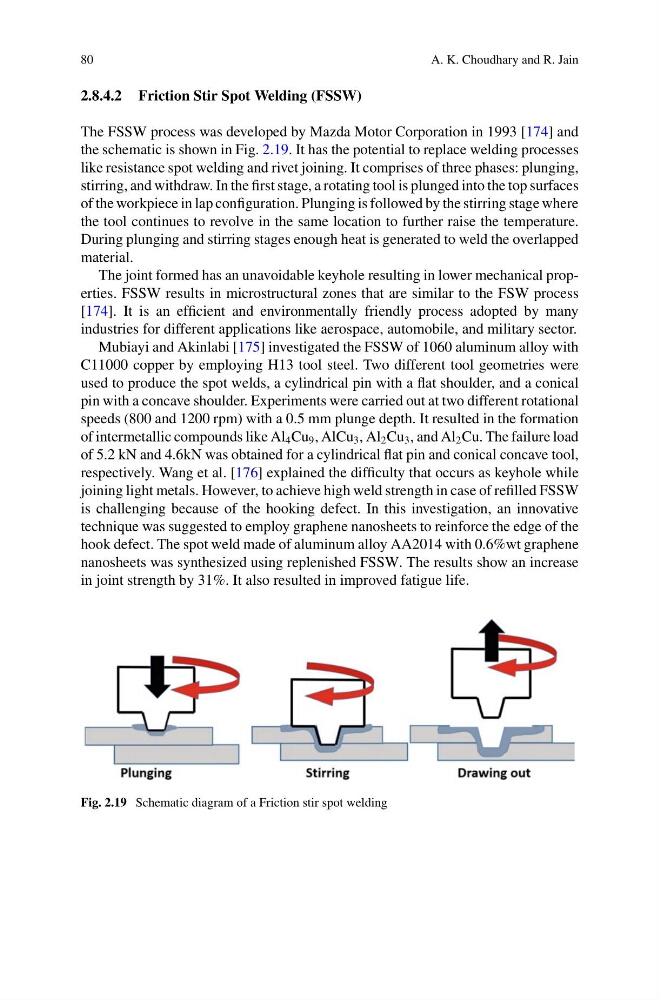
the schematic is shown in Fig. 2.19. It has the potential to replace welding processes
like resistance spot welding and rivet joining. It comprises of three phases: plunging,
stirring, and withdraw. In the first stage, a rotating tool is plunged into the top surfaces
of the workpiece in lap configuration. Plunging is followed by the stirring stage where
the tool continues to revolve in the same location to further raise the temperature.
During plunging and stirring stages enough heat is generated to weld the overlapped
material.
The joint formed has an unavoidable keyhole resulting in lower mechanical properties. FSSW results in microstructural zones that are similar to the FSW process
[174]. It is an efficient and environmentally friendly process adopted by many
industries for different applications like aerospace, automobile, and military sector.
Mubiayi and Akinlabi [175] investigated the FSSW of 1060 aluminum alloy with
C11000 copper by employing H13 tool steel. Two different tool geometries were
used to produce the spot welds, a cylindrical pin with a flat shoulder, and a conical
pin with a concave shoulder. Experiments were carried out at two different rotational
speeds (800 and 1200 rpm) with a 0.5 mm plunge depth. It resulted in the formation
of intermetallic compounds like Al 4 Cu 9 , AlCu 3 , Al 2 Cu 3 , and Al 2 Cu. The failure load
of 5.2 kN and 4.6kN was obtained for a cylindrical flat pin and conical concave tool,
respectively. Wang et al. [176] explained the difficulty that occurs as keyhole while
joining light metals. However, to achieve high weld strength in case of refilled FSSW
is challenging because of the hooking defect. In this investigation, an innovative
technique was suggested to employ graphene nanosheets to reinforce the edge of the
hook defect. The spot weld made of aluminum alloy AA2014 with 0.6%wt graphene
nanosheets was synthesized using replenished FSSW. The results show an increase
in joint strength by 31%. It also resulted in improved fatigue life.
Fig. 2.19 Schematic diagram of a Friction stir spot welding
A. K. Choudhary and R. Jain
2.8.4.2 Friction Stir Spot Welding (FSSW)
The FSSW process was developed by Mazda Motor Corporation in 1993 [174] and
the schematic is shown in Fig. 2.19. It has the potential to replace welding processes
like resistance spot welding and rivet joining. It comprises of three phases: plunging,
stirring, and withdraw. In the first stage, a rotating tool is plunged into the top surfaces
of the workpiece in lap configuration. Plunging is followed by the stirring stage where
the tool continues to revolve in the same location to further raise the temperature.
During plunging and stirring stages enough heat is generated to weld the overlapped
material.
The joint formed has an unavoidable keyhole resulting in lower mechanical properties. FSSW results in microstructural zones that are similar to the FSW process
[174]. It is an efficient and environmentally friendly process adopted by many
industries for different applications like aerospace, automobile, and military sector.
Mubiayi and Akinlabi [175] investigated the FSSW of 1060 aluminum alloy with
C11000 copper by employing H13 tool steel. Two different tool geometries were
used to produce the spot welds, a cylindrical pin with a flat shoulder, and a conical
pin with a concave shoulder. Experiments were carried out at two different rotational
speeds (800 and 1200 rpm) with a 0.5 mm plunge depth. It resulted in the formation
of intermetallic compounds like Al 4 Cu 9 , AlCu 3 , Al 2 Cu 3 , and Al 2 Cu. The failure load
of 5.2 kN and 4.6kN was obtained for a cylindrical flat pin and conical concave tool,
respectively. Wang et al. [176] explained the difficulty that occurs as keyhole while
joining light metals. However, to achieve high weld strength in case of refilled FSSW
is challenging because of the hooking defect. In this investigation, an innovative
technique was suggested to employ graphene nanosheets to reinforce the edge of the
hook defect. The spot weld made of aluminum alloy AA2014 with 0.6%wt graphene
nanosheets was synthesized using replenished FSSW. The results show an increase
in joint strength by 31%. It also resulted in improved fatigue life.
Fig. 2.19 Schematic diagram of a Friction stir spot welding