

78
A. K. Choudhary and R. Jain
terms of tool wear because the adhesion mechanism influences the heat transfer
rate resulted in a narrower HAZ. While comparing the performance between the
WC-Co grade tool, 11% Co was better as compared with the tool having 8% Co.
Yusuf et al. [167] investigated wear mechanism by evaluating the tribological and
mechanical properties of the tool. A physical cathodic arc vapor-deposited AlCrN
coating on spark plasma sintered W25%Re-HfC tool was studied for wear analysis.
Both AlCrN coated and uncoated tool samples were investigated by pin-on-disk
tests to estimate the wear properties. Results show that the wear rate of the coated
specimen is ten times lesser than the uncoated sample. The coated specimen has
undergone a reduced wear characteristic due to the formation of Cr 2 O 3 and Al 2 O 3
oxides layers. Improved wear property attributed to better mechanical properties i.e.
improved cohesive strength and reduced coefficient of friction. Adesina et al. [168]
studied the wear properties of the AlCrN (through physical vapor deposition(PVD))
coated FSW tool for joining 6061-T6 aluminum alloy and 4140 alloy grade steel in
a butt configuration. It showed full penetration without defects and a reduction in
the weight loss of around 87% as compared with the uncoated specimen. Improved
cohesive and adhesive load of the coating to around 19.12 N and 10.70 N, respectively.
Siddiquee and Pandey [169] have investigated the deformation and wear behavior of
the WC tool during FSW of austenitic stainless steel AISI 304. A conical tool with
a 1.5° tilt angle was employed for welding. Elevated temperature and severe stress
conditions resulted in deformation and tool wear during welding. The wear at pin
bottom show groove formation because of the diffusion during FSW. A significant
reduction of microhardness was observed for tool due to high-temperature exposure
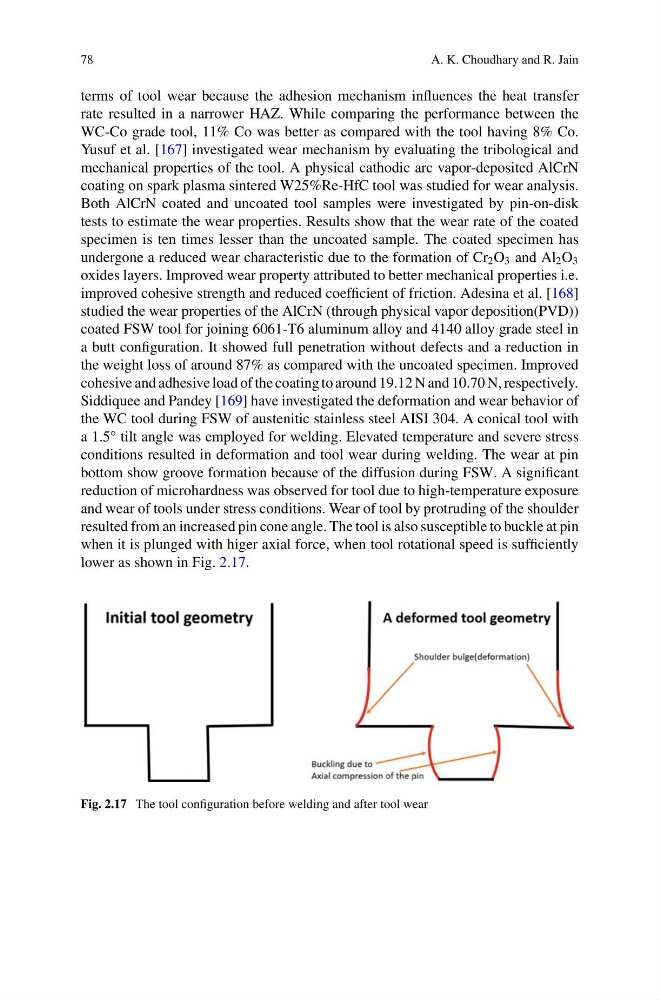
and wear of tools under stress conditions. Wear of tool by protruding of the shoulder
resulted from an increased pin cone angle. The tool is also susceptible to buckle at pin
when it is plunged with higer axial force, when tool rotational speed is sufficiently
lower as shown in Fig. 2.17.
Fig. 2.17 The tool configuration before welding and after tool wear
A. K. Choudhary and R. Jain
terms of tool wear because the adhesion mechanism influences the heat transfer
rate resulted in a narrower HAZ. While comparing the performance between the
WC-Co grade tool, 11% Co was better as compared with the tool having 8% Co.
Yusuf et al. [167] investigated wear mechanism by evaluating the tribological and
mechanical properties of the tool. A physical cathodic arc vapor-deposited AlCrN
coating on spark plasma sintered W25%Re-HfC tool was studied for wear analysis.
Both AlCrN coated and uncoated tool samples were investigated by pin-on-disk
tests to estimate the wear properties. Results show that the wear rate of the coated
specimen is ten times lesser than the uncoated sample. The coated specimen has
undergone a reduced wear characteristic due to the formation of Cr 2 O 3 and Al 2 O 3
oxides layers. Improved wear property attributed to better mechanical properties i.e.
improved cohesive strength and reduced coefficient of friction. Adesina et al. [168]
studied the wear properties of the AlCrN (through physical vapor deposition(PVD))
coated FSW tool for joining 6061-T6 aluminum alloy and 4140 alloy grade steel in
a butt configuration. It showed full penetration without defects and a reduction in
the weight loss of around 87% as compared with the uncoated specimen. Improved
cohesive and adhesive load of the coating to around 19.12 N and 10.70 N, respectively.
Siddiquee and Pandey [169] have investigated the deformation and wear behavior of
the WC tool during FSW of austenitic stainless steel AISI 304. A conical tool with
a 1.5° tilt angle was employed for welding. Elevated temperature and severe stress
conditions resulted in deformation and tool wear during welding. The wear at pin
bottom show groove formation because of the diffusion during FSW. A significant
reduction of microhardness was observed for tool due to high-temperature exposure
and wear of tools under stress conditions. Wear of tool by protruding of the shoulder
resulted from an increased pin cone angle. The tool is also susceptible to buckle at pin
when it is plunged with higer axial force, when tool rotational speed is sufficiently
lower as shown in Fig. 2.17.
Fig. 2.17 The tool configuration before welding and after tool wear