

2 Fundamentals of Friction Stir Welding, Its Application, and Advancements
49
2.3 Effect of Input Process Parameters
2.3.1 Tool Design
Tool design is crucial as it is responsible for maintaining both joint quality and the
number of welds that can be done with the same tool. The material of the tool should
possess high toughness, strength, and hot hardness, good oxidation resistance and
thermal conductivity to dissipate heat while welding [33]. Tool design influences the
material flow and bond formation between the workpiece surfaces. Its geometry and
design are responsible for the required heat generation. The optimum ratio between
the shoulder and pin diameter ranges between 3 and 4 [13]. The tool shoulder is
responsible for retaining material beneath it to reduce the flash formation. There
exists a temperature gradient in the radial and thickness direction with maximum
temperature being generated beneath the shoulder [34]. The tool pin should neither
be too long nor too short as the former result in buckling failure and the latter may
lead to improper penetration resulting in insufficient material mixing. The tool pin
contributes about 10–20% of total heat generation [35]. The main functionality of the
tool pin is to provide stirring/material mixing along with the thickness of the material.
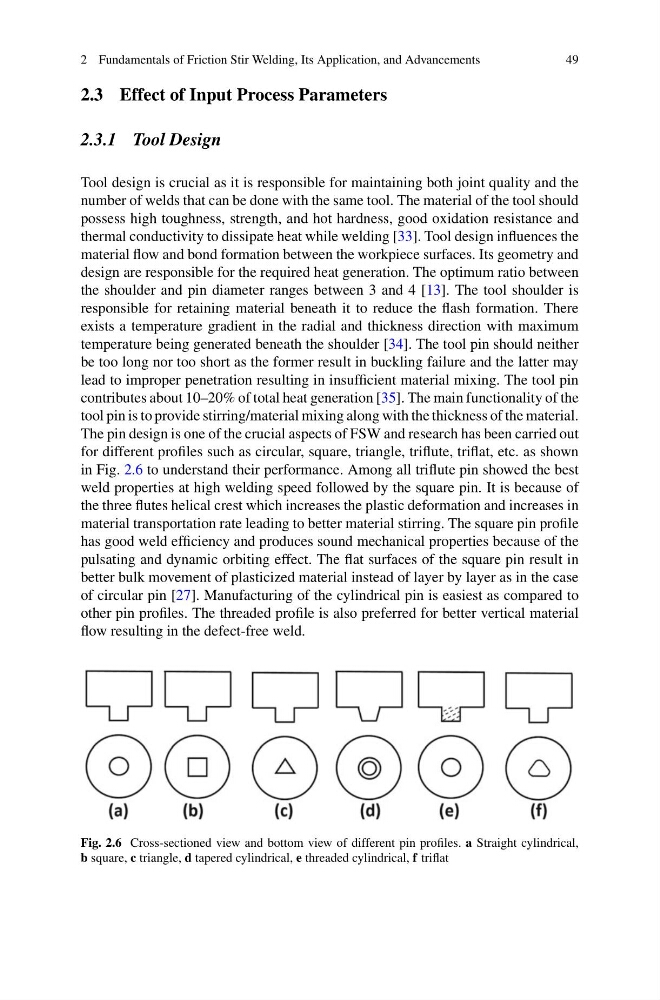
The pin design is one of the crucial aspects of FSW and research has been carried out
for different profiles such as circular, square, triangle, triflute, triflat, etc. as shown
in Fig. 2.6 to understand their performance. Among all triflute pin showed the best
weld properties at high welding speed followed by the square pin. It is because of
the three flutes helical crest which increases the plastic deformation and increases in
material transportation rate leading to better material stirring. The square pin profile
has good weld efficiency and produces sound mechanical properties because of the
pulsating and dynamic orbiting effect. The flat surfaces of the square pin result in
better bulk movement of plasticized material instead of layer by layer as in the case
of circular pin [27]. Manufacturing of the cylindrical pin is easiest as compared to
other pin profiles. The threaded profile is also preferred for better vertical material
flow resulting in the defect-free weld.
Fig. 2.6 Cross-sectioned view and bottom view of different pin profiles. a Straight cylindrical,
b square, c triangle, d tapered cylindrical, e threaded cylindrical, f triflat
49
2.3 Effect of Input Process Parameters
2.3.1 Tool Design
Tool design is crucial as it is responsible for maintaining both joint quality and the
number of welds that can be done with the same tool. The material of the tool should
possess high toughness, strength, and hot hardness, good oxidation resistance and
thermal conductivity to dissipate heat while welding [33]. Tool design influences the
material flow and bond formation between the workpiece surfaces. Its geometry and
design are responsible for the required heat generation. The optimum ratio between
the shoulder and pin diameter ranges between 3 and 4 [13]. The tool shoulder is
responsible for retaining material beneath it to reduce the flash formation. There
exists a temperature gradient in the radial and thickness direction with maximum
temperature being generated beneath the shoulder [34]. The tool pin should neither
be too long nor too short as the former result in buckling failure and the latter may
lead to improper penetration resulting in insufficient material mixing. The tool pin
contributes about 10–20% of total heat generation [35]. The main functionality of the
tool pin is to provide stirring/material mixing along with the thickness of the material.
The pin design is one of the crucial aspects of FSW and research has been carried out
for different profiles such as circular, square, triangle, triflute, triflat, etc. as shown
in Fig. 2.6 to understand their performance. Among all triflute pin showed the best
weld properties at high welding speed followed by the square pin. It is because of
the three flutes helical crest which increases the plastic deformation and increases in
material transportation rate leading to better material stirring. The square pin profile
has good weld efficiency and produces sound mechanical properties because of the
pulsating and dynamic orbiting effect. The flat surfaces of the square pin result in
better bulk movement of plasticized material instead of layer by layer as in the case
of circular pin [27]. Manufacturing of the cylindrical pin is easiest as compared to
other pin profiles. The threaded profile is also preferred for better vertical material
flow resulting in the defect-free weld.
Fig. 2.6 Cross-sectioned view and bottom view of different pin profiles. a Straight cylindrical,
b square, c triangle, d tapered cylindrical, e threaded cylindrical, f triflat