

12 Industrial Pipeline Welding
415
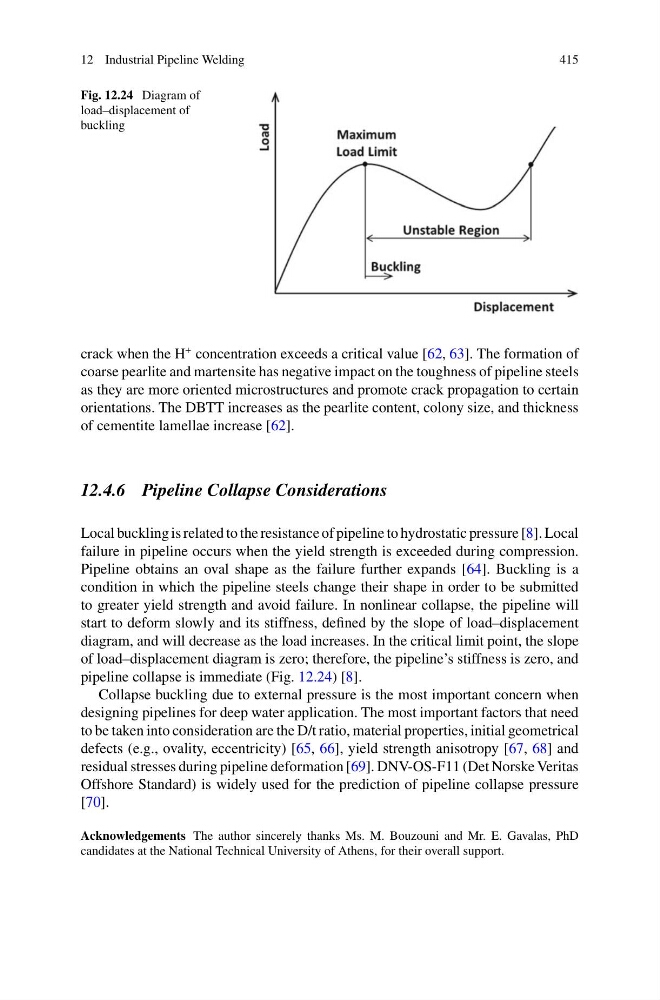
Fig. 12.24 Diagram of
load–displacement of
buckling
crack when the H
+ concentration exceeds a critical value [62, 63]. The formation of
coarse pearlite and martensite has negative impact on the toughness of pipeline steels
as they are more oriented microstructures and promote crack propagation to certain
orientations. The DBTT increases as the pearlite content, colony size, and thickness
of cementite lamellae increase [62].
12.4.6 Pipeline Collapse Considerations
Local buckling is related to the resistance of pipeline to hydrostatic pressure [8]. Local
failure in pipeline occurs when the yield strength is exceeded during compression.
Pipeline obtains an oval shape as the failure further expands [64]. Buckling is a
condition in which the pipeline steels change their shape in order to be submitted
to greater yield strength and avoid failure. In nonlinear collapse, the pipeline will
start to deform slowly and its stiffness, defined by the slope of load–displacement
diagram, and will decrease as the load increases. In the critical limit point, the slope
of load–displacement diagram is zero; therefore, the pipeline’s stiffness is zero, and
pipeline collapse is immediate (Fig. 12.24) [8].
Collapse buckling due to external pressure is the most important concern when
designing pipelines for deep water application. The most important factors that need
to be taken into consideration are the D/t ratio, material properties, initial geometrical
defects (e.g., ovality, eccentricity) [65, 66], yield strength anisotropy [67, 68] and
residual stresses during pipeline deformation [69]. DNV-OS-F11 (Det Norske Veritas
Offshore Standard) is widely used for the prediction of pipeline collapse pressure
[70].
Acknowledgements The author sincerely thanks Ms. M. Bouzouni and Mr. E. Gavalas, PhD
candidates at the National Technical University of Athens, for their overall support.
415
Fig. 12.24 Diagram of
load–displacement of
buckling
crack when the H
+ concentration exceeds a critical value [62, 63]. The formation of
coarse pearlite and martensite has negative impact on the toughness of pipeline steels
as they are more oriented microstructures and promote crack propagation to certain
orientations. The DBTT increases as the pearlite content, colony size, and thickness
of cementite lamellae increase [62].
12.4.6 Pipeline Collapse Considerations
Local buckling is related to the resistance of pipeline to hydrostatic pressure [8]. Local
failure in pipeline occurs when the yield strength is exceeded during compression.
Pipeline obtains an oval shape as the failure further expands [64]. Buckling is a
condition in which the pipeline steels change their shape in order to be submitted
to greater yield strength and avoid failure. In nonlinear collapse, the pipeline will
start to deform slowly and its stiffness, defined by the slope of load–displacement
diagram, and will decrease as the load increases. In the critical limit point, the slope
of load–displacement diagram is zero; therefore, the pipeline’s stiffness is zero, and
pipeline collapse is immediate (Fig. 12.24) [8].
Collapse buckling due to external pressure is the most important concern when
designing pipelines for deep water application. The most important factors that need
to be taken into consideration are the D/t ratio, material properties, initial geometrical
defects (e.g., ovality, eccentricity) [65, 66], yield strength anisotropy [67, 68] and
residual stresses during pipeline deformation [69]. DNV-OS-F11 (Det Norske Veritas
Offshore Standard) is widely used for the prediction of pipeline collapse pressure
[70].
Acknowledgements The author sincerely thanks Ms. M. Bouzouni and Mr. E. Gavalas, PhD
candidates at the National Technical University of Athens, for their overall support.