

382
C. Mani et al.
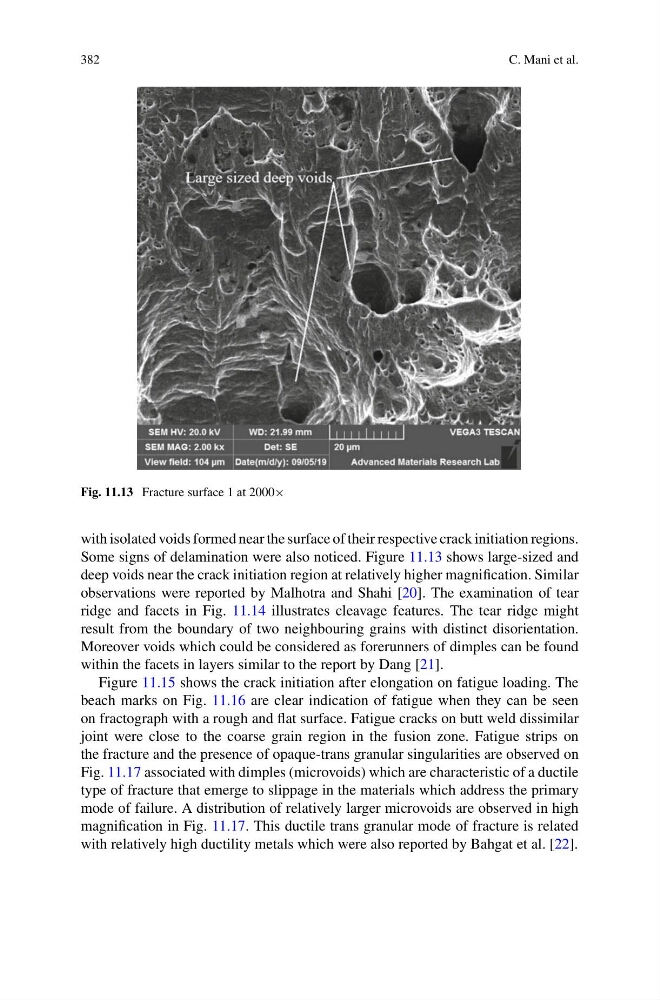
Fig. 11.13 Fracture surface 1 at 2000×
with isolated voids formed near the surface of their respective crack initiation regions.
Some signs of delamination were also noticed. Figure 11.13 shows large-sized and
deep voids near the crack initiation region at relatively higher magnification. Similar
observations were reported by Malhotra and Shahi [20]. The examination of tear
ridge and facets in Fig. 11.14 illustrates cleavage features. The tear ridge might
result from the boundary of two neighbouring grains with distinct disorientation.
Moreover voids which could be considered as forerunners of dimples can be found
within the facets in layers similar to the report by Dang [21].
Figure 11.15 shows the crack initiation after elongation on fatigue loading. The
beach marks on Fig. 11.16 are clear indication of fatigue when they can be seen
on fractograph with a rough and flat surface. Fatigue cracks on butt weld dissimilar
joint were close to the coarse grain region in the fusion zone. Fatigue strips on
the fracture and the presence of opaque-trans granular singularities are observed on
Fig. 11.17 associated with dimples (microvoids) which are characteristic of a ductile
type of fracture that emerge to slippage in the materials which address the primary
mode of failure. A distribution of relatively larger microvoids are observed in high
magnification in Fig. 11.17. This ductile trans granular mode of fracture is related
with relatively high ductility metals which were also reported by Bahgat et al. [22].
C. Mani et al.
Fig. 11.13 Fracture surface 1 at 2000×
with isolated voids formed near the surface of their respective crack initiation regions.
Some signs of delamination were also noticed. Figure 11.13 shows large-sized and
deep voids near the crack initiation region at relatively higher magnification. Similar
observations were reported by Malhotra and Shahi [20]. The examination of tear
ridge and facets in Fig. 11.14 illustrates cleavage features. The tear ridge might
result from the boundary of two neighbouring grains with distinct disorientation.
Moreover voids which could be considered as forerunners of dimples can be found
within the facets in layers similar to the report by Dang [21].
Figure 11.15 shows the crack initiation after elongation on fatigue loading. The
beach marks on Fig. 11.16 are clear indication of fatigue when they can be seen
on fractograph with a rough and flat surface. Fatigue cracks on butt weld dissimilar
joint were close to the coarse grain region in the fusion zone. Fatigue strips on
the fracture and the presence of opaque-trans granular singularities are observed on
Fig. 11.17 associated with dimples (microvoids) which are characteristic of a ductile
type of fracture that emerge to slippage in the materials which address the primary
mode of failure. A distribution of relatively larger microvoids are observed in high
magnification in Fig. 11.17. This ductile trans granular mode of fracture is related
with relatively high ductility metals which were also reported by Bahgat et al. [22].