

11 Fatigue Analysis of Dissimilar Metal Welded …
373
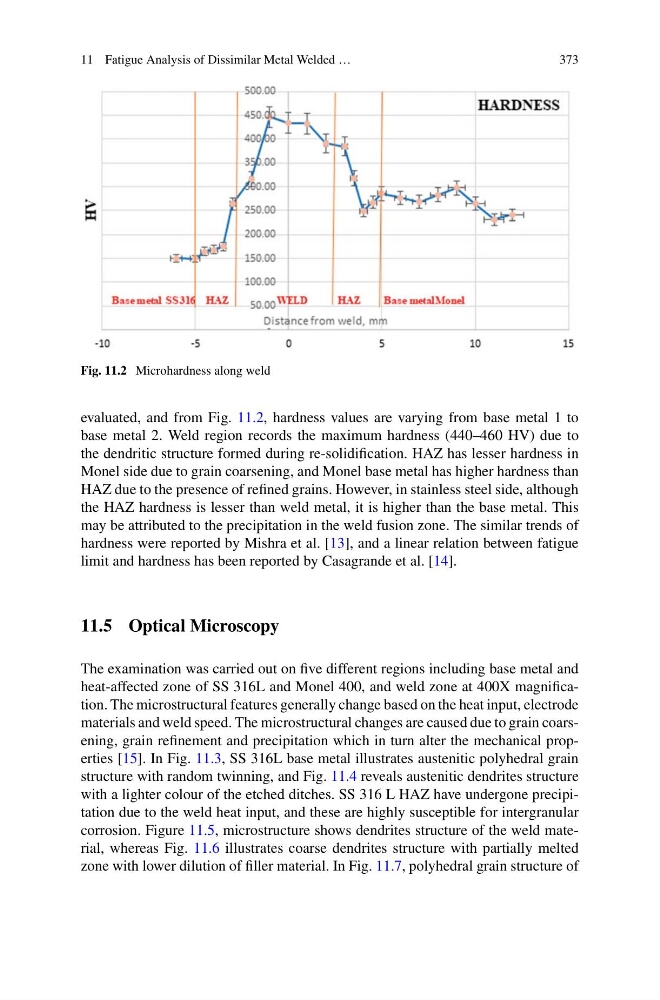
Fig. 11.2 Microhardness along weld
evaluated, and from Fig. 11.2, hardness values are varying from base metal 1 to
base metal 2. Weld region records the maximum hardness (440–460 HV) due to
the dendritic structure formed during re-solidification. HAZ has lesser hardness in
Monel side due to grain coarsening, and Monel base metal has higher hardness than
HAZ due to the presence of refined grains. However, in stainless steel side, although
the HAZ hardness is lesser than weld metal, it is higher than the base metal. This
may be attributed to the precipitation in the weld fusion zone. The similar trends of
hardness were reported by Mishra et al. [13], and a linear relation between fatigue
limit and hardness has been reported by Casagrande et al. [14].
11.5 Optical Microscopy
The examination was carried out on five different regions including base metal and
heat-affected zone of SS 316L and Monel 400, and weld zone at 400X magnification. The microstructural features generally change based on the heat input, electrode
materials and weld speed. The microstructural changes are caused due to grain coarsening, grain refinement and precipitation which in turn alter the mechanical properties [15]. In Fig. 11.3, SS 316L base metal illustrates austenitic polyhedral grain
structure with random twinning, and Fig. 11.4 reveals austenitic dendrites structure
with a lighter colour of the etched ditches. SS 316 L HAZ have undergone precipitation due to the weld heat input, and these are highly susceptible for intergranular
corrosion. Figure 11.5, microstructure shows dendrites structure of the weld material, whereas Fig. 11.6 illustrates coarse dendrites structure with partially melted
zone with lower dilution of filler material. In Fig. 11.7, polyhedral grain structure of
373
Fig. 11.2 Microhardness along weld
evaluated, and from Fig. 11.2, hardness values are varying from base metal 1 to
base metal 2. Weld region records the maximum hardness (440–460 HV) due to
the dendritic structure formed during re-solidification. HAZ has lesser hardness in
Monel side due to grain coarsening, and Monel base metal has higher hardness than
HAZ due to the presence of refined grains. However, in stainless steel side, although
the HAZ hardness is lesser than weld metal, it is higher than the base metal. This
may be attributed to the precipitation in the weld fusion zone. The similar trends of
hardness were reported by Mishra et al. [13], and a linear relation between fatigue
limit and hardness has been reported by Casagrande et al. [14].
11.5 Optical Microscopy
The examination was carried out on five different regions including base metal and
heat-affected zone of SS 316L and Monel 400, and weld zone at 400X magnification. The microstructural features generally change based on the heat input, electrode
materials and weld speed. The microstructural changes are caused due to grain coarsening, grain refinement and precipitation which in turn alter the mechanical properties [15]. In Fig. 11.3, SS 316L base metal illustrates austenitic polyhedral grain
structure with random twinning, and Fig. 11.4 reveals austenitic dendrites structure
with a lighter colour of the etched ditches. SS 316 L HAZ have undergone precipitation due to the weld heat input, and these are highly susceptible for intergranular
corrosion. Figure 11.5, microstructure shows dendrites structure of the weld material, whereas Fig. 11.6 illustrates coarse dendrites structure with partially melted
zone with lower dilution of filler material. In Fig. 11.7, polyhedral grain structure of